Minor Arcana · Swords
Five of Swords
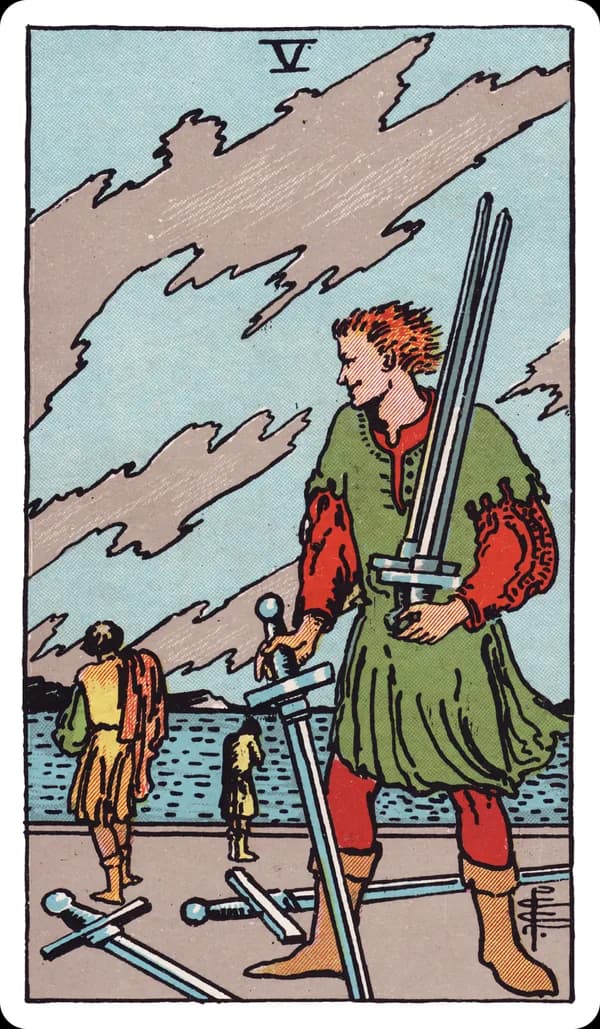
The Five of Swords stages the aftermath of a fight rather than the fight itself — a man stands in the foreground, three swords gathered into his arms and two more lying discarded on the ground nearby, watching two other figures walk away in the distance, their postures slumped, their backs turned. His expression is usually read as a smirk rather than a smile: satisfaction, but a cold and slightly unpleasant kind. Behind them all, the sky is streaked with windblown, turbulent clouds, giving the whole scene an unsettled, unresolved feeling even though the confrontation itself has apparently ended. Nothing about this image reads as a clean, admirable win. The winner has swords the losers no longer hold, but the losers' posture — walking away rather than staying to argue further — suggests the cost of the confrontation, whatever it was, has landed harder on them than the victory has visibly benefited him. This is tarot's clearest single image of a Pyrrhic victory: technically winning, while something more valuable than the specific point at stake quietly walks away in the process.
- Element
- air
- Ruling planet / sign
- Venus in Aquarius
- Suit
- swords
Numerology: Golden Dawn title "Lord of Defeat" — Venus's normally harmonizing influence, landing awkwardly in Aquarius's more detached decan, curdles into a victory that damages connection rather than restoring it.
Upright Meaning
Upright, the Five of Swords describes conflict won at real cost — a victory that leaves the winner more isolated than triumphant, because the way it was achieved, through manipulation, overreach, or simply refusing to consider anyone else's position, damages something bigger than the specific dispute. It's a genuinely uncomfortable card to draw when it describes your own behavior, since it asks a direct question: was this fight worth winning this way? In readings about interpersonal conflict, it can point to someone escalating a disagreement past the point of resolution, more interested in being right or in dominating the exchange than in actually solving anything. It can also describe being on the receiving end — outmaneuvered or overpowered by someone playing by fewer rules than you were, walking away from a confrontation with real damage even if you weren't technically 'wrong.' Either way, the card names conflict that produces a clear winner and a clear loser rather than any real resolution, and warns that the cost of that kind of win tends to surface later, in relationships or reputation, even when it doesn't show up immediately.
Reversed Meaning
Reversed, the Five of Swords usually points toward the aftermath of that kind of conflict being addressed directly — reconciliation being sought, an apology offered or accepted, or a genuine attempt to repair the relational damage a win-at-all-costs approach caused. It can mark the winner recognizing, after the fact, that what was gained wasn't worth what it cost, and taking real steps to make amends rather than simply enjoying the spoils. A second reading applies when resentment lingers instead of resolving: the fight is technically over, but the bitterness hasn't cleared, showing up as coldness, distance, or a grudge quietly nursed by whichever side felt wronged. It can also describe finally walking away from a pattern of conflict altogether — recognizing that a particular fight, or a particular way of fighting, simply isn't worth continuing, and choosing peace over being right. Distinguishing the readings usually comes down to whether real repair has actually started, or whether the conflict has just gone quiet without anyone genuinely letting go of it.
Read the full reversed meaning →Symbolism
The gathered swords are the card's central detail: not one sword taken as a trophy, but multiple, more than any single confrontation would typically require, suggesting the winner took more than his due — pressing an advantage past the point where it was actually necessary. The two discarded swords on the ground, left rather than collected, hint that even the winner hasn't claimed everything available to him, whether from a flicker of restraint or simply because he already has enough to prove his point. The defeated figures' retreating backs are deliberately unreadable — the deck doesn't show their faces, denying the viewer, and the person drawing the card, easy access to their specific grief or humiliation, which keeps the card's meaning focused on the winner's choices rather than inviting simple sympathy for the losers. The turbulent sky ties the whole scene to the suit's broader visual language of mental and emotional storm, suggesting that even a decisive outcome here hasn't actually settled anything calmly — the air itself is still unsettled, regardless of who technically won.
The Five of Swords from the Rider-Waite-Smith deck: a smirking man in the foreground gathers three swords into his arms while two more lie discarded on the ground at his feet, two defeated figures walk away in the distance with heads bowed and shoulders slumped, a turbulent, wind-streaked sky stretching overhead.
→ See what Venus in Aquarius means in your horoscope on GetMyHoro
→ Find your own life-path number on NumberAngel
In Love
In a love reading, the Five of Swords describes conflict that leaves real damage — an argument won by one partner at the expense of the relationship itself, where being right mattered more in the moment than staying connected. For someone single, it can point to a pattern of relationships that end in confrontation rather than mutual, respectful closure, worth examining honestly for a recurring role you might be playing in how those endings unfold. For someone partnered, it often names a specific fight that went further than it needed to — words used to win rather than to understand, leaving one or both people feeling more distant afterward regardless of who was technically correct. This card asks a pointed question: is winning this particular argument worth what it's costing the relationship overall? Reversed, the reading turns toward repair — a genuine apology, a real attempt at reconciliation, or letting go of the need to be right in favor of actually reconnecting. It can also describe resentment that hasn't cleared yet, a relationship where the fight has ended on the surface but the hurt underneath is still very much active.
Read the full love meaning →In Career
At work, the Five of Swords describes conflict that damages more than it resolves — winning an argument, a negotiation, or a power struggle through tactics that leave real resentment behind, whether that's undermining a colleague, taking credit unfairly, or simply refusing to compromise on a point that didn't actually require total victory. It's a caution against confusing being right with being effective, especially in a team setting where the relationships damaged along the way often cost more than whatever was won. It can also describe being on the losing end of exactly this dynamic — outmaneuvered by office politics or a colleague willing to play rougher than you were, leaving with real professional damage even when you weren't in the wrong. Reversed, the career reading points toward repair: rebuilding a working relationship after a conflict, or recognizing that a recent professional 'win' has cost more in trust and goodwill than it delivered in practical benefit. It can also describe lingering workplace resentment that hasn't cleared — a team still quietly divided by a conflict that was never actually resolved, just declared over.
Read the full career meaning →Money & Health — Reflection Themes
Money: Financial conflict with a clear winner and a clear loser sits at the center of this card's money reading — a negotiation won through pressure rather than fairness, a financial dispute that leaves lasting resentment even after it's technically settled, or a shared financial arrangement, such as a loan, an inheritance, or a joint account, that turns into a battleground where 'winning' matters more than the relationship attached to the money. The Five of Swords upright is a genuine caution here: a financial victory achieved by outmaneuvering someone close to you, even if legally or technically justified, tends to cost more in trust than it gains in dollars. Reversed, the card usually points toward financial reconciliation — repairing a money-related rift, coming to a fairer agreement after an initial dispute, or simply letting go of a financial grievance that's been costing more in ongoing resentment than the original amount at stake. It can also describe lingering financial resentment that hasn't resolved, a money dispute technically settled but still quietly poisoning a relationship underneath the surface.
Health: As a theme for reflection, the Five of Swords upright can point to conflict taking a real toll on your wellbeing — the specific exhaustion of winning an argument or a confrontation that cost more energy, sleep, or peace of mind than it was worth. It can also describe a more internal version of the same dynamic: a harsh, win-at-all-costs relationship with yourself, pushing your body past reasonable limits because backing down, from a workout, a deadline, a habit, feels like losing, even when your body is the one actually paying the price. Reversed, the card often marks a genuine shift toward peace over combat — choosing rest or recovery over continuing to push, or making amends with a part of yourself you'd been fighting unnecessarily hard. It can also describe lingering tension that hasn't resolved: stress or resentment from a past conflict still living in the body, showing up as tightness or fatigue even after the original disagreement has technically ended.
Spiritual Meaning
Spiritually, the Five of Swords is an uncomfortable but useful mirror: it asks whether you're currently fighting a battle that actually needs winning, or one that's become more about ego and being right than about any principle worth the cost. Many readers treat this card as a prompt to examine the difference between genuine conviction and simple stubbornness, since both can look identical from the outside but lead to very different outcomes over time. It can mark a moment of spiritual reckoning after a conflict — recognizing, honestly, that a recent 'win' left you feeling worse rather than better, a useful signal that the victory wasn't actually aligned with what matters to you. Reversed, the spiritual reading turns toward humility and reconciliation: choosing peace over being right, releasing a grudge that's been costing more spiritually than it's worth, or recognizing that some conflicts are better let go of entirely than resolved through further struggle. It's a card that ultimately favors long-term integrity over short-term victory, however satisfying that victory might feel in the moment.
Yes or No?
For yes/no questions, the Five of Swords upright leans toward a 'no,' though its specific flavor is worth understanding: this isn't a card about a plan quietly failing to materialize, it's a card about conflict, and if your question involves a confrontation, negotiation, or dispute, this card cautions that even a technical win is likely to cost more than it's worth. If you're asking whether pursuing something contentious will pay off, the honest reading is that it might succeed narrowly while damaging something bigger in the process, which for most questions functions closer to a no than a yes once the full cost is counted. Reversed, the reading shifts toward reconciliation becoming possible — a 'no' about continuing the fight, but potentially a softer, more hopeful reading about repairing what the fight has already damaged. If your question is really about whether a relationship or situation can recover after conflict, reversed Five of Swords leans more encouraging than the upright card's warning about pursuing further confrontation. Either way, this card is rarely a strong yes for any question that hinges on winning a dispute cleanly.
Read the full yes-or-no breakdown →Frequently Asked Questions
Does the Five of Swords always mean I did something wrong?
Not necessarily — it can describe you as the one who was outmaneuvered rather than the one who overreached. The card names a conflict with real cost attached to it, but which side of that dynamic you're on depends on the full context of your situation and the surrounding cards.
Why is the man in the Five of Swords smirking?
His expression is usually read as satisfaction that's slightly unpleasant rather than warm — technically pleased with the outcome, but in a way that suggests the win came at a cost he either hasn't noticed yet or doesn't care about. It's part of why this card is read as a hollow, rather than a clean, victory.
Is the Five of Swords a card about a physical fight?
Not usually — despite the swords, most modern tarot readings treat this card as interpersonal and psychological conflict, such as arguments, power struggles, and workplace politics, rather than literal violence, consistent with how the Swords suit generally governs the mind and communication rather than physical action.
What's the difference between the Five of Swords and the Seven of Swords?
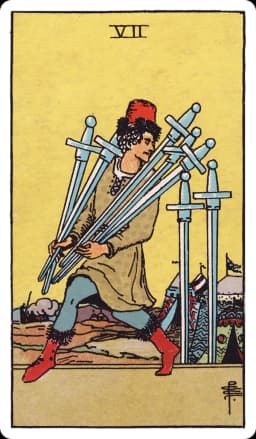
The Five of Swords is open conflict — a confrontation that happened visibly, with a clear winner and loser. The Seven of Swords is covert — deception or strategy used quietly, without an open confrontation at all. One wins by overpowering; the other wins by not being seen.
Related Cards
Where Five of Swords sits in the deck
Card correspondences sourced from the Hermetic Order of the Golden Dawn tradition — see our methodology.