Major Arcana · Major Arcana
The Hierophant
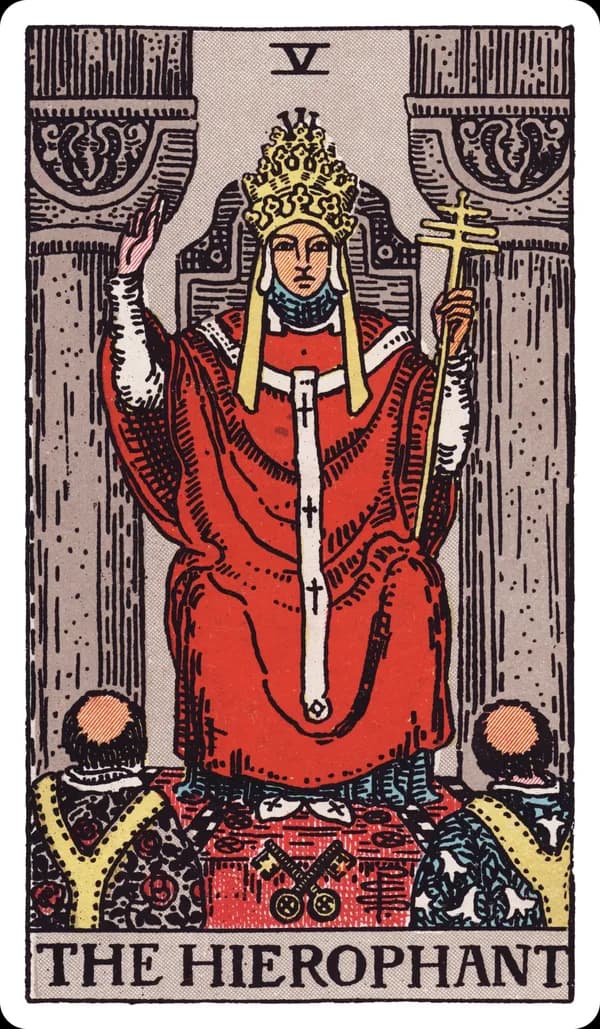
The Hierophant is the Major Arcana's clearest picture of organized, institutional belief — not private, hidden knowledge like the High Priestess, but structured, shared, and openly taught doctrine. He wears a triple crown, echoing a papal tiara, and sits between two grey pillars that visually recall (while differing from) the High Priestess's black-and-white pair, suggesting his authority is a more public, formalized version of the same threshold she guards privately. Two acolytes kneel before him in a posture of instruction, receiving his blessing, and their robes carry the same rose-and-lily pattern found elsewhere in the deck — passion tempered by purity, now channeled through a formal teaching relationship rather than found alone. Numbered V, right after the Emperor's secular authority, the Hierophant represents spiritual and social authority specifically: the traditions, institutions, and shared systems of belief that hold a community together and pass wisdom down from one generation to the next, whether that's an organized religion, an academic discipline, a professional guild, or simply 'the way things are done' in a given field.
- Element
- earth
- Ruling planet / sign
- Taurus
Numerology: Five is the number of challenge and friction — the first number in the Major Arcana's sequence to disrupt an established structure rather than build one, testing whether the Emperor's order can survive contact with individual conscience and dissent. In most numerology traditions, five is associated with instability, change, and the tension that comes from a system being questioned.
Upright Meaning
Upright, the Hierophant favors tradition, established institutions, and learning from recognized, credentialed sources over improvising your own path. He shows up in readings about formal education, organized religion, marriage as a recognized social institution, professional credentialing, or simply following well-established conventions because they genuinely serve a purpose rather than because no alternative has been considered. This card values belonging to a community bound by shared belief or practice — a congregation, a school, a professional association — and the sense of grounding and continuity that comes from participating in something larger and older than yourself. He's also associated with mentorship and formal guidance specifically: seeking out a teacher, counselor, or advisor with recognized expertise rather than figuring something out entirely alone. Ruled by Taurus, an earth sign known for steadiness and resistance to unnecessary change, the Hierophant favors the tried-and-tested over the untested and new — in a reading, he often suggests that the wiser move is following an established, well-understood path rather than reinventing one from scratch, particularly in situations (a wedding, a professional certification, a spiritual practice) where convention exists for good, tested reasons.
Reversed Meaning
Reversed, the Hierophant's respect for tradition curdles into rigid, unquestioned conformity, or flips entirely into open rebellion against it. The first reading points to dogma: rules followed not because they still serve their original purpose but simply because they're rules, an institution or belief system that's calcified into restriction rather than genuine guidance, or personal conformity driven by fear of judgment rather than actual conviction. The second, opposite reading points to a deliberate break from convention — choosing an unconventional path (in relationships, career, spirituality, or lifestyle) because the traditional one genuinely doesn't fit, and doing so with clear eyes rather than as mere rebellion for its own sake. This card reversed can also describe questioning an authority or institution you previously trusted without reservation, discovering that its teachings or rules don't hold up to closer scrutiny, or a mentor relationship that's become more restrictive than genuinely instructive. Which reading actually fits usually comes down to whether something is being followed too rigidly, or something traditional is being consciously and appropriately left behind.
Read the full reversed meaning →Symbolism
The two crossed keys at the base of the Hierophant's throne are traditionally read as the keys to conscious and subconscious knowledge, or, in a more institutional reading, the keys to heaven — either way, they mark him as a gatekeeper of a kind of understanding that isn't accessed alone but is passed on through recognized teachers and established channels. His raised right hand, two fingers extended and two folded, is the classic gesture of religious benediction found across centuries of Christian iconography, marking a blessing given from a position of recognized spiritual authority. The triple-barred cross he holds and his triple crown both use the number three in a way that distinguishes him from the Emperor's plainer, more secular scepter and orb — a signal that his authority claims a spiritual, not merely worldly, dimension. The two kneeling acolytes are essential to the card's meaning: the Hierophant's authority exists specifically in relationship to students or followers, unlike the Hermit's solitary wisdom later in the deck. Without someone to teach, bless, or induct, this card's whole structure of meaning collapses — it's fundamentally a card about transmission, not private insight.
The Hierophant from the Rider-Waite-Smith deck: a robed figure wearing a triple-tiered papal crown sits enthroned between two grey pillars, right hand raised in a two-fingered gesture of benediction, a triple-barred cross staff in his left hand, two crossed keys resting at the base of his throne, and two tonsured acolytes kneeling before him, their robes patterned with lilies and roses.
→ See what Taurus means in your horoscope on GetMyHoro
→ Find your own life-path number on NumberAngel
In Love
In love, the Hierophant upright often points toward a relationship that follows a fairly traditional or socially recognized path — marriage, a formal commitment, meeting the family, or a relationship that fits comfortably within familiar social or cultural expectations. For someone single, this card can favor meeting a partner through more conventional means (family introductions, community, shared religious or cultural background) over unconventional or purely spontaneous encounters, and it can suggest an openness to guidance from people you respect — parents, mentors, close friends — about what you're looking for. For someone partnered, the Hierophant frequently shows up around formalizing a relationship: engagement, marriage, or simply a shared commitment to values and traditions you both genuinely believe in rather than merely go along with. Reversed, the caution splits: either the relationship is being shaped by outside expectations (family pressure, social convention) rather than genuine mutual desire, or, in the opposite reading, you or your partner are consciously and appropriately choosing a less conventional relationship structure that fits you better than the traditional template would. It can also point to rigid expectations about how a relationship 'should' look getting in the way of what actually works for the two people involved.
Read the full love meaning →In Career
At work, the Hierophant favors formal education, professional credentialing, and learning within an established system — a degree, a certification, a structured apprenticeship, or simply following your field's recognized best practices rather than improvising an unconventional approach. He suits careers within traditional institutions specifically: education, religious organizations, law, medicine, or any field with well-defined credentials and a clear hierarchy of expertise. A coworker or manager shaped by this energy values established process and precedent, often a mentor figure who teaches by passing down accumulated institutional knowledge rather than encouraging improvisation. This card can also point toward the genuine value of finding a mentor and learning a field's fundamentals properly before trying to innovate past them. Reversed, the caution shifts toward institutional rigidity — a workplace bound by outdated rules or bureaucracy that no longer serves its actual purpose, or your own career path feeling constrained by expectations (family, cultural, professional) that don't actually fit your genuine interests. It can also describe a deliberate, well-considered move away from a traditional career path toward something less conventional but more authentic, which the reversed Hierophant supports when the surrounding cards suggest real conviction rather than mere restlessness.
Read the full career meaning →Money & Health — Reflection Themes
Money: Taurus steadiness runs through this card's approach to money: sticking with the tested, well-documented route — a retirement account through a recognized institution, a mortgage from an established lender, an investment vehicle with a long track record — over anything speculative or improvised. It suits working with a credentialed advisor and following recommendations that have actually held up over time rather than chasing what's currently trending. Reversed, two different problems tend to hide behind the same card: financial choices driven mainly by family expectation or convention rather than what genuinely fits your situation, or the opposite — over-relying on an institution's word without doing any of your own checking, following a financial 'rule' without confirming it actually applies to you. A less common but valid reading is a deliberate, well-examined step outside a purely conventional financial path, which this card can support once it's been genuinely thought through rather than adopted on a whim.
Health: This card leans toward what's well-documented and broadly recognized: working with credentialed practitioners, trusting conventional medical guidance, sticking with an established approach to diet, movement, and rest over something untested chosen purely for novelty. It suits consistency with a proven method over experimenting for its own sake. Reversed, watch for two opposite failure modes: rigid over-adherence to a regimen or set of rules that's stopped actually serving you, or, on the other side, a considered decision to move away from standard advice because it genuinely hasn't worked for your specific situation. This card doesn't endorse or discourage any particular treatment — its meaning here is about your relationship to convention and established guidance broadly, not a verdict on any specific method.
Spiritual Meaning
Where the High Priestess holds knowledge privately, the Hierophant passes it on — a shared tradition, a recognized teacher, or a structured practice inherited through a lineage rather than discovered alone. He values the grounding that comes from belonging to something larger than one person's private belief: a congregation, a school of thought, a community bound by shared practice. As the fifth numbered trump, following the Emperor's secular structure, he represents that same impulse toward order applied specifically to spiritual and communal life — moving the traveler from personal will and growth into systems of meaning that connect an individual to a wider tradition. This card tends to favor seeking out an actual teacher, a defined practice, or a real community over continuing to work everything out alone.
Yes or No?
For yes/no questions, the Hierophant leans toward yes — specifically favoring the conventional, well-tested path over an unconventional alternative. Asked whether to follow an established route (a traditional wedding, a formal education path, a recognized professional credential), this card affirms it, since it's proven and supported by real precedent. It's a weaker fit for a question specifically about breaking from convention, where its confident yes doesn't really apply — the reversed card or a different one entirely speaks better to that. Reversed, the answer turns genuinely ambiguous rather than a flat no: it can mean the conventional path isn't right for this particular situation, or that the institution or authority you're relying on has become too rigid to trust fully. There, the honest move is checking whether you're following a tradition because it still genuinely serves you, or simply because it's expected — and answering according to which one is actually true.
Read the full yes-or-no breakdown →Frequently Asked Questions
Is the Hierophant always about organized religion?
Religion is one common reading, especially in a spiritual-context question, but the card more broadly represents any established tradition, institution, or system of shared belief — education, professional credentialing, cultural convention, or a recognized mentor relationship, not only formal religious practice.
What's the difference between the Hierophant and the High Priestess?
The High Priestess represents private, intuitive, often hidden knowledge held individually; the Hierophant represents public, structured, institutionally transmitted knowledge shared through recognized teachers and traditions. One is inward and personal, the other outward and communal.
Does the Hierophant reversed mean I should reject tradition entirely?
Not automatically — it can mean that, if the surrounding cards support a genuine, considered break from convention, but it more often flags rigid conformity or dogma that's stopped serving its original purpose. Reversed doesn't mean tradition itself is bad, only that something about your current relationship to it needs examining.
Why does the Hierophant have two acolytes kneeling before him?
Two rather than one matters: a single student could just be a private mentorship, but two establishes a pattern, a repeatable transmission that could extend to a third, a fourth, a whole line of successors. That's the visual difference between personal tutoring and an actual institution.
Related Cards
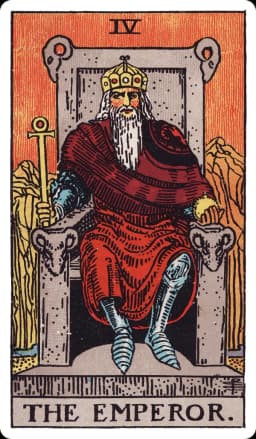
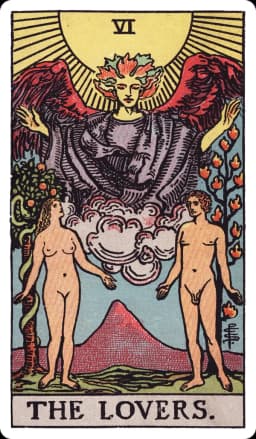
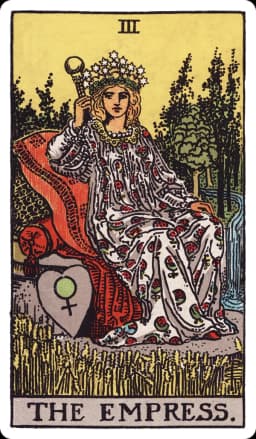
Where The Hierophant sits in the deck
Card correspondences sourced from the Hermetic Order of the Golden Dawn tradition — see our methodology.