Minor Arcana · Swords
Seven of Swords
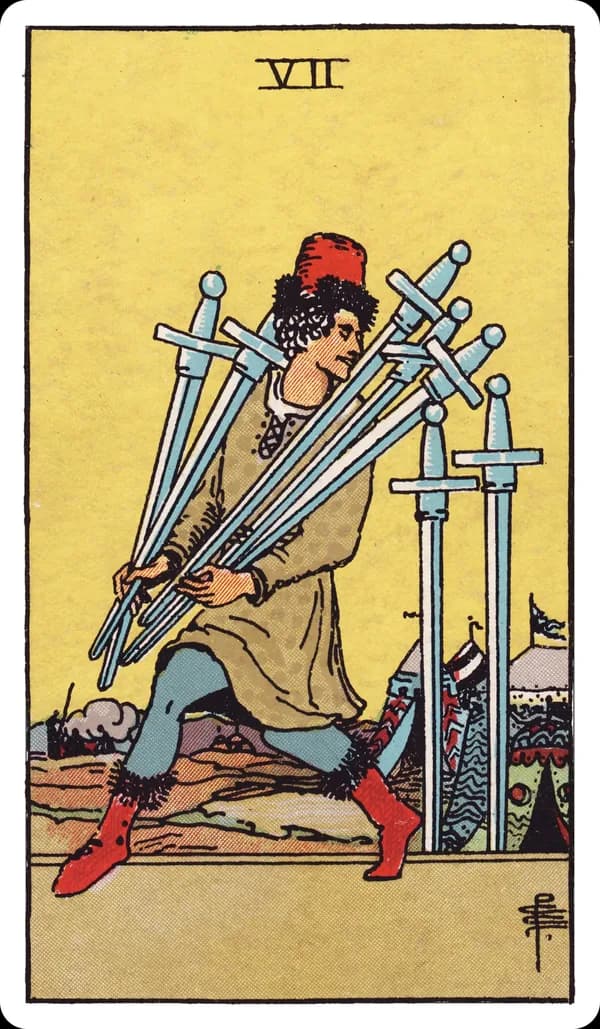
The Seven of Swords catches its central figure mid-getaway, five swords gathered awkwardly against his body, moving quickly but not quite running, glancing back over his shoulder with an expression that reads less like fear and more like satisfaction at having pulled something off. Behind him, a military camp sits mostly quiet, tents pitched, a couple of small distant figures who don't appear to have noticed him yet, and two swords still standing upright in the ground, the two he left behind, either because he couldn't carry seven at once or because he chose to leave some evidence of a fair fight rather than a clean theft. His bare feet and light step suggest speed and stealth rather than confrontation; whatever's happening here, it isn't a battle, it's an exit, timed carefully around whoever might still be watching. Where most of the suit's other scenes show conflict head-on, a decision being weighed, a wound being felt, this card shows something handled sideways, a problem solved through cleverness and avoidance rather than through direct confrontation.
- Element
- air
- Ruling planet / sign
- Moon in Aquarius
- Suit
- swords
Numerology: Golden Dawn title "Lord of Unstable Effort" — the Moon's shifting, hidden light meeting Aquarius' detached cleverness describes success built on a foundation that won't hold under scrutiny. Seven, the suit's test-of-what's-been-built number, here tests whether a shortcut was ever going to be sustainable in the first place.
Upright Meaning
Upright, the Seven of Swords describes a strategic, sometimes ethically murky approach to a problem, working around an obstacle rather than through it, using cleverness, stealth, or a bit of misdirection to get what you need without a direct confrontation. It favors resourcefulness in a genuinely difficult spot: this card doesn't automatically condemn its own method, sometimes the honest reading is that a situation called for tact and strategy rather than head-on conflict, and quietly sidestepping a fight that wasn't worth having is a legitimate reading alongside the more cautionary one. That said, the card carries real ambiguity by design, it can just as easily describe outright deception, taking something, credit, an advantage, information, that wasn't honestly yours to take, or getting away with a shortcut that a more direct approach wouldn't have allowed. It can also describe someone else's deception directed at you, a situation where you're the camp being quietly raided rather than the one doing the raiding. Distinguishing a shrewd, defensible strategy from actual dishonesty usually comes down to a fairly simple question: would this still feel acceptable if everyone involved could see exactly what was happening.
Reversed Meaning
Reversed, the Seven of Swords most often describes deception coming to light, a strategy that worked for a while finally being noticed, questioned, or exposed, the two remaining swords in the ground turning out to have been evidence all along. It can point to guilt specifically, a growing discomfort with a shortcut or a deception that's technically still working but increasingly hard to live with internally, the weight of self-deceit becoming harder to ignore than the original problem it was meant to solve. A second reversed reading involves genuinely coming clean, choosing honesty and direct confrontation after a period of avoidance, returning what wasn't earned honestly, admitting to a strategy that crossed a line. A third reading describes being caught in someone else's deception, discovering that you were the one being strategized around rather than the one holding the cards, which can land as a genuine, disorienting betrayal. Distinguishing these usually comes down to who's doing the concealing and revealing: your own guilt and confession point toward the first two readings, discovering someone else's hidden strategy points toward the third.
Read the full reversed meaning →Symbolism
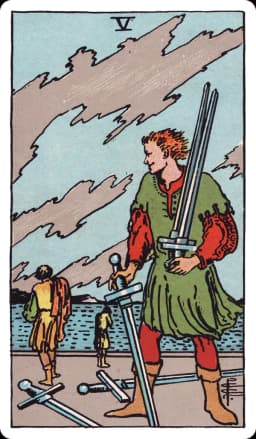
The mismatched count, five swords carried, two left standing, is the detail every serious reading of this card returns to, and it raises the question the whole image is built around: is this a clever, resourceful escape, or an incomplete, risky theft that's going to be noticed. Carrying five swords at once is clearly a strain, they're bundled awkwardly rather than gripped with easy control, suggesting he's taken on more than he can comfortably manage, greed or overreach layered on top of the underlying deception. His backward glance is doing real narrative work, he isn't sure he's gotten away with it yet, the exit is still in progress, the outcome still genuinely uncertain despite his outwardly confident half-smile. The camp itself, quiet and largely undisturbed, suggests this wasn't a violent confrontation but a quiet exploitation of an unguarded moment, a strategy rather than a fight. Unlike the Five of Swords, where the deception and conflict are visible and confrontational, played out in the open with a clear winner and losers watching, the Seven of Swords' whole method depends on not being seen at all, which is exactly what makes it a genuinely different kind of card, less about winning a fight than about avoiding one entirely through cunning.
The Seven of Swords from the Rider-Waite-Smith deck: a man creeps away from a military camp at dusk carrying five swords bundled awkwardly against his chest, glancing back over his shoulder with a sly half-smile, two swords left standing upright in the ground behind him, tents and distant figures visible in the background.
→ See what Moon in Aquarius means in your horoscope on GetMyHoro
→ Find your own life-path number on NumberAngel
In Love
In a love reading, the Seven of Swords often points to dishonesty or concealment somewhere in the picture, information being withheld, a partner keeping something significant back, or feelings and intentions that aren't being stated plainly for strategic reasons. For someone single, it can describe dating with a hidden agenda, seeing multiple people without disclosure, or being less than fully honest about your intentions to avoid an uncomfortable conversation. It can also describe being on the receiving end of someone else's concealment, sensing that a person you're interested in isn't showing you the full picture. For someone partnered, it frequently marks something being hidden within the relationship, an emotional affair, a financial secret, a decision made unilaterally and not disclosed, that's working for now but resting on a foundation that won't hold indefinitely. This card rarely describes a relationship built on solid, transparent ground; its presence usually signals that something isn't being said that probably should be. Reversed, the reading turns toward that concealment surfacing, a secret discovered, a partner finally telling the truth after a period of avoidance, or the discomfort of maintaining a deception finally outweighing whatever it was protecting.
Read the full love meaning →In Career
At work, the Seven of Swords can describe navigating office politics through strategy and discretion rather than direct confrontation, choosing your battles carefully, working around an obstacle rather than escalating it into open conflict. In a more favorable reading, it can describe legitimate strategic thinking, protecting sensitive information, negotiating cleverly, avoiding an unnecessary confrontation that wouldn't have served you. In its more cautionary reading, it can describe outright professional dishonesty, taking credit for work that wasn't yours, cutting corners that will eventually be noticed, or a colleague doing the same to you. It can also describe information being withheld strategically, a decision made without full transparency, a plan being kept quiet until it's too late for others to weigh in. Reversed, the career reading points toward exposure, a shortcut or a deception finally being discovered, professional credit finally attributed correctly after being misappropriated, or growing guilt about a professional compromise that's becoming harder to justify to yourself. It can also describe discovering that a colleague or a company has been less than honest with you, a hidden agenda or a withheld piece of information finally coming to light.
Read the full career meaning →Money & Health — Reflection Themes
Money: As a theme for financial reflection, the Seven of Swords upright can describe a financial strategy that involves some degree of risk-taking or corner-cutting, finding a clever workaround to a financial obstacle, or, more cautiously, taking a financial shortcut that isn't fully above board, underreporting, an undisclosed debt, spending kept hidden from a partner or family member. An honest look at which version actually describes your situation is worth taking before reading further. Reversed, it can point to a hidden financial matter finally being discovered or disclosed, a secret debt or expense surfacing, an accounting discrepancy noticed, or the discomfort of a financial deception you've been maintaining becoming harder to sustain than simply telling the truth would be. It can also describe being on the receiving end of someone else's financial dishonesty, discovering that a partner, business associate, or family member hasn't been fully transparent with you about money. As with any card touching money, treat this as a starting point for honest reflection on your own financial transparency, not a verdict.
Health: As a theme for reflection, the Seven of Swords upright can describe managing a health matter quietly or strategically, choosing not to disclose a diagnosis or a struggle to everyone around you, sometimes for genuinely good reasons of privacy and control over your own story. It can also describe avoiding a health issue rather than addressing it directly, a kind of strategic dodge that works for a while but doesn't actually resolve anything. Reversed, the same card can flag a health matter finally being disclosed or confronted honestly after a period of concealment or avoidance, or growing internal discomfort from continuing to avoid a health concern that increasingly needs direct attention rather than continued sidestepping. It can also describe a health situation you weren't fully told the truth about finally becoming clear. No specific condition is being flagged by this card; what's genuinely worth examining is the cost, sometimes reasonable, sometimes not, of managing a health matter through avoidance or concealment rather than direct engagement.
Spiritual Meaning
A method built on cleverness rather than confrontation raises a genuinely useful spiritual question: is avoidance ever actually wisdom, or is it simply postponing something that eventually has to be faced directly. The Seven of Swords, spiritually, tends to mark a stretch where you're relying on strategy, distraction, or quiet sidestepping to manage a difficulty rather than meeting it honestly, which can be a legitimate, temporarily wise choice or a form of self-deception depending on what's actually being avoided and why. It rewards real honesty with yourself about which one is happening, since the two remaining swords left standing in the card's own imagery suggest that whatever's being avoided tends to leave some trace behind, a marker that eventually gets noticed no matter how quietly the exit was managed. Reversed, the spiritual reading shifts toward reckoning, a truth you've been avoiding finally surfacing, guilt about a spiritual shortcut or a compromised value finally becoming too heavy to keep carrying quietly, or the relief of finally choosing integrity over a strategy that was working but never sat right.
Yes or No?
For yes/no questions, the Seven of Swords leans toward 'no,' specifically because this card's core meaning involves something not being fully above board, a shortcut, a concealment, an incomplete picture, which tends to undermine confidence in a straightforwardly favorable outcome. It's a particularly relevant caution for questions about trust, honesty, or whether a plan is built on solid ground, since this card's whole scene depicts something that appears to be working while resting on shaky, undisclosed foundations. It's a weaker signal for questions about whether a clever, discreet strategy will succeed in the short term, since upright this card does describe a getaway that's currently in progress and not yet caught. Reversed, the verdict shifts rather than simply softening: exposure or confession is often already underway, which can read as a difficult but ultimately clarifying 'no' to the original deceptive plan working out, alongside a more hopeful 'yes' to the relief that comes once the truth is finally out in the open.
Read the full yes-or-no breakdown →Frequently Asked Questions
Why does the man in the Seven of Swords leave two swords behind?
It's read a few ways: he may simply not be able to carry all seven at once, or he may be deliberately leaving some behind to avoid suspicion, or the two remaining swords may represent evidence that will eventually give the deception away. The ambiguity is generally treated as intentional, part of what makes this card's meaning genuinely uncertain rather than a straightforward theft.
Is the Seven of Swords always about lying or stealing?
Not always, it can describe legitimate strategic thinking, choosing discretion over confrontation, or protecting sensitive information for good reason. Context from the surrounding cards and your own honest read of the situation usually clarifies whether the reading is cautionary or simply about clever, defensible strategy.
What's the difference between the Seven of Swords and the Five of Swords?
The Five of Swords shows an open, visible conflict with a clear, if hollow, winner. The Seven of Swords shows something handled quietly and indirectly, avoiding confrontation entirely rather than winning one, which makes its deception or strategy far less visible until it's eventually discovered.
Does reversed Seven of Swords mean I'll get caught?
It often points toward exposure or the surfacing of something previously hidden, though it can also describe you being the one who chooses to come clean voluntarily rather than being caught. Either way, it usually signals the concealment phase is ending, one way or another.
Related Cards

Where Seven of Swords sits in the deck
Card correspondences sourced from the Hermetic Order of the Golden Dawn tradition — see our methodology.