Minor Arcana · Wands
Five of Wands
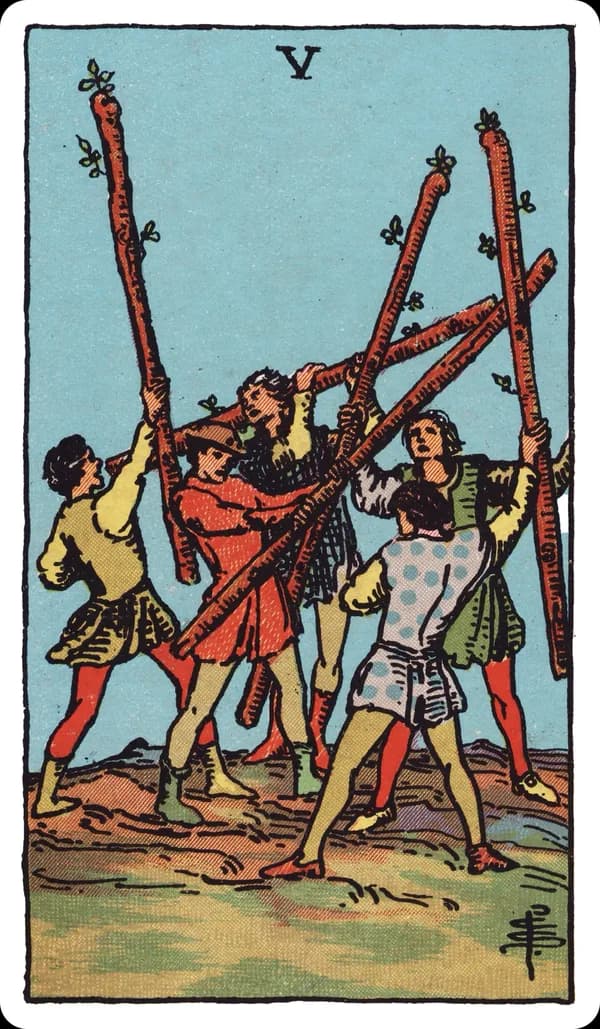
The garlanded calm of the Four of Wands doesn't last: the Five of Wands shows five young men on an open field, each holding a staff, each apparently swinging or jabbing at the others in a scene that reads as somewhere between a real skirmish and an unruly game whose rules nobody quite agreed on beforehand. No two of them face exactly the same direction, no one wears armor or shows any sign of serious injury, and there's no referee or clear winner visible anywhere in the frame — which is precisely the point tarot readers have made about this card for over a century. This is competitive, noisy, disorganized friction rather than a genuine, high-stakes war; five separate people, each pursuing their own version of the contest, at cross-purposes with each other more than in any coordinated opposition. Where the Four of Wands celebrated a shared, agreed-upon threshold, the Five of Wands depicts what happens the moment that agreement breaks down into competing individual agendas — not necessarily malicious, but genuinely hard to make progress through until someone finds a way to actually coordinate the group.
- Element
- fire
- Ruling planet / sign
- Saturn in Leo
- Suit
- wands
Numerology: Golden Dawn title "Lord of Strife" — the Saturn-in-Leo decan puts restrictive, testing Saturn directly against Leo's need to be seen and to compete, which is exactly the friction this card depicts. Fives across the deck mark a disruption to the stability a four just built; here that disruption takes the specific shape of five people unable to agree.
Upright Meaning
Upright, the Five of Wands describes real, active friction: competition, disagreement, or open conflict between multiple parties, none of whom is necessarily wrong, but none of whom is currently coordinating with the others either. It shows up around workplace disputes, family disagreements, competitive situations with several genuine contenders, or simply a period where it feels like everyone around you wants something slightly different and none of those wants line up cleanly. This card isn't automatically a bad sign — a certain amount of this kind of friction can sharpen ideas, test plans against real pushback, and surface disagreements that were better addressed openly than left to fester quietly. It does, however, describe a genuinely effortful, noisy stretch rather than a smooth one; nothing about the image suggests this resolves itself without someone actively working to bring the competing energies into some kind of order. Compared with the more serious, wounding conflict of the Swords suit, this card's fire-based friction tends to be loud and dramatic but rarely deeply damaging — closer to a heated argument or a scrappy competition than to lasting betrayal.
Reversed Meaning
Reversed, the Five of Wands most often describes conflict that's been avoided or suppressed rather than resolved — everyone quietly agreeing not to bring up the disagreement, which doesn't make it disappear so much as push it underground, where it tends to resurface later in a worse form. It can point to unresolved tension simmering beneath an outwardly calm surface: a team, a family, or a relationship that looks fine from the outside but is actually holding real friction nobody's addressing directly. A second reading involves internal rather than interpersonal conflict: competing impulses or priorities within yourself, pulled in several directions at once the way the five figures in the upright card are pulled toward each other. A third, more positive reading applies when the card follows a period of genuine open conflict: reversed Five of Wands can then describe that conflict finally settling down, competing parties starting to find common ground after a noisy stretch. Distinguishing which applies usually comes down to what came before the card in the spread's sequence — active tension earlier in the story favors the resolution reading, while calm earlier in the story favors the suppressed-tension reading.
Read the full reversed meaning →Symbolism
The number five recurs across the deck as a disruption to whatever stability the preceding four just achieved, and this card enacts that disruption almost literally: where four wands stood planted and still in the previous card, here five wands are all in violent motion, none of them grounded. The men's mismatched postures and directions are the card's real argument — this isn't one clear team against another, it's five individuals each fighting a slightly different fight, which is a specific and recognizable kind of conflict distinct from a simple two-sided dispute. Notably, nobody in the scene appears to be losing badly or winning decisively; the fight is genuinely inconclusive as depicted, suggesting this stage of conflict is more about the noise and friction of competing energies than about any resolution being close at hand. Saturn's presence in this card's decan (Saturn in Leo) is worth sitting with: Saturn typically represents restriction, testing, and hard limits, landing here on Leo's proud, performative fire, which produces exactly the kind of frustrated, competitive posturing the image depicts — energy that wants to shine individually but keeps colliding with other people's equally insistent need to do the same.
The Five of Wands from the Rider-Waite-Smith deck: five young men on a green field each brandish a wand at odd, crossing angles, caught mid-motion in what looks like a chaotic mock battle with no clear leader, formation, or winner.
→ See what Saturn in Leo means in your horoscope on GetMyHoro
→ Find your own life-path number on NumberAngel
In Love
In a love reading, the Five of Wands often describes genuine friction between partners, disagreements over priorities, values, or how to handle a shared decision, that need to actually be worked through rather than avoided. It can also describe competition for someone's attention, multiple people interested in the same person, or a relationship that feels like it's constantly competing against other demands (work, family, other commitments) for real priority. For someone single, it can point to a dating life that feels scattered or combative, several interesting but incompatible options, or a pattern of attracting people who bring more friction than ease. This card isn't necessarily a warning that a relationship is doomed; more often it describes a genuinely disagreement-heavy stretch that, handled directly, can actually clarify what both people actually want rather than papering over real differences. Reversed, the love reading points to conflict avoidance: real disagreements being swept aside rather than discussed, tension building quietly under a falsely calm surface. It can also describe internal conflict about the relationship itself, torn between staying and leaving, or between competing feelings for more than one person, that needs honest attention rather than continued avoidance.
Read the full love meaning →In Career
At work, the Five of Wands frequently describes competitive friction between colleagues, competing bids for the same project, disagreement over how to approach a shared task, or a generally scrappy, high-friction stretch where everyone has a different opinion about the right way forward. It can also describe a genuinely competitive job market or interview process, several strong candidates pursuing the same limited opportunity, none of them wrong for the role, simply competing for a single spot. This card doesn't necessarily predict a bad outcome from this friction; disagreement handled well can sharpen a plan and surface real problems that a falsely harmonious team might have missed entirely. Reversed, the career reading points to unresolved workplace tension being avoided rather than addressed, disagreements between colleagues or departments that everyone quietly works around instead of resolving directly, which tends to resurface later as a bigger problem. It can also describe internal career conflict, torn between two different paths or priorities, that needs to be named honestly rather than left to simmer beneath the surface of day-to-day work.
Read the full career meaning →Money & Health — Reflection Themes
Money: Several genuine, valid uses competing for the same limited pool of money is this card's clearest financial reading, a shared household disagreeing over spending priorities, or your own internal tug-of-war between saving and spending on something you want right now. It can also describe genuine competition for a financial opportunity, multiple people bidding on the same asset, several strong candidates for the same investment or deal, where the friction itself is a normal part of a functioning, competitive market rather than a sign anything's gone wrong. Reversed, it can point to financial disagreements being avoided rather than resolved, a couple or family quietly not discussing a real difference in spending habits or priorities until it becomes a bigger issue. It can also describe internal financial conflict left unexamined, competing impulses around money that stay unresolved because naming them honestly feels uncomfortable. Either way, this card rewards bringing the actual disagreement into the open rather than letting it continue running quietly in the background of every financial decision.
Health: Physical or mental tension from competing demands is this card's most common health-adjacent reading, feeling pulled in several directions at once, by work, family, and your own needs, in a way that leaves genuinely little room to properly attend to any one of them. It can describe a stretch where stress shows up as restlessness, irritability, or a general sense of friction in your body and mood rather than any single identifiable cause. It can also point to a competitive or high-pressure environment (a demanding job, a competitive sport, a busy household) taking a real toll if the friction isn't given some kind of outlet or resolution. Reversed, the same tension can turn inward and go quiet rather than disappear, stress that's being suppressed or ignored rather than actually addressed, which tends to resurface later as a bigger physical or emotional strain than if it had been dealt with directly. It can also describe genuine internal conflict about a health decision, competing opinions or competing parts of yourself about how to proceed, that benefits from being named honestly. There's no single diagnosis this card points toward; its subject is friction, and whether that friction is finding a real outlet.
Spiritual Meaning
Five people, five separate agendas, no coordination, offers a pointed spiritual image: the specific difficulty of trying to grow or seek meaning while pulled between competing inner voices, each insisting it knows the right direction. Drawn for a spiritual question, the Five of Wands often marks a stretch where different parts of yourself, ambition and rest, tradition and change, the desire to be seen and the desire for quiet, are genuinely at odds, and the discomfort of that isn't a sign anything's gone wrong so much as a normal, necessary stage of sorting out what actually matters most. It can also describe a spiritual community or practice going through real disagreement, different people or different teachings pulling toward different interpretations of the same underlying tradition. There's a real lesson available in the card's apparent chaos: none of the five figures is depicted as fundamentally wrong, they're simply not yet working together, which suggests the goal isn't eliminating any one of your competing inner voices but finding a way to let them actually collaborate rather than continually colliding. Whether upright or reversed, the underlying invitation is the same: bring the friction into the open rather than letting it run silently underneath everything else.
Yes or No?
The Five of Wands answers yes/no questions with a genuinely mixed signal, since its core subject is unresolved friction rather than a clean outcome in either direction. Where it leans depends heavily on what's actually being asked: for questions about whether conflict or competition is present, this card says a confident yes; for questions about whether that conflict resolves favorably, it stays notably quiet, since the image itself shows the fight still in progress with no clear winner visible. If your question is something like 'will I get this opportunity despite the competition,' the honest reading is that real competition exists and the outcome isn't decided by this card alone. Reversed, the maybe shifts toward either 'the tension is being avoided rather than resolved, so the real answer is still pending' or, in a more favorable reading, 'the conflict is genuinely settling down now.' Context from the surrounding cards usually decides which reversed reading applies. If you need a firmer answer than this card offers on its own, a follow-up question aimed specifically at how the current friction is likely to resolve tends to produce something more useful than pushing this particular card toward a binary verdict it isn't built to give.
Read the full yes-or-no breakdown →Frequently Asked Questions
Is the Five of Wands always about a real fight?
Not necessarily a physical fight — the card's imagery reads more accurately as competitive, disorganized friction, which can be anything from a heated disagreement to a competitive job market to internal conflict within yourself. Genuine physical violence is a less common reading than everyday competition and disagreement.
Why doesn't anyone in this card seem to be winning?
The lack of a clear winner or leader is deliberate — it emphasizes that this stage of conflict is about noise, friction, and competing individual agendas rather than a decisive resolution. The card describes the middle of a disagreement, not its outcome.
Is the Five of Wands a bad card to draw?
Not automatically — a moderate amount of friction and disagreement can actually sharpen a plan or surface real issues that a falsely calm situation would have missed. It's more accurately read as a demanding, effortful stretch than as a purely negative sign.
What's the difference between the Five of Wands and the Five of Swords?
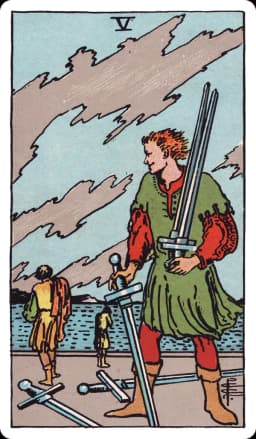
The Five of Wands describes scrappy, largely harmless competitive friction among multiple parties with no clear winner. The Five of Swords describes a much sharper, more damaging conflict with a clear winner who has won at real cost to the relationship — a colder, more serious kind of fight.
Related Cards
Spreads that read Five of Wands
- Relationship Spread (Two-Person) — 6 positions, intermediate
- Chakra Spread — 7 positions, intermediate
- Shadow Work Spread — 5 positions, advanced
- Daily Guidance Spread — 3 positions, beginner
Where Five of Wands sits in the deck
Card correspondences sourced from the Hermetic Order of the Golden Dawn tradition — see our methodology.