Minor Arcana · Cups
Five of Cups
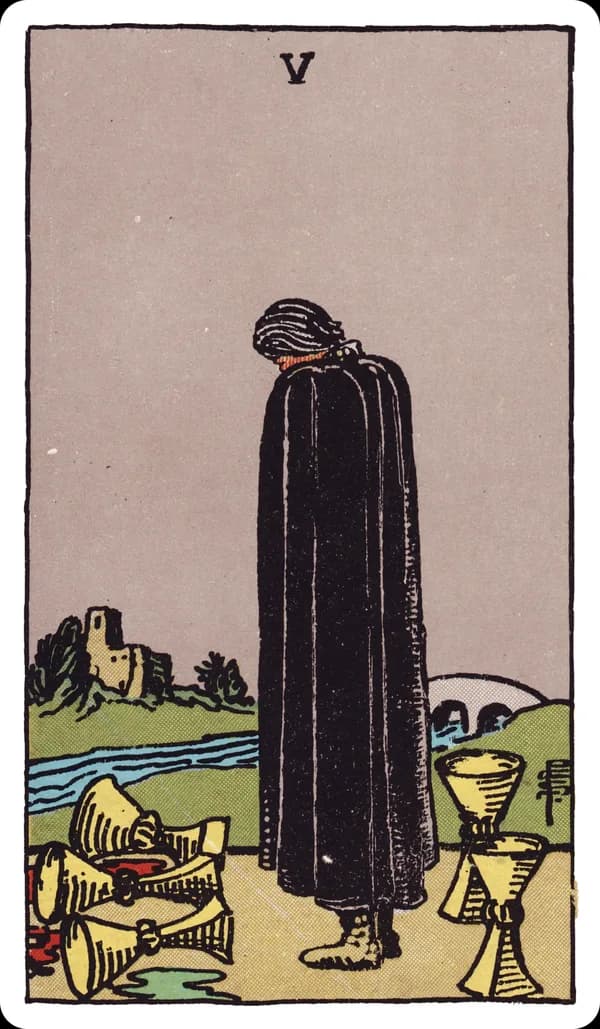
A lone figure in a black cloak stands with his back to the viewer, head bowed toward three cups lying overturned at his feet, dark liquid spilled and soaking into the ground beneath them. His posture — shoulders low, gaze fixed downward — is unmistakably one of grief, and the composition makes sure the viewer reads the scene the same way he does: the three fallen cups dominate the foreground, impossible to look past. But directly behind him, easy to miss on a first look, two cups stand upright and untouched, their contents intact. Further back still, a river runs beside a small bridge leading toward a distant castle — a way forward, present in the frame but outside the figure's current line of sight, since his back is turned to it. The Five of Cups is often paired conceptually with the Four, since both describe a kind of narrowed attention, but where the Four's man ignores a new gift out of apathy, the Five's mourner ignores what remains out of grief — a very different, and much more sympathetic, kind of not-looking.
- Element
- water
- Ruling planet / sign
- Mars in Scorpio
- Suit
- cups
Numerology: Five is the suit's first real disruption — where Four's stagnant comfort finally breaks, Five breaks it painfully rather than gently. The Golden Dawn calls this decan "Lord of Loss in Pleasure," pairing Mars's sharp, wounding energy with Scorpio's intensity, the same combination that turns a joyful cup into a mourned one.
Upright Meaning
Upright, the Five of Cups describes real grief and real loss — not every disappointment, but a loss that genuinely deserves to be mourned: a relationship ending, a plan falling through, a death, or any situation where something meaningful is now, factually, gone. The card doesn't rush the mourning; unlike some tarot cards that quickly pivot toward silver linings, the Five of Cups sits with the loss directly, which is part of why it can feel like one of the deck's heavier draws. Its second, equally important message is about the two standing cups: something intact remains, even during genuine grief, though it's genuinely hard to see while facing the wrong direction. The card isn't telling you to stop grieving before you're ready — it's naming a stage that mourning naturally passes through, where the loss is still the only thing visible. In a reading about a difficult situation, the Five of Cups usually confirms that the pain is real and legitimate, while also gently pointing toward resources or support that haven't disappeared along with whatever was actually lost.
Reversed Meaning
Reversed, the Five of Cups typically describes movement out of that fixation — beginning to accept a loss, finding some genuine peace after a period of grief, or finally turning around and noticing the two cups, and the bridge, and the path forward, that were there all along. It's a meaningfully positive reversal in most readings, marking real emotional progress rather than a return to how things were before the loss. A second, more cautious reversed reading describes forgiveness or reconciliation specifically — letting go of resentment tied to how something ended, which is its own distinct kind of moving on from the loss itself. A less common but real reversed reading points to prolonged or complicated grief: mourning that's stuck, unable to complete its natural course, sometimes because the loss keeps getting reopened rather than allowed to settle. Telling these apart usually depends on how long the underlying loss has been present and what the surrounding cards suggest about the current emotional trajectory.
Read the full reversed meaning →Symbolism
The three spilled cups are usually read as real, genuine loss — not imagined or exaggerated, since the dark liquid pooling on the ground makes clear that something was actually there and is now actually gone. The black cloak marks the figure as being in active mourning, a color used elsewhere in the deck (Death's armor, some renderings of the Hermit's robe) to signal solemnity and internal seriousness rather than external drama. What the card asks the viewer to notice, more than the grief itself, is the composition's deliberate cruelty and mercy at once: the two standing cups are placed directly behind the mourning figure, visible to us but invisible to him, meaning the card isn't simply depicting loss — it's depicting the specific, human tendency to fixate so completely on what's gone that what remains becomes literally impossible to see without turning around. The bridge crossing the river toward the castle in the distance completes the picture: a path forward exists, structurally sound and already built, but it requires the figure to first turn from his current position, a psychological as much as a physical act. Some readers connect the number five, across the Minor Arcana's fives generally — Wands' conflict, Swords' hollow victory, Pentacles' hardship — as the suit's designated point of genuine disruption, the moment each element's early promise runs into real difficulty for the first time.
The Five of Cups from the Rider-Waite-Smith deck: a figure in a black cloak stands with head bowed before three overturned cups spilling dark liquid onto the ground, while two upright cups stand untouched behind him; a river and a distant bridge leading to a castle complete the scene.
→ See what Mars in Scorpio means in your horoscope on GetMyHoro
→ Find your own life-path number on NumberAngel
In Love
In a love reading, the Five of Cups upright most often describes real heartbreak — a breakup, an unreturned feeling, or grief over a relationship that didn't survive despite real investment in it. It's one of the more honest cards in the deck about romantic disappointment, not softening the pain or rushing toward a lesson before the grief has actually been felt. For someone single, it can describe still mourning a past relationship in a way that's making it hard to notice anyone new, even if new possibilities are genuinely present. For someone partnered, it can point to grieving something specific within the relationship — a version of the relationship that used to exist, a broken piece of trust, or an unmet hope — while other, still-intact parts of the relationship go temporarily unacknowledged. Reversed, the reading turns toward healing: genuinely moving past a heartbreak, forgiving an ex or yourself for how something ended, or finally noticing that real possibility for connection still exists even after a painful loss. It can also describe reconciling with a partner after real hurt, provided the reconciliation comes from actual acceptance rather than simply avoiding the grief.
Read the full love meaning →In Career
At work, the Five of Cups usually describes a genuine professional disappointment — a project that failed despite real effort, a job loss, being passed over for something you'd counted on, or grieving a career path that didn't work out the way you'd hoped. It doesn't minimize the setback; this card tends to appear when the disappointment is real and worth acknowledging rather than immediately reframing as a hidden blessing. It can also describe fixating on one professional failure so completely that other, still-viable opportunities or existing strengths go unnoticed for a while. Reversed, the career reading shifts toward recovery: processing a setback and genuinely moving forward, recognizing the skills or opportunities that remain intact even after a specific failure, or making peace with a career chapter that didn't go as planned. It can also describe forgiving a colleague, employer, or yourself for how a professional disappointment unfolded. The card's core message for career questions is that acknowledging a real loss honestly, rather than skipping past it, is usually what actually clears the way toward what comes next.
Read the full career meaning →Money & Health — Reflection Themes
Money: Real regret over a financial loss is where this card's money-themed reflection usually lands — a bad investment, an expense that didn't pay off, or money spent on something that didn't turn out the way you'd hoped. It's worth sitting honestly with that regret rather than immediately trying to reframe or minimize it, since the card's whole point is that some losses are genuinely worth acknowledging before moving past them. It can also describe fixating on a specific financial setback so completely that a still-stable overall financial position goes temporarily unnoticed. Genuine financial recovery tends to be what this card's reversal names — processing a loss and rebuilding, or simply making peace with a decision that didn't work out rather than continuing to relitigate it. It can also describe recognizing the financial resources that remain intact after a specific setback, rather than measuring your whole situation by the one thing that went wrong.
Health: Grief connected to health is where this card's wellbeing theme most often lands, held here as reflection rather than anything clinical — mourning a physical capacity that's changed, processing a difficult diagnosis, or the emotional weight of a health setback that deserves to be acknowledged rather than minimized. It can also describe fixating on one health difficulty so completely that other, still-functioning parts of your wellbeing go unnoticed and unappreciated for a while. Reversed, the card can describe genuine emotional recovery around a health matter — accepting a change in your body or circumstances, or finally noticing the support and resources that remain available even after a difficult health experience. It can also point to complicated or stalled grief around a health loss, where processing hasn't been able to fully complete. No specific condition is really the point here — validating that health-related grief is real and worth feeling fully, rather than rushed past, is.
Spiritual Meaning
Spiritually, the Five of Cups represents the necessary, unavoidable place grief occupies in any genuine growth — the idea that spiritual development doesn't skip past real loss, it moves through it. The card's imagery resists the temptation to spiritually bypass pain: the mourning figure isn't told his grief is secretly a blessing, he's simply shown standing in it, with a path forward available but not forced on him before he's ready. This card can mark a genuine dark night of the soul, a period where loss dominates your attention completely, and it treats that period as legitimate rather than as a failure of resilience or faith. Its deeper spiritual lesson lies in the two untouched cups: even in real grief, something remains intact, and the work of spiritual growth here isn't to deny the loss but to eventually, in your own time, turn and notice what's still there. The bridge in the background matters too — it suggests that moving forward is genuinely possible, but the card is careful not to rush the timeline for reaching it.
Yes or No?
For yes/no questions, the Five of Cups upright leans toward a 'no' — this card describes real disappointment and loss, and honesty matters more here than false optimism: if the question concerns whether something hoped-for will come through, this card is often naming that it won't, or that it already hasn't. It's a particularly direct 'no' for questions where grief or regret is already present, since the card is confirming a loss rather than predicting an uncertain outcome. Reversed, the reading softens meaningfully: not this, but recovery is available — the specific hoped-for outcome may still be gone, but the reversed card points toward genuine healing and toward resources or possibilities that remain intact even after the loss. It's worth treating a reversed Five of Cups as permission to grieve fully and then look up, rather than as a promise that the original loss will somehow be undone.
Read the full yes-or-no breakdown →Frequently Asked Questions
Is the Five of Cups always about a breakup?
No — while heartbreak is one of its most common readings, the card describes genuine loss and grief broadly, which can apply to a career setback, a financial loss, a friendship, or any situation where something real and meaningful is now gone.
What do the two upright cups behind the figure mean?
They represent something intact that remains even during real grief — resources, relationships, or possibilities that haven't been lost, even though the mourning figure, and often the person drawing the card, can't currently see them. The card doesn't deny the loss; it points out that the loss isn't the whole picture.
Should I ignore my grief if I draw the Five of Cups?
No — the card doesn't ask you to skip past real feeling. It depicts genuine mourning without rushing it, and its message is closer to 'this pain is real and valid' than 'get over it quickly.' The invitation to notice what remains comes only once the grief has had its due.
How is the Five of Cups different from the Three of Swords?
The Three of Swords describes a sharp, specific wound — betrayal or a painful truth landing all at once. The Five of Cups describes the aftermath: the ongoing mourning and fixation that follows a loss, whatever caused it, rather than the sharp moment of injury itself.
Related Cards
Spreads that read Five of Cups
- Three-Card Spread — 3 positions, beginner
- Horseshoe Spread — 7 positions, intermediate
- Break-Up / Closure Spread — 5 positions, intermediate
- Four Elements Spread — 4 positions, beginner
Where Five of Cups sits in the deck
Card correspondences sourced from the Hermetic Order of the Golden Dawn tradition — see our methodology.