Minor Arcana · Pentacles
Five of Pentacles
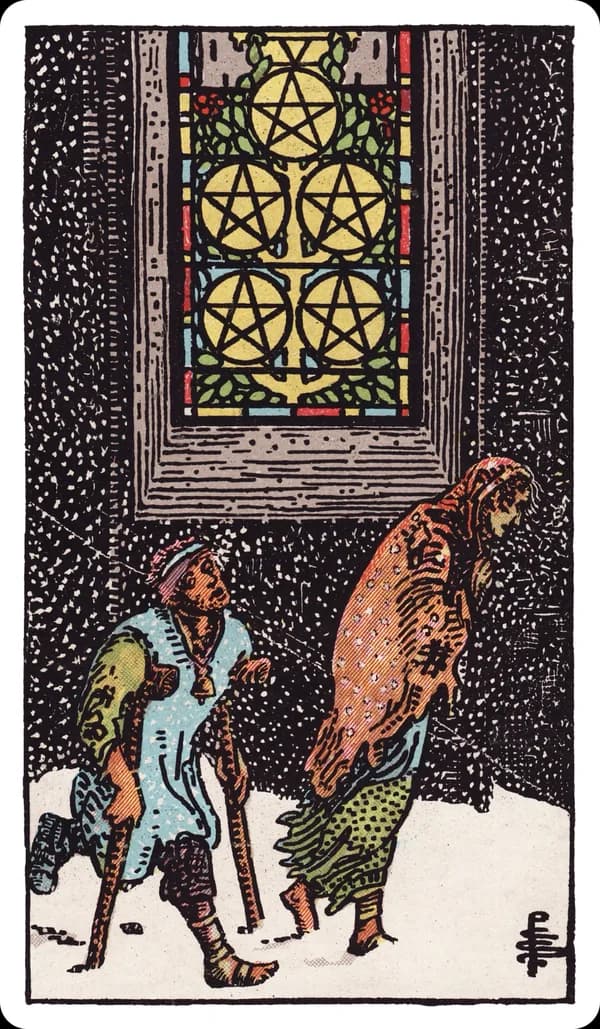
Snow falls on two figures trudging past a church at night — one leaning on crutches with a bandaged foot, the other pulling a thin shawl close against the cold, both dressed in torn, inadequate clothing. Above them, a stained-glass window glows warmly from inside, displaying five pentacles in leaded glass, lit from within by a warmth and shelter the two figures outside don't share. This is the Pentacles suit's clearest image of hardship, and it's a specific kind: not abstract misfortune, but visible, physical want set directly against visible, available relief that simply isn't being accessed. The church's presence isn't incidental — it's usually read as a place of charity and community support, open and lit, right there past the two figures walking by it in the cold.
- Element
- earth
- Ruling planet / sign
- Mercury in Taurus
- Suit
- pentacles
Numerology: Golden Dawn's "Lord of Material Trouble" pairs quick, communicative Mercury with slow, stubborn Taurus — a mismatch that reads as hardship dragging on longer than it should. Fives across the deck mark the point where a suit's early structure first meets real friction; in Pentacles, the material world's version of friction is simply want.
Upright Meaning
Upright, the Five of Pentacles describes real hardship — financial strain, job loss, illness, or a period of genuine material insecurity that's been going on long enough to wear you down. It's one of the more difficult cards to draw honestly, and it doesn't soften the difficulty: this is a card about actually struggling, not a metaphor for minor inconvenience. But the lit church window carries real weight in the reading too — this card rarely describes a situation with no help available at all; more often it describes help that exists and hasn't yet been reached, whether because of pride, isolation, not knowing where to look, or simply not believing support is meant for you. It can also describe the specific isolation of hardship: feeling shut out, overlooked, or forgotten while others seem warm and secure, which is its own kind of pain distinct from the material lack itself. In a reading, this card is often less useful as a prediction than as a prompt: what relief is currently available nearby that hasn't been asked for yet, and what's actually stopping that ask from happening.
Reversed Meaning
Reversed, the Five of Pentacles most often describes the beginning of recovery — the worst of a hard stretch passing, financial improvement finally arriving, or, significantly, help finally being sought and accepted after a period of struggling alone. Few reversals in the deck read as warmly as this one can: where the upright card shows two figures walking past open help, the reversed card often shows that same help finally being reached, whether that's a support system, a program, a loan, or simply the decision to ask someone for what's needed. It can also describe recovering from illness or hardship in a broader sense, a period of genuine improvement after difficulty that had gone on longer than it needed to. A second, harder reading applies when reversed suggests hardship dragging on specifically because help continues to be refused or avoided — pride or isolation still keeping someone from the relief that's available, the upright pattern persisting rather than resolving. Which reading fits usually depends on the surrounding cards and the honest state of things: cards suggesting movement, connection, or change favor recovery; cards suggesting continued stagnation favor the harder reading of help still being turned away.
Read the full reversed meaning →Symbolism
The stained-glass window is the card's most-debated image: it holds the same five pentacles the two figures outside so plainly lack, and it's warmly lit, meaning people are inside, meaning help is close at hand. Whether the two figures don't see the church, don't believe they're welcome there, or are too proud or too resigned to knock is left genuinely ambiguous by the artwork, and most readers treat that ambiguity as intentional — the point isn't which specific reason applies, it's that relief exists nearby and isn't currently being reached. The bandaged foot and crutches on the front figure mark this hardship as at least partly physical, not just financial — illness and poverty are shown as compounding each other, the way they often genuinely do. Snow falling steadily over both figures, rather than a single sharp storm, suggests this is an ongoing condition rather than a single bad night, hardship that's had time to wear the two travelers down rather than catching them by surprise. Unlike the Ten of Swords' single dramatic catastrophe, the Five of Pentacles depicts grinding, prolonged difficulty — the kind that isn't caused by one bad decision but by accumulated circumstance, made harder by the visible presence of help that isn't being taken.
The Five of Pentacles from the Rider-Waite-Smith deck: two ragged figures trudge through falling snow past a lit stained-glass church window, one on crutches with a bandaged foot, beneath a window displaying five pentacles.
→ See what Mercury in Taurus means in your horoscope on GetMyHoro
→ Find your own life-path number on NumberAngel
In Love
In a relationship reading, the Five of Pentacles can describe a partnership under real strain — financial hardship putting genuine pressure on the relationship, or a couple who feel isolated and unsupported, cut off from the friends, family, or community who might otherwise help carry the load. Partnered, this card tends to describe a season where love is real but everything around it feels genuinely hard, and where the relationship needs outside support (family, friends, counseling) that hasn't yet been asked for or accepted. For someone single, it can describe feeling shut out of love altogether — watching others' warmth and connection from the cold the way the card's two figures watch the lit church window, with a sense of being overlooked or left behind. This card doesn't argue that feeling is accurate, only that it's real and worth naming rather than sitting with silently. Reversed, the love reading often points toward relief: a relationship's hard season easing, finally asking for and receiving the support that had been avoided, or, for someone single, connection and warmth beginning to feel reachable again after a period of real loneliness. The harder reversed reading applies when isolation persists specifically because help or connection keeps being refused — a reminder that some kinds of hardship don't resolve until you let someone in.
Read the full love meaning →In Career
At work, the Five of Pentacles frequently describes job loss, financial strain tied to work, or the specific isolation of struggling professionally while colleagues or the broader industry seem to be doing fine — being overlooked for opportunities, passed over, or simply left out of the support and networks that might otherwise help. It's a genuinely difficult card in a career context, and it doesn't pretend the difficulty away, but the church window in its imagery matters here too: resources, programs, or people willing to help are frequently closer than they feel from inside a hard stretch, whether that's a professional network, a mentor, unemployment support, or simply a willingness to ask colleagues for a lead. It can also describe skills or experience that are genuinely valuable going unrecognized, leaving someone materially struggling despite real ability. Reversed, the career reading usually points toward improvement — a new job finally coming through, financial pressure easing, or, importantly, reaching out for professional help (a recruiter, a mentor, a support network) after trying to manage a hard stretch alone. The harder reversed reading describes a job search or financial strain still dragging on specifically because pride or isolation is keeping someone from the outreach that would actually help — worth naming honestly if this reading feels closer to the truth.
Read the full career meaning →Money & Health — Reflection Themes
Money: This card describes real financial hardship without softening it — tight or insufficient income, mounting debt, or a stretch where money worries dominate daily life in a way that's genuinely hard to escape. Sit with the specific detail of the lit church window: this card usually implies that some form of relief exists and hasn't yet been reached, whether that's a program, a person willing to help, a resource not yet looked into, or simply the step of asking for support that pride has been resisting. It can also describe the isolating side of financial hardship — the sense of being cut off from others' apparent ease and security, which compounds the material difficulty with a real emotional one. Reversed, the more hopeful reading points to financial recovery: a debt starting to shrink, an income stream stabilizing, or relief finally reached after a hard stretch, often specifically because help was finally sought rather than avoided. The harder reversed reading describes financial strain continuing specifically because the ask — for a loan, an extension, assistance, or simply advice — keeps being avoided. Whichever way this card lands, it's worth naming plainly: is there a specific, concrete form of help available right now that hasn't yet been reached for.
Health: Illness, injury, or a health struggle compounded by financial strain — the cost of care, time away from work, the toll a long recovery takes on a budget — is a genuinely difficult stretch this card can name honestly when it's read for physical wellbeing — illness, injury, or a health struggle compounded by financial strain (the cost of care, time away from work, the toll a long recovery takes on a budget). The card's imagery of a bandaged foot and crutches makes the physical dimension of hardship explicit rather than purely financial, and the lit church window nearby suggests that support — medical, financial, or simply human — is often closer than it feels during a hard stretch, even when reaching it takes more effort than it should. Reversed, this card frequently describes recovery beginning: healing progressing, treatment finally accessed, or support (medical, financial, or emotional) finally being sought after a period of trying to manage alone. The harder reversed reading describes a health struggle continuing specifically because care or help hasn't been reached for yet, whether from cost, pride, or simple exhaustion. This card carries no fixed link to a specific diagnosis; its use here is as a plain prompt to ask whether real support — medical or otherwise — is currently available and simply not yet being accessed.
Spiritual Meaning
The gap between the two cold figures and the warmly lit window beside them is this card's central spiritual image, and it points toward a real, uncomfortable truth about hardship: isolation is very often not the same thing as an actual absence of support. Many spiritual and contemplative traditions treat asking for help as its own discipline, harder in some ways than enduring alone, because it requires setting down pride or the belief that struggling alone is somehow more virtuous or more honest. This card is worth using to examine whether a current difficulty is being made harder than it needs to be by isolation — a reluctance to let a community, a faith practice, a support system, or simply another person in close enough to actually help. It's also a card that takes real suffering seriously rather than spiritually bypassing it — the two figures' hardship in the artwork is genuine and physically visible, not an illusion to be reasoned away, even as the card insists that relief exists nearby. The invitation here isn't to pretend the cold isn't cold; it's to notice that the door beside you might actually open if you were willing to knock.
Yes or No?
For yes/no questions, the Five of Pentacles upright leans toward 'no, not without help' — a genuine caution that whatever is being asked about is currently under real strain, lacking the resources or support it needs to succeed on its own. This isn't the same as an absolute no forever; it's closer to a warning that proceeding without addressing a resource gap or reaching out for support first is likely to end in the hardship the card depicts. Reversed, the answer often shifts toward yes, particularly for questions about recovery, relief, or improvement after a hard stretch — but that shift usually depends specifically on help having been sought or accepted rather than the situation simply resolving on its own. Naming plainly what specific support or resource is missing tends to do more work than repeating the question, since the card's whole imagery argues that the honest answer changes considerably once that gap is addressed.
Read the full yes-or-no breakdown →Frequently Asked Questions
What does the lit church window mean in the Five of Pentacles?
It represents help, shelter, or community support that exists close by and is currently accessible, even though the two figures in the foreground are walking past it in the cold. The artwork deliberately leaves open why they haven't gone in — pride, not noticing, not believing they're welcome — which is usually the exact question this card is asking the reader to examine in their own situation.
Is the Five of Pentacles always about money?
No — the two figures in the image are defined as much by cold and injury as by poverty, so illness, isolation, and social exclusion read just as validly as a strict money shortage. What ties every version together isn't the specific hardship, it's the lit window nearby that nobody's yet walked into.
Isn't the Five of Pentacles basically the same hardship as the Ten of Swords?
Not really — the Ten of Swords is a single, dramatic ending that's already fully happened, the worst already behind you. This card is different: hardship still ongoing and grinding rather than resolved, with relief still available nearby instead of a catastrophe in the past.
Does reversed Five of Pentacles always mean things are getting better?
Usually, but not always — it most often describes recovery or help finally being accepted, which is genuinely hopeful. But it can also describe hardship continuing specifically because help keeps being avoided, so it's worth checking the surrounding cards and your actual circumstances to see which reading fits.
Related Cards
Spreads that read Five of Pentacles
- Celtic Cross Spread — 10 positions, advanced
- Pros and Cons Spread — 5 positions, beginner
- Money & Abundance Spread — 5 positions, intermediate
- Career Change Spread — 6 positions, intermediate
Where Five of Pentacles sits in the deck
Card correspondences sourced from the Hermetic Order of the Golden Dawn tradition — see our methodology.