Major Arcana · Major Arcana
The Tower
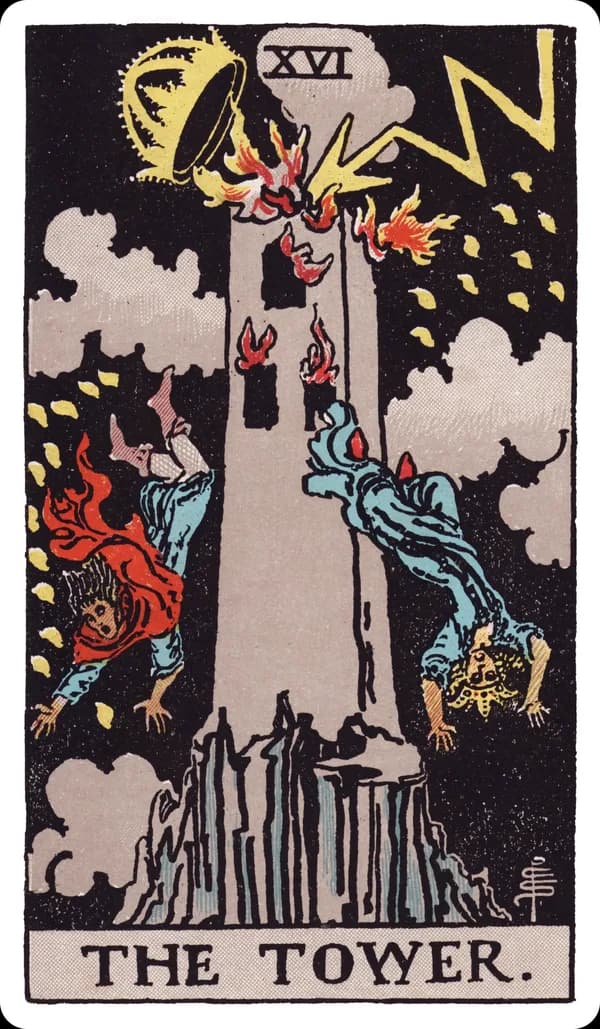
Nothing in the Major Arcana arrives with less warning than the Tower — a bolt of lightning strikes a tall stone structure, its crown is blown clean off, flames pour from its windows, and two figures tumble headfirst out of it toward the ground. Numbered XVI, right after the Devil's slow-building trap, the Tower represents the sudden, often violent collapse of a structure — a belief, a relationship, a job, a self-image — that had been standing on a foundation too weak or too false to actually last. Unlike Death's recognizable, gradually-arriving ending, the Tower's collapse tends to feel genuinely shocking in the moment it happens, even when, looking back afterward, the cracks were arguably visible all along. It's one of the deck's most feared cards to draw, and also one of its most honest: some structures genuinely need to fall before something real can be built in their place.
- Element
- fire
- Ruling planet / sign
- Mars
Numerology: Sixteen reduces to seven (1+6) and forces the Chariot's willful assertion into a collision it can no longer control — the same driving momentum from card VII, but now meeting a truth or structural weakness too large to steer around. Where seven achieved victory through directed will, sixteen shows what happens when that will has been built on a foundation that can't actually hold.
Upright Meaning
Upright, the Tower represents sudden, disruptive change — a collapse that arrives with real shock, exposing a truth or a structural weakness that had been hidden, denied, or simply not yet visible. This card doesn't soften its message: something significant is breaking down, quickly and without much warning, and the experience of it tends to be genuinely uncomfortable while it's happening. But its deeper meaning is more constructive than its imagery suggests — the Tower typically only strikes structures that genuinely needed to fall, foundations built on a lie, an unsustainable arrangement, or a false sense of security that couldn't have held indefinitely regardless of when the collapse actually happened. This card tends to surface around an unexpected event that shatters an existing plan, belief, or relationship — a sudden revelation, an abrupt ending, a crisis that forces a genuine reckoning. Its silver lining is that whatever the Tower destroys was, by its very nature, never as stable as it appeared; the collapse, however painful, tends to clear the ground for something built on more honest, solid footing afterward, even though that rebuilding can't begin until the initial shock has passed.
Reversed Meaning
Reversed, the Tower's sudden collapse either gets delayed or is narrowly avoided, though rarely without cost either way. The most common reading is delayed upheaval: a structural weakness that clearly exists but hasn't yet triggered its inevitable collapse, meaning the disruption this card represents is still coming even though it hasn't fully arrived yet. A second reading is averted disaster: narrowly avoiding a crisis through last-minute intervention or sheer luck, though often at the cost of significant stress and without fully addressing whatever weakness nearly caused the collapse in the first place. A third, closely related reading is fear of change: resisting an obviously needed disruption out of dread of what breaking things down would actually mean, clinging to an unstable structure specifically because the idea of its collapse feels too frightening to face directly, which tends to make the eventual, unavoidable reckoning worse rather than actually preventing it. This card reversed is a genuine caution against false security: whatever weakness the upright Tower would expose is still present even when the dramatic collapse hasn't happened yet, and addressing it proactively is usually less painful than waiting for it to force itself into the open.
Read the full reversed meaning →Symbolism
The crown being knocked from the Tower's top is a deliberate, pointed detail — this isn't just a building collapsing, it's a structure of authority or false pride specifically being humbled, the same crown-symbolism that appears on rulers and figures of established power throughout the earlier cards now violently removed. The lightning bolt itself is traditionally read as a sudden flash of truth or revelation, striking with enough force to expose what a structure was actually built on, whether or not anyone wanted to see it. The two falling figures are usually read as representing ego and pride, cast down from a height that was, in retrospect, never as secure as it looked from the top. Some interpretations connect the Tower to the biblical Tower of Babel — a structure built too high, on too much human hubris, eventually destroyed by a force beyond its builders' control — reinforcing the card's core theme that structures built on false foundations (whether that's a lie, an unsustainable belief, or an ego that's grown too large) are eventually exposed and cannot be permanently propped up. Mars' rulership, the traditional planet of conflict and sudden force, reinforces the card's abrupt, forceful character, distinguishing it clearly from Death's more gradual, if still significant, kind of ending.
The Tower from the Rider-Waite-Smith deck: a tall stone tower is struck by a bolt of lightning, its crowned top blown off and engulfed in flame, two human figures falling headfirst through the air toward the ground below, while smaller flames or drops of light fall around the tower against a dark sky.
→ See what Mars means in your horoscope on GetMyHoro
→ Find your own life-path number on NumberAngel
In Love
A relationship touched by the Tower upright often faces a sudden, disruptive revelation or ending — discovering a truth about a partner that changes everything, a breakup that arrives abruptly rather than gradually, or a crisis that exposes a relationship's real foundation was never as solid as it appeared. Single, this card can point toward a sudden, unexpected event — a revelation about a past relationship, an abrupt realization about your own patterns — that shatters an old belief about love, clearing space, however painfully, for a more honest understanding going forward. Partnered, it can describe a genuine crisis — an affair discovered, a long-buried issue finally surfacing, a sudden argument that reveals a much deeper incompatibility that had been quietly ignored. Reversed, the caution splits: either a relationship's real problems are being delayed rather than resolved, a crisis narrowly avoided without the underlying issue actually being addressed, or genuine fear of an obviously needed ending or confrontation keeping someone in a situation that's clearly unstable. It can also describe sensing a relationship's foundation is shaky without yet having faced that truth directly.
Read the full love meaning →In Career
At work, the Tower often signals a sudden, disruptive professional event — an unexpected layoff, a company crisis, a sudden revelation that upends a project or a working relationship, or an abrupt ending to a job or arrangement that had been quietly unstable for longer than was visible. This card doesn't soften the shock of such an event, but its deeper meaning suggests that whatever collapses under this card's influence was, in some real sense, already unsustainable — a company built on a flawed model, a role that never actually fit, a professional relationship built on a foundation of dishonesty or false assumptions. As coworker or manager energy, the Tower describes sudden, disruptive organizational change — a restructuring, an abrupt departure, a crisis that forces rapid, unplanned adaptation. Reversed, the caution points toward a professional crisis being delayed rather than resolved — an organization's real structural problems papered over rather than addressed, a difficult professional conversation avoided out of fear of the disruption it would cause, or a near-miss (a project that almost failed, a crisis narrowly averted) that hasn't actually prompted the deeper changes it should have. It can also describe genuine anxiety about an obviously needed professional change, holding onto an unstable situation out of fear of what disruption would mean.
Read the full career meaning →Money & Health — Reflection Themes
Money: As a theme for financial reflection, the Tower upright often signals a sudden, disruptive financial event — an unexpected expense, a market shock, or a financial arrangement collapsing abruptly after being built on an unstable foundation for longer than was visible. This card's deeper message suggests that whatever collapses financially under its influence was, in some real sense, already unsustainable — debt that had been quietly accumulating, an investment built on unrealistic assumptions, a financial arrangement resting on dishonesty or denial. Reversed, watch for a financial reckoning being delayed rather than resolved — real financial problems papered over rather than addressed honestly, a crisis narrowly averted without the underlying instability actually being fixed, or genuine fear of facing an obviously necessary financial change that's being avoided at real cost.
Health: This card can point toward a sudden, disruptive shift in physical or mental wellbeing — an unexpected diagnosis, a sudden realization about an unsustainable habit or lifestyle, or a genuine health crisis that forces an abrupt confrontation with something that had been quietly building for longer than was visible. Its deeper message suggests that whatever the disruption exposes was, in some way, already an unstable foundation — a pattern of denial, an unsustainable pace, a habit that couldn't have continued indefinitely regardless of timing. Reversed, it can flag a health issue being avoided rather than addressed — symptoms or warning signs ignored out of fear of what facing them directly would mean, or a crisis narrowly avoided without the underlying pattern that caused it actually being changed.
Spiritual Meaning
Lightning splits a stone tower in this card's imagery, its crown blown clean off, two figures falling from a height that was never as secure as it looked from the top — spiritually, this represents the sudden collapse of a belief or self-image that was never genuinely solid, a necessary, if painful, shattering of illusion that clears the way for a more honest understanding of yourself. Its lightning-strike revelation is often read as a forced confrontation with truth: something you'd been avoiding seeing clearly is exposed, sometimes harshly, and while the experience is rarely comfortable, illusions, however comfortable, ultimately can't sustain genuine growth. As the sixteenth numbered trump, following the Devil's slow-building trap, this card represents its sudden, forced release — the shadow pattern finally breaking open, whether the traveler was ready or not. Drawing this card usually points to a season of significant, possibly unwelcome upheaval that's ultimately clearing away something false, trusting that a more honest foundation will follow the initial shock.
Yes or No?
For yes/no questions, the Tower is one of the deck's clearer 'no' answers — specifically because this card represents sudden collapse and disruption rather than a stable, favorable outcome. If your question concerns whether a current plan or situation will hold up, this card cautions that a significant, unexpected disruption is likely, particularly if the foundation the question concerns has genuine hidden instability. It's a weaker fit as a firm no for a question specifically about facing a difficult truth or making a needed change, which the card actually supports rather than discourages, even though the process itself is disruptive. Reversed, the answer softens somewhat but doesn't become genuinely favorable: it suggests the disruption is being delayed rather than avoided, which reads less as 'no' and more as 'not yet, but the underlying instability is still there.' In that reversed case, the honest next step is proactively addressing whatever weakness the situation actually has, rather than assuming a delayed crisis means the danger has passed.
Read the full yes-or-no breakdown →Frequently Asked Questions
Is the Tower always a bad card?
It's one of the more challenging cards to receive in the moment, since it represents sudden, disruptive collapse, but its deeper meaning is often ultimately constructive — the structures it destroys were, in some real sense, already unstable and needed to fall before something more honest could be built.
What's the difference between the Tower and Death?
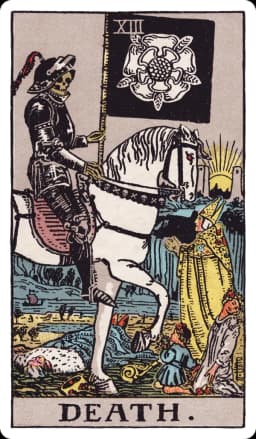
Death represents an ending that's usually the recognizable culmination of a process already underway, even if the exact moment still stings. The Tower represents a much more sudden, unexpected collapse, arriving as a genuine shock rather than the visible conclusion of a longer transition.
Why does the Tower show a crown being knocked off?
It's traditionally read as a symbol of false authority, pride, or established power being specifically humbled by the collapse — this card doesn't just destroy a structure, it exposes that whatever status or security the structure represented was resting on a false or unstable foundation.
Does reversed Tower mean disaster has been avoided for good?
A concrete test worth applying: has the specific weak point actually been fixed, a contract renegotiated, a habit changed, a conversation finally had, or did the immediate scare simply pass without anything underneath it changing? Only the first counts as genuinely averted; the second is delay wearing avoidance's clothes.
Related Cards
Spreads that read The Tower
- Single Card Draw — 1 positions, beginner
Where The Tower sits in the deck
Card correspondences sourced from the Hermetic Order of the Golden Dawn tradition — see our methodology.