Minor Arcana · Swords
Two of Swords
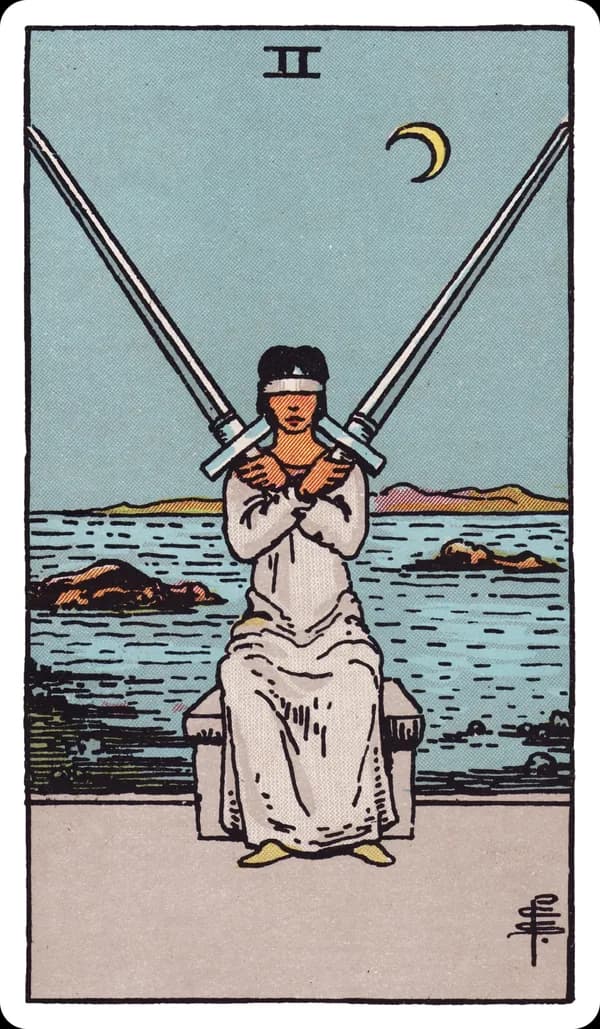
The Two of Swords freezes its subject mid-decision, and freezes her literally: a woman in pale robes sits at the edge of a rocky shoreline, a blindfold covering her eyes, two full-length swords crossed and balanced against each shoulder, her arms folded tightly over her chest to hold them steady. Behind her, the sea is choppy under a sky where a crescent moon hangs low, and jagged rock outcroppings break the water's surface like unresolved obstacles she can't currently see. Nothing about her posture suggests panic — she sits upright, composed, deliberately still — but the stillness reads less like peace than like paralysis, a held breath rather than a resting one. This is the deck's clearest single image of a stalemate: two competing truths, two equally weighted swords, held in perfect, exhausting balance by someone who has chosen not to look at either one directly. The card's numerology reinforces the reading — twos in this deck consistently represent a fork not yet taken, and here that fork is made physical, resting directly on the body of the person who has to eventually choose.
- Element
- air
- Ruling planet / sign
- Moon in Libra
- Suit
- swords
Numerology: Golden Dawn title "Lord of Peace Restored" — the Moon-in-Libra decan colors this card with the Moon's instinctive, non-verbal pull toward equilibrium, applied to Libra's scales at the exact moment they're still perfectly balanced and not yet tipped either way.
Upright Meaning
Upright, the Two of Swords describes a genuine crossroads — a decision significant enough that avoiding it has become its own kind of choice. It shows up when two options sit in real balance: neither is obviously right, both carry real cost, and the person facing them has, consciously or not, chosen to stay still rather than commit to either. This isn't always a flaw; sometimes a pause before an irreversible choice is exactly the right move, giving a situation time to clarify on its own before you act. But the card's blindfold is a genuine caution too — this stillness often depends on not looking too closely at the facts, since looking clearly might force the decision the blindfold is currently preventing. In a reading, the Two of Swords upright usually means you already have enough information sitting somewhere just out of view; the block isn't a lack of facts but a refusal to weigh them honestly. It favors quiet reflection over impulsive action, but it doesn't favor indefinite postponement — at some point, the blindfold has to come off.
Reversed Meaning
Reversed, the Two of Swords describes the stalemate breaking, in one of two directions. Sometimes it's a welcome release: new information finally surfaces, a conversation forces the issue, or you simply can't sustain the balancing act any longer and let one sword fall, choosing — even imperfectly — rather than continuing to hold both positions equally. Other times the break is less comfortable — a decision forced by circumstance or by someone else's timeline before you were genuinely ready, the blindfold torn off rather than removed voluntarily. It can also describe the opposite problem: indecision that's actually worsened, spiraling into so much conflicting information or so many competing opinions that choosing feels harder now than when the two options first appeared. Distinguishing which reading fits usually comes down to how the decision resolves in the surrounding cards — ones suggesting relief and forward motion point toward a healthy release; ones suggesting pressure or overwhelm point toward a decision forced too soon, or a mind now more tangled than clarified.
Read the full reversed meaning →Symbolism
The blindfold is the card's central and most debated symbol: read one way, it's self-protection, a deliberate refusal to look at information too painful to face directly; read the other way, it's simple avoidance, choosing not to see rather than being unable to. Both readings are traditionally valid, and which one fits usually depends on whether the surrounding cards suggest active suffering (protection) or comfortable denial (avoidance). The two swords, crossed and held at equal height, represent two options — or two truths — in genuine balance, neither one currently winning, which is a meaningfully different image than a single sword being drawn or lowered. The sea behind her, choppy rather than calm, hints that the stillness in the foreground is not matched by the emotional or circumstantial reality surrounding it; trouble is present even if it's not being looked at. The crescent moon, a recurring lunar marker in several Swords and Cups cards, signals that this decision is being made — or avoided — more by feeling and instinct than by the sword suit's usual clear-headed logic, an irony the card leans into, since Swords typically govern clarity, and this particular Sword card is defined by its absence.
The Two of Swords from the Rider-Waite-Smith deck: a woman in pale robes sits blindfolded at the edge of a rocky shoreline, two full-length swords crossed and balanced against her shoulders, her arms folded over her chest to hold them steady, a choppy sea and jagged rocks behind her under a low crescent moon.
→ See what Moon in Libra means in your horoscope on GetMyHoro
→ Find your own life-path number on NumberAngel
In Love
In a love reading, the Two of Swords upright often describes a relationship — or a decision about one — held in careful, deliberate suspension. For someone single, it can mean weighing two real romantic possibilities, or one clear option against the comfortable status quo of staying single a while longer, without being ready to choose either. For someone partnered, it frequently points to an unresolved tension both people sense but neither has addressed directly: a disagreement quietly tabled, a boundary neither has actually stated, an issue held at arm's length because naming it might force a bigger decision. The card doesn't judge the pause itself — sometimes waiting genuinely is wiser than choosing under pressure — but it does ask whether the blindfold is protecting you from real harm or simply letting a necessary conversation stay comfortably unspoken. Reversed, the tension usually breaks: a decision gets made, sometimes with relief, sometimes because circumstances — a confession, an ultimatum, someone else's patience running out — force it before you were ready. It can also describe a relationship where indecision has curdled into real confusion, with too many mixed signals to read clearly anymore.
Read the full love meaning →In Career
At work, the Two of Swords tends to appear around a genuinely difficult choice: two job offers, two directions for a project, or a decision between staying in a safe, familiar role and pursuing something riskier but potentially more fulfilling. It favors taking real time before deciding, especially if the choice is significant and not easily reversed — but it's also a caution against using 'more time' as a permanent excuse to avoid actually deciding. As workplace energy, it can describe a team or working relationship stuck in unspoken tension, where a disagreement about direction or approach is being managed around rather than resolved directly. Reversed, the career reading usually means the decision finally gets made, whether by your own resolve or because a deadline, a competing offer, or a manager's patience forces the issue before you feel fully ready. It can also point to analysis paralysis worsening rather than resolving — gathering so much conflicting advice or data about a career choice that the original two clear options have dissolved into something harder to parse than when you started.
Read the full career meaning →Money & Health — Reflection Themes
Money: Two competing uses for the same resources sit at the heart of this card's money reading: a choice between a safer option and a riskier one, or a decision about spending versus saving that you've been putting off making explicit. The Two of Swords upright favors giving yourself real time to weigh a financial choice rather than rushing it, particularly when both options carry genuine merit and neither is obviously wrong. Its caution is the same one that runs through the whole card: don't let 'still deciding' quietly become 'avoiding looking at the numbers at all,' since a financial blindfold tends to get more expensive the longer it stays on. Reversed, the card often marks the financial decision finally getting made — sometimes because you're ready, sometimes because a bill, a deadline, or a change in circumstances removes the option of waiting any longer. It can also describe financial indecision curdling into genuine overwhelm: too many opinions, too many spreadsheets, or too much conflicting advice about a money choice that used to feel more straightforward before you started researching it this thoroughly.
Health: As a theme for reflection, the Two of Swords upright can point to a health-related decision being held in careful suspension — weighing two approaches to a wellness change, or simply not yet ready to face a piece of information about your own body or mind that you suspect but haven't confirmed. It can also describe a more general kind of tension: holding your body rigid, tense, or braced, the physical mirror of the card's frozen, arms-crossed posture, sometimes showing up as tightness through the shoulders or chest that stress-related tension commonly produces. The card's blindfold has a specific health-reading application worth naming honestly: sometimes not looking at a symptom, a test result, or a pattern is a form of self-protection, and sometimes it's simply avoidance that makes the eventual reckoning harder. Reversed, the card can describe that avoidance finally breaking — deciding to actually look, actually ask, actually get the answer you've been circling — or it can describe a more anxious unraveling, where too much conflicting health information has made a formerly simple question feel newly overwhelming.
Spiritual Meaning
Spiritually, the Two of Swords sits at an unusually literal intersection of intuition and denial — the blindfolded figure could be listening inward with unusual focus, or she could be refusing to see something her own intuition is already telling her. Both readings show up in how tarot communities discuss this card, and the difference matters: a spiritual pause, taken deliberately to let inner guidance surface before acting, is a genuinely valuable practice; a spiritual avoidance, refusing to face a truth your intuition has already delivered, is the same posture used for a very different purpose. The crescent moon overhead is often read as an invitation to trust feeling and instinct here rather than pure logic, since the sword suit's usual clear-cut reasoning has, for once, been set aside. Many readers treat this card as an honest prompt to check which version currently applies to you: are you genuinely still gathering inner clarity, or have you already received it and simply haven't taken the blindfold off yet to look at what you already know.
Yes or No?
For yes/no questions, the Two of Swords is one of the deck's most honest 'maybe' cards, and that answer isn't a dodge — it's the actual content of the reading. This card describes a genuine stalemate: two real possibilities in balance, with the situation itself not yet resolved enough to produce a confident yes or no. Pushing for a firmer answer when this card appears usually means overriding what the cards are actually showing you, which is that the decision isn't ready to be made from where you're currently standing. Reversed, the reading tips toward the stalemate finally breaking — which can shift the answer either way, but signals that clarity, or at least resolution, forced or chosen, is closer than it was. Rather than treating 'maybe' as an unsatisfying non-answer, it helps to ask what specifically would need to happen for the blindfold to come off — since naming that condition is often the fastest way to move from stalemate to an actual answer.
Read the full yes-or-no breakdown →Frequently Asked Questions
Why is the woman in the Two of Swords blindfolded?
Tarot readers give this two traditional readings, both valid: self-protection from a truth too painful to face directly, or plain avoidance of a decision she'd rather not make. Which fits best in a specific reading usually depends on the surrounding cards — ones suggesting genuine hurt favor protection; ones suggesting comfort or denial favor avoidance.
Does the Two of Swords mean I have to make a decision right now?
Not necessarily — the card is often more useful as a description of where you currently stand (weighing two real options) than as an instruction to decide immediately. It becomes more urgent if it appears reversed, which usually signals the stalemate is about to break whether you're ready or not.
What's the difference between the Two of Swords and the Seven of Cups?
Both involve choices, but the Two of Swords is a stalemate between two known, roughly equal options that the person is deliberately not looking at. The Seven of Cups is closer to fantasy and overwhelm — too many appealing but often illusory choices, none of them clearly defined. One is a frozen decision; the other is an unclear one.
Is the Two of Swords a bad card?
No — it's a pause card, not a warning card. It simply reflects a genuine, often difficult, moment of weighing two real options. Whether that pause is wise or is becoming a problem depends entirely on how long it's lasted and what's being avoided by staying in it.
Related Cards
Spreads that read Two of Swords
- Three-Card Spread — 3 positions, beginner
- Horseshoe Spread — 7 positions, intermediate
- Decision-Making Spread (Two Paths) — 7 positions, intermediate
- Four Elements Spread — 4 positions, beginner
Where Two of Swords sits in the deck
Card correspondences sourced from the Hermetic Order of the Golden Dawn tradition — see our methodology.