Minor Arcana · Wands
Two of Wands
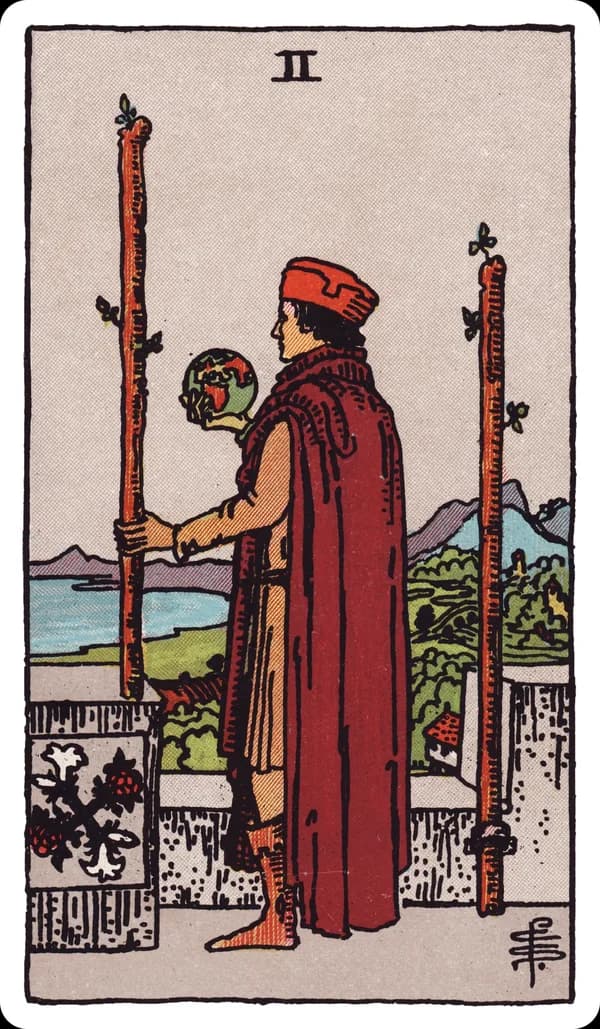
The Ace's raw spark has already been claimed by the time the Two of Wands opens — a man in fine robes stands on the parapet of a castle he has evidently already built or inherited, one wand mounted firmly to the wall behind him, the other held almost absentmindedly in his hand. In his free palm sits a small globe, turned toward the view: the wide sea and the mountain range stretching out beyond the battlement. He has, in other words, already won something — the castle is real, the position is secure — and the card's actual subject is what he does with that position now that it's his. Unlike the Ace's sudden, undirected charge, the Two of Wands is fire that has paused to look at a map. Golden Dawn tradition titles this card 'Lord of Dominion,' and the dominion in question is less about ruling over others than about the private, sometimes uncomfortable authority of deciding your own next move with no one else to consult. The globe in his hand is the tell: this is a card about scope, about a world of options rather than a single fixed path, held by someone who has to choose which part of it to actually go toward.
- Element
- fire
- Ruling planet / sign
- Mars in Aries
- Suit
- wands
Numerology: Golden Dawn title "Lord of Dominion" — the Mars-in-Aries decan brings that planet's assertive, self-starting character to bear on this stage of the Wands suit's journey. Twos across the deck represent a fork or a partnership; here, fittingly for fire, the fork is entirely self-authored rather than negotiated with another person.
Upright Meaning
Upright, the Two of Wands describes the specific moment after an initial success or a secured position where a bigger decision opens up: what to actually do with the platform you've built. It favors deliberate planning over impulsive action — a notable shift from the Ace's immediate spark — and often shows up when someone is weighing an expansion, a bigger opportunity, or a genuinely larger version of something already working on a smaller scale. This is a card of real personal power exercised through foresight rather than force: surveying the terrain, considering more than one option, and making a considered choice about where fire's energy gets pointed next. It can also describe the discomfort of standing at that hinge point — having outgrown a comfortable, secured position but not yet having committed to the next one, which can feel more unsettled than either the security behind you or the goal ahead. Compared with the Ace, this card is less about whether to start and more about which specific direction, at what scale, is worth the fire's continued investment.
Reversed Meaning
Reversed, the Two of Wands most often describes hesitation at exactly the moment decisive planning was called for — staying inside the secured, comfortable position (the castle wall) rather than committing to the larger vision (the world beyond it), usually out of a fear that's bigger than the actual risk involved. It can look like someone who has genuinely earned a bigger opportunity but keeps finding reasons to delay reaching for it, playing smaller than their actual position allows. It can also point to poor planning working against otherwise real ambition: a big goal held without the practical groundwork (research, timeline, resources) that would make it more than a daydream. A less common but real reading involves the opposite imbalance — grand plans made without ever checking them against reality, all vision and no map, which the reversed card flags just as readily as excessive caution does. Distinguishing the two usually comes down to whether the surrounding cards suggest someone frozen (fear-driven caution) or someone scattered (ungrounded ambition); both are variations on the same core problem, foresight not being put to real use.
Read the full reversed meaning →Symbolism
The two wands themselves carry the card's central tension: one is planted and fixed to the battlement, representing the ground already secured, the achievement already in hand; the other he holds free, representing the untaken step, the direction not yet chosen. Read together, they describe someone standing exactly at the hinge between what's already been built and what comes next, neither wand doing anything more than existing as a possibility until he moves. The globe is a deliberately global image rather than a local one — not a map of a specific destination but the whole visible world, suggesting the scale of ambition available to someone in this position is genuinely large, not modest. His vantage point matters too: a battlement is a place built for surveying, not for staying — defensible, elevated, useful for planning, but not somewhere anyone is meant to live permanently. The sea and mountains beyond are notably distant and slightly hazy compared with the castle's solid stonework, echoing a pattern across the Wands suit's early cards: the goal exists and is visible, but it isn't close, and getting there is a separate undertaking from simply seeing it.
The Two of Wands from the Rider-Waite-Smith deck: a man in rich robes stands on a castle battlement overlooking sea and distant mountains, one wand fixed to the wall beside him and the other held loosely in his hand, a small globe resting in his other palm.
→ See what Mars in Aries means in your horoscope on GetMyHoro
→ Find your own life-path number on NumberAngel
In Love
In a love reading, the Two of Wands often marks a relationship, or a single person's romantic life, at a genuine decision point: something secure already exists, and the real question is whether to expand it into something bigger — moving in together, making a long-distance relationship permanent, or deciding whether an existing connection has room to grow into the future both people actually want. For someone single, it can describe weighing your options deliberately rather than settling for the first comfortable connection available, holding out for a partnership that matches a genuinely larger vision of what you want rather than what's simply convenient. It favors patience and real planning over impulsive romantic leaps, which sets it apart from more immediately passionate cards elsewhere in this suit. Reversed, the love reading points to hesitation about committing to a bigger, more serious version of a relationship that's already proven itself on a smaller scale — staying in a comfortable holding pattern out of fear of what expanding it might cost. It can also describe indecision between two real options, or ambitious romantic plans (a big move, a major commitment) made without the groundwork that would let them actually succeed.
Read the full love meaning →In Career
At work, few cards match the Two of Wands for genuine strategic planning at a pivotal moment: after an initial success, when a bigger opportunity, expansion, or new direction becomes possible and needs to be deliberately chosen rather than stumbled into. It favors ambition paired with real foresight — surveying more than one option, weighing timelines and resources, and committing to a specific direction rather than staying in a comfortable but limiting position purely out of habit. It's a particularly apt card for someone who has already built something (a business, a reputation, a skill set) and is now deciding how far to take it, or in what new direction to expand it. Reversed, the career reading turns toward hesitation at exactly the wrong moment: an earned opportunity to grow or expand that keeps getting deferred out of fear rather than genuine strategic reason, or ambitious plans that were never actually grounded in research or a workable timeline. It can also describe playing it safe well past the point where safety was actually serving you, staying inside a secured but increasingly limiting position rather than reaching for the larger one already visible.
Read the full career meaning →Money & Health — Reflection Themes
Money: Deciding how far to scale an already-working financial plan is this card's natural territory: not the initial investment or first venture (that belongs to the Ace), but the deliberate choice of whether and how to expand something that's already proven itself, whether that's a business, a savings strategy, or an investment approach. It favors genuine research and a real plan over either impulsive expansion or excessive caution — this is a card that rewards actually studying the globe in your hand rather than either ignoring it or being paralyzed by how big it is. Reversed, it can point to financial ambition held back by fear of risking what's already secured, turning down a genuinely sound expansion because the current position feels too comfortable to leave. It can also describe the opposite problem: a financial plan that's all vision and insufficient groundwork, chasing scale before the fundamentals are actually in place to support it. Either way, this card is a useful prompt to look honestly at whether your current financial caution or ambition is actually calibrated to the real opportunity in front of you.
Health: The Two of Wands in a health-adjacent reading often points to a deliberate decision about scaling up a wellness routine that's already working — moving from a modest, established habit (a short daily walk, a basic diet change) toward something more ambitious, once the smaller version has proven it can stick. It favors planning that decision rather than either staying indefinitely in the comfortable, smaller routine or jumping straight to an overly ambitious one without a real transition plan. It can also describe a broader moment of taking stock of your physical or mental wellbeing and consciously deciding what a bigger, more complete version of it would actually look like. Reversed, the card can flag hesitation to expand a health routine that's clearly ready for the next stage, staying in a safe holding pattern out of fear of failure or change. It can also describe ambitious health goals set without a realistic plan behind them — a familiar pattern where enthusiasm for a bigger transformation outpaces the practical steps that would actually get you there. This card carries no link to a specific physical condition; its subject is the planning and scaling of your own wellbeing choices.
Spiritual Meaning
Standing on a battlement with a whole world in your palm is a striking image for a specific spiritual moment: having done real inner work already, and now facing the question of what a larger, more deliberately chosen spiritual life might actually look like. The Two of Wands often shows up when an early spiritual practice or insight has taken hold and the real work becomes choosing, consciously, how far and in what direction to take it — rather than simply continuing to receive whatever comes. It's a card of personal authority in the spiritual sense: trusting your own vision enough to plan a path rather than waiting for one to be handed to you. There's also a note of solitude in the image worth naming — no other figure appears with him on the battlement, and spiritual dominion, in this card's reading, is something claimed alone even when it eventually gets shared with others. Reversed or upright, the underlying question stays the same: given what you've already built inwardly, what's the larger version of a spiritually engaged life you're actually willing to plan for, rather than simply hope arrives.
Yes or No?
The Two of Wands gives one of the more genuinely conditional answers in the deck: not quite yes, not quite no, but 'that depends on which direction you actually choose, and you haven't chosen yet.' The card describes a real fork with multiple live options rather than a single clear path, so a yes/no question drawing this card is often, honestly, still open — the outcome depends on a decision that hasn't been made within the reading itself. Where it leans is toward encouraging deliberate planning before committing either way: if the question is 'should I expand/commit to this bigger version of what I already have,' this card supports doing so, but only once real groundwork (research, a timeline, an honest look at resources) is in place, not before. Reversed, the maybe tilts more cautious: hesitation or ungrounded ambition is currently in the way of a clear answer, and the practical next step is closing that gap rather than forcing a premature yes or no. If you need a firmer verdict than this card offers on its own, a follow-up card asking specifically which of the visible options is the stronger one tends to be more useful than treating this draw as indecisive.
Read the full yes-or-no breakdown →Frequently Asked Questions
Why does the man in this card already have a castle?
The Two of Wands picks up after an initial success rather than at the very beginning — the castle represents ground already secured. The card's actual subject is the bigger decision that opens up once you already have something real, which sets it apart from the Ace's raw, unclaimed potential.
What does the globe in his hand mean?
It represents the scale of what's genuinely possible from this position — a whole visible world of options rather than one narrow path. It's often read as an invitation to think bigger than the immediate, comfortable next step, while still requiring a real, deliberate choice about which direction to actually take.
Is the Two of Wands a good card for starting a business?
It's a better fit for expanding or scaling something already proven than for the very first spark of an idea, which belongs more to the Ace of Wands. If you already have a working small version of a venture, this card favors deliberately planning its next, bigger stage.
Does the Two of Wands mean a partnership with another person?
Not typically — despite being a numbered 'two,' this card's decision is usually solitary, made by one person surveying their own options rather than negotiated with a partner. For a genuinely shared decision or partnership, cards like the Two of Cups fit more directly.
Related Cards
Spreads that read Two of Wands
- New Moon Spread — 4 positions, beginner
Where Two of Wands sits in the deck
Card correspondences sourced from the Hermetic Order of the Golden Dawn tradition — see our methodology.