Minor Arcana · Swords
Eight of Swords
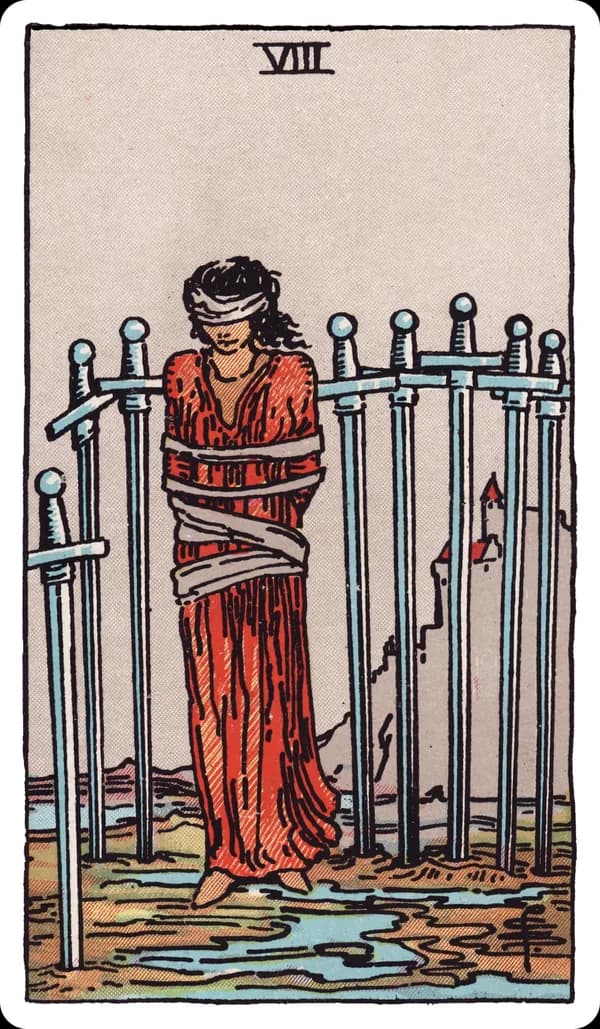
The Eight of Swords presents one of the deck's most quietly devastating optical illusions: a woman stands bound and blindfolded, eight swords planted upright in the ground around her in a rough enclosure, and the whole scene reads at first glance as genuine imprisonment. Look closer and the trap loosens. The swords don't form a complete circle, there are real gaps between them, wide enough to walk through. Her bindings are loose, wrapped rather than tightly restraining. Her feet are bare and standing in mud, uncomfortable but not chained to the ground. A castle sits on a hill in the distance, visible, reachable, not impossibly far. Nothing in the actual physical scene fully explains why she hasn't simply walked away. The blindfold is the answer the card is quietly offering: she can't see the gaps, the loose bindings, the open path, because she can't see anything at all, and it's that lack of sight, not the swords themselves, doing most of the actual trapping.
- Element
- air
- Ruling planet / sign
- Jupiter in Gemini
- Suit
- swords
Numerology: Golden Dawn title "Lord of Shortened Force" — Jupiter's expansive potential compressed by Gemini's restless duality describes power that should be available but currently isn't being used. Eight, the suit's swift-momentum number in Wands, here becomes almost the opposite: motion withheld by a limitation that's more perceived than absolute.
Upright Meaning
Upright, the Eight of Swords describes feeling trapped in a situation that, examined honestly, has more actual room to move than it currently appears to have. It favors questioning the trap's boundaries directly: this card rarely describes a genuinely inescapable circumstance, its far more common message is that fear, self-doubt, or a narrowed, anxious perspective is doing more of the restricting than the actual external circumstances are. It can describe a victim mindset specifically, a pattern of feeling powerless in a situation where real, if uncomfortable, choices actually exist, choices that feel invisible rather than genuinely absent. This card often shows up during periods of anxiety or overwhelm, when a difficulty feels total and inescapable specifically because it's being viewed through a narrowed, fearful lens rather than a clear one. It rewards, gently, the difficult work of removing the metaphorical blindfold, seeking outside perspective, questioning catastrophic assumptions, actually testing whether the walls are as solid as they feel, since this card's whole visual argument is that the exit exists and simply hasn't yet been located.
Reversed Meaning
Reversed, the Eight of Swords most often describes the blindfold finally coming off, a limiting belief or a distorted, fear-driven perspective loosening its grip enough for the actual, available options to become visible for the first time in a while. It favors genuine self-liberation: recognizing that a trap you'd been treating as absolute was significantly more permeable than it felt, and beginning to act on that new clarity rather than continuing to operate as though the old restriction were still fully in force. It can also describe outside help arriving, someone else pointing out the gaps in the swords that you genuinely couldn't see on your own, since this card's trap is notoriously hard to perceive clearly from the inside. A second, more cautious reversed reading involves a limiting belief being named but not yet fully released, seeing the gaps intellectually while still feeling too afraid to actually walk through them, a partial rather than complete liberation. Distinguishing these usually comes down to whether new perspective has translated into any real, if small, action yet.
Read the full reversed meaning →Symbolism
The gaps between the swords are the single most important detail in this card's whole composition, and they're easy to miss on a first pass precisely because the overall impression of the scene is so convincingly one of total enclosure. That mismatch between what the image actually shows and what it feels like it shows is the entire point: this is a card about a trap that's significantly less absolute than it appears from the inside. The blindfold restricts sight rather than movement directly, but its effect on movement is total, since she can't attempt an escape route she genuinely cannot see, however available it might actually be. The loose ropes reinforce this further, real restriction exists here, but it's notably less severe than the visual impression the whole arrangement first creates. The muddy ground beneath her feet is worth noting too, uncomfortable and difficult, but not literally holding her in place the way a locked cage would. The distant castle, sometimes read as safety, sometimes as home, represents a real, reachable destination that exists whether or not she can currently perceive it, patiently waiting on the other side of a limitation that is, on close examination, largely self-imposed and perceptual rather than externally absolute.
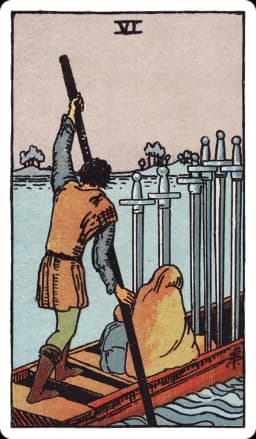
The Eight of Swords from the Rider-Waite-Smith deck: a woman stands blindfolded and loosely bound, surrounded by eight swords planted upright in the muddy ground around her forming a loose, incomplete cage, a castle visible on a hill in the distance, the ground beneath her feet clear of any barrier.
→ See what Jupiter in Gemini means in your horoscope on GetMyHoro
→ Find your own life-path number on NumberAngel
In Love
In a love reading, the Eight of Swords often describes feeling trapped in a relationship or a dating pattern that, looked at honestly, has more actual options than it currently feels like it does, staying out of fear of the unknown, fear of being alone, or a narrowed sense of what you actually deserve. For someone single, it can describe a self-imposed restriction around dating itself, a belief that good options aren't available, that you're somehow stuck with the same disappointing pattern, when the real limitation is more about perspective and self-worth than about the actual dating landscape. For someone partnered, it can describe feeling stuck in a relationship that isn't working, convinced there's no way out, no better alternative, no way to voice a real concern, when in fact more room to change the situation exists than fear is currently allowing you to see. Reversed, the reading turns toward genuine clarity finally arriving, recognizing that a relationship or a pattern you'd treated as inescapable actually has real exits, or the relief of an outside friend or therapist helping name options that had become genuinely invisible from inside the situation.
Read the full love meaning →In Career
At work, the Eight of Swords frequently describes feeling stuck in a job or a professional situation that, examined honestly, likely has more actual flexibility than it currently feels like it does, staying out of fear of financial instability, fear of failure, or a narrowed belief that better options simply aren't available to you. It favors questioning that narrowed view directly: this card rarely describes someone with genuinely zero professional options, more often it describes someone whose fear has made real, if uncomfortable, alternatives feel invisible. It can also describe a self-imposed restriction on your own ambition, believing you're not qualified, not ready, or not deserving of something you actually could pursue with real effort. Reversed, the career reading points toward that restriction lifting, recognizing that a professional situation you'd treated as a dead end actually has real paths forward, or finally seeking outside perspective, a mentor, a career counselor, a trusted colleague, who can see options that fear had made genuinely invisible to you on your own.
Read the full career meaning →Money & Health — Reflection Themes
Money: As a theme for financial reflection, the Eight of Swords upright can describe feeling trapped by financial circumstances that, examined closely, likely have more actual room to maneuver than fear is currently allowing you to see, a scarcity mindset that treats every option as closed even when some genuinely aren't. It favors questioning catastrophic financial thinking directly, actually reviewing the numbers, actually researching the real alternatives, rather than continuing to operate on an assumption of total restriction that hasn't been tested against reality. Reversed, it can point to a genuine financial breakthrough in perspective, realizing that a financial situation you'd treated as hopeless actually has real, workable paths through it, whether that's a debt repayment option you hadn't researched, a source of income you hadn't considered, or simply outside financial guidance finally clarifying options that fear had obscured. As with any card touching money on this site, take it as a prompt to test your own assumptions against real information rather than as a financial forecast on its own.
Health: As a theme for reflection, the Eight of Swords upright can describe feeling trapped by a health situation, physical or mental, that, examined honestly, may have more real options and support available than anxiety is currently allowing you to perceive. It favors questioning a catastrophic or hopeless framing directly, actually researching treatment options, actually reaching out for support, rather than continuing to operate as though no path forward exists. It can also describe anxiety itself as the primary trap, a mind caught in a loop of fearful, restrictive thinking that narrows perceived options far more than the actual physical or medical situation does. Reversed, the same card can flag real relief arriving, a limiting belief about your own health or capability finally loosening, new information or outside support making previously invisible options visible for the first time. No particular condition attaches to this card; what's actually useful here is the gap between how trapped a health situation feels and how trapped it actually, provably is.
Spiritual Meaning
A blindfolded figure standing inside a cage with real gaps she cannot see is one of the deck's most precise images for the specific way fear narrows perception long before it narrows actual circumstance. The Eight of Swords tends to show up spiritually during a period of self-imposed limitation, a belief about your own worth, capability, or freedom that's become so familiar it feels like an objective fact rather than a perspective that could genuinely be questioned and revised. It rewards the sometimes frightening work of actually testing the walls, seeking a new perspective, whether through reflection, a trusted guide, or simply time and distance, rather than continuing to treat a felt limitation as an unquestionable truth about reality itself. Reversed, the spiritual reading shifts toward genuine liberation, the blindfold coming off, old fears and limiting stories about yourself finally loosening their grip enough for a clearer, freer relationship with your own actual circumstances to become possible.
Yes or No?
For yes/no questions, the Eight of Swords lands closest to 'maybe,' and understanding why the card resists a clean yes or no matters more than the verdict itself: it describes a situation where the real answer depends heavily on perspective and perceived limitation rather than on fixed external circumstance. If your question is really 'do I have any real options here,' the honest answer this card offers is usually yes, more than currently feels true, but accessing them requires questioning assumptions that feel like fact rather than accepting them as the final word. Questions built to demand a flat, unconditional verdict get the least reliable read from this eight, since what it's actually measuring is how much of the obstacle is real versus assumed, not a fixed outcome. Reversed, the maybe firms up considerably toward yes, since reversed typically marks the blindfold coming off and previously invisible options becoming genuinely visible and actionable, which tends to make whatever you were asking about noticeably more possible than it seemed while the upright card's restricted perspective was still fully in force.
Read the full yes-or-no breakdown →Frequently Asked Questions
Why doesn't the woman in the Eight of Swords just walk away?
The blindfold prevents her from seeing that the swords around her form an incomplete circle with real gaps, and that her bindings are loose rather than absolute. The card's core message is that the restriction is significantly more perceptual than physical, she can't see the way out, not that no way out exists.
Is the Eight of Swords a bad card to draw?
It describes a genuinely difficult, anxious feeling of being trapped, but its underlying message is actually encouraging once fully understood: the trap is largely self-imposed and more permeable than it feels. It's more a call to seek clearer perspective than a prediction of true, inescapable misfortune.
What's the difference between the Eight of Swords and the Ten of Swords?
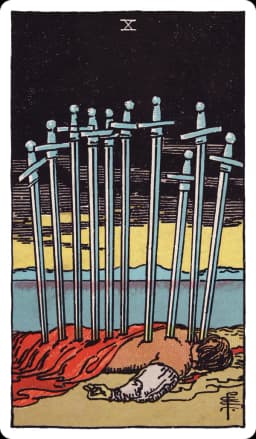
The Ten of Swords describes something that's already, definitively over, a situation genuinely concluded. The Eight of Swords describes a situation that only feels concluded or inescapable, while real, if hard to see, options actually remain available.
Does reversed Eight of Swords mean my problems are solved?
Not necessarily the external circumstances themselves, but it does describe a genuine shift in perspective, seeing real options that fear had previously made invisible. Acting on that new clarity is usually still required to actually change the situation.
Related Cards
Spreads that read Eight of Swords
- Tree of Life Spread — 10 positions, advanced
- Chakra Spread — 7 positions, intermediate
- Self-Love Spread — 4 positions, beginner
- Mind-Body-Spirit Spread — 3 positions, beginner
- Past Life Spread — 5 positions, advanced
- Soulmate Spread — 5 positions, intermediate
- Health & Wellness Reflection Spread — 4 positions, beginner
Where Eight of Swords sits in the deck
Card correspondences sourced from the Hermetic Order of the Golden Dawn tradition — see our methodology.