Minor Arcana · Swords
Ace of Swords
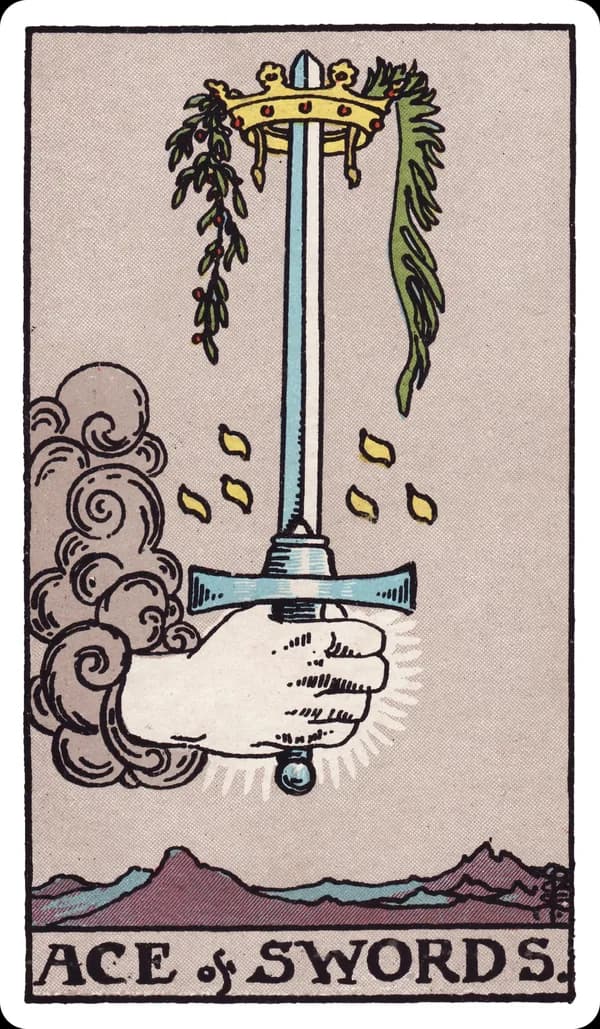
The Ace of Swords is the cleanest single image the deck has for a mind cutting straight through to what's actually true. Like the other three Aces, a hand extends from a bank of cloud — the recurring device marking all four root cards as gifts arriving from somewhere beyond ordinary effort — but here the hand holds only one thing: a double-edged blade, held bolt upright, catching light against a grey and turbulent sky. A crown circles the tip of the sword, and from that crown hang a sprig of olive and a length of palm, the same paired symbols of peace and victory used elsewhere in the deck's imagery. Below, jagged, snow-touched peaks sit at a considerable distance, small against the scale of the sword itself. Where the Ace of Cups offers something soft and overflowing, the Ace of Swords offers something hard-edged and singular: not abundance, but precision. It is the suit's least ambiguous card in one specific sense — a sword only cuts one way at a time, and this Ace represents the moment a confused, cluttered situation finally reduces to one clear, actionable truth.
- Element
- air
- Ruling planet / sign
- Air (root force, no decan)
- Suit
- swords
Numerology: Aces are the suit's root number — the raw, undivided potential of the air element before it takes any shape. Every other Swords card is a variation on the cut this Ace makes in seed form.
Upright Meaning
Upright, the Ace of Swords marks a genuine mental breakthrough — the moment scattered thoughts, mixed signals, or a half-understood situation snap into a single, unmistakable realization. It favors decisions made from clear thinking over decisions made from mood, habit, or what everyone else seems to be doing. This is the card of the idea that finally lands fully formed, the conversation where someone finally says the thing that's been avoided, or the piece of information that changes how you see an entire situation at once. Because it's an Ace, the card represents the moment of clarity itself rather than everything that follows from acting on it — the sword is drawn, but nothing has been cut yet. In a reading about a decision, its presence usually means the fog is lifting or has already lifted, and the honest next step is to act on what you now see rather than keep second-guessing a conclusion you've actually already reached. It rewards directness: saying the true thing plainly, cutting through a stalled conversation, or naming a problem instead of managing around it indefinitely.
Reversed Meaning
Reversed, the Ace of Swords describes the clarity not arriving, or arriving and then being ignored. Thoughts stay tangled, a conversation goes in circles without landing anywhere, or a truth that should be obvious keeps getting talked around instead of named. It can point to a specific miscommunication — words chosen badly, an intention read wrong, a message that lands as something other than what was meant — or to a more general mental fog: difficulty concentrating, a decision that keeps getting postponed because no single clear reason to choose either way has actually surfaced yet. A second, sharper reading applies when clarity has arrived but is being used carelessly: a hard truth delivered without any regard for how it lands, cutting for the sake of being right rather than for the sake of being understood. Distinguishing the two readings usually depends on what's actually missing — cards suggesting stagnation and confusion point toward the fog not lifting yet; cards suggesting conflict or bluntness point toward a truth being wielded more like a weapon than a resolution.
Read the full reversed meaning →Symbolism
Every Ace in this deck repeats the cloud-hand device, but the object each hand holds tells you what kind of gift is being offered, and a sword is a notably ungentle one to receive. The blade's double edge is the detail worth sitting with: a sword this shape cuts equally in either direction, which tarot readers have long taken to mean that clarity itself is double-edged — the same insight that frees you from a lie can also wound whoever told it, including yourself. The crown at the sword's tip is a mark of authority and command, suggesting that whatever truth this card names carries real weight and isn't easily argued with once spoken. The palm and olive sprigs draped from that crown are the same victory-and-peace pairing seen on other cards in the deck, here suggesting that a genuine mental breakthrough, however sharp, ultimately serves reconciliation rather than ongoing conflict. The distant, barely visible mountains below are a deliberate contrast to the sword's closeness and clarity — proof that even the sharpest insight doesn't resolve everything in view at once; there's still ground to cross after the cut is made.
The Ace of Swords from the Rider-Waite-Smith deck: a hand emerges from a cloud gripping a single upright sword, its blade catching light against a stormy grey sky, a golden crown encircling the tip with a sprig of palm and olive draped from it, jagged snow-capped mountains visible in the far distance below.
→ See what Air (root force, no decan) means in your horoscope on GetMyHoro
→ Find your own life-path number on NumberAngel
In Love
In a love reading, the Ace of Swords upright is one of the more bracing cards to see — it favors an honest conversation over a comfortable silence, even when the honest conversation is the harder option. For someone single, it can mark a sudden clarity about what you actually want from a partner, cutting through the vague hoping that usually precedes real dating decisions. For someone partnered, it often signals the moment a couple finally says the thing they've been circling for weeks: a boundary, a need, a hard truth about where the relationship stands. This card doesn't guarantee the truth is a welcome one — only that naming it clearly beats leaving it unspoken. Reversed, the love reading turns toward miscommunication: a message misread, an intention misunderstood, or a conversation that keeps almost happening and then doesn't. It can also describe a truth being delivered too bluntly, wounding a partner in the process of trying to finally be honest. Either way, this card asks whether the thing being avoided is actually more painful left unsaid than said.
Read the full love meaning →In Career
At work, the Ace of Swords favors the idea that finally cuts through a stalled project, the decision made from a clear head rather than office politics, or the moment a plan's real weak point gets named out loud instead of quietly worked around. It's a strong card for negotiations, strategic planning, or any situation where the person willing to say the obvious but uncomfortable thing moves everyone forward. It can also mark a genuine intellectual breakthrough — solving a problem that's been stuck, or finally understanding what a role or project actually requires after a period of confusion about it. Reversed, the career reading points to communication breakdown: an email misread, a meeting that produces more confusion than direction, or a decision delayed because no one will say plainly what needs to be said. It can also describe cutting words used badly — blunt criticism delivered without care for how it lands, damaging a working relationship in the process of being 'honest.' The corrective is rarely to soften the truth itself, only how and when it gets delivered.
Read the full career meaning →Money & Health — Reflection Themes
Money: A clear-eyed money decision is what this card describes best — cutting through vague anxiety about your finances into one specific, nameable fact: the actual number, the actual gap, the actual choice in front of you. Read as a theme for financial reflection, the Ace of Swords upright often turns up right before a genuinely useful realization: seeing exactly where money is leaking, understanding a contract's real terms for the first time, or simply admitting to yourself what something actually costs instead of estimating around it. It favors research and plain arithmetic over gut feeling when a financial choice is on the table. Reversed, the same card can describe financial confusion that hasn't resolved: numbers that don't add up cleanly, mixed information from different sources, or a decision put off because the full picture still feels unclear. It can also point to a financial truth delivered or received too bluntly — a hard conversation about money handled clumsily. Either way, the card's usual nudge is toward looking directly at the actual figures rather than the feeling attached to them.
Health: As a theme for reflection, the Ace of Swords upright often shows up around mental clarity specifically — a sharper, calmer head after a period of foggy thinking, or the relief of finally understanding what's actually been causing a stretch of stress once it's named plainly. It can mark a moment where a pattern affecting your wellbeing (a habit, a trigger, a source of tension) becomes obvious in a way it wasn't before, which on its own can feel like a genuine turning point even before anything changes practically. Physically, it sometimes accompanies a new burst of mental sharpness or focus rather than any specific bodily change, since the sword speaks to the mind before the body. Reversed, the card can flag the opposite: a foggy, scattered mental state, trouble concentrating, or racing thoughts that won't resolve into anything useful. It can also point to overthinking sharpened into something harsher — a harsh inner voice, judging yourself with the same cutting precision the upright card applies more usefully outward. Naming that inner voice for what it is tends to be the more useful move than trying to out-argue it.
Spiritual Meaning
Air is the element of thought, breath, and communication, and the Ace of Swords is that element distilled to its sharpest point — the instant a truth becomes undeniable to you, whether or not you were looking for it. In a spiritual reading, it can mark a genuine realization, the kind of insight that reorganizes how you see an entire period of your life once you have it, or the end of a long stretch of confusion about which direction actually matters to you right now. Some readers connect this card to the crown chakra, or to the moment intellect and intuition briefly align on the same answer, cutting through the usual argument between the two. It's a notably unsentimental card for spiritual growth — the truth it offers doesn't arrive wrapped in comfort, and accepting it sometimes means giving up a story about yourself or your situation that felt safer than the plainer one now in front of you. The mountains sitting distant beneath the blade are a reminder that one clear insight doesn't finish a spiritual journey; it just marks where the next stretch of it actually begins.
Yes or No?
For yes/no questions, the Ace of Swords upright leans toward a clean 'yes' — and unlike some of the deck's more conditional yeses, this one comes with real confidence, since the card's whole meaning is about a situation becoming clear rather than staying ambiguous. If the question concerns whether the truth of a matter is actually knowable, or whether a decision can be made with real clarity rather than more guessing, this card answers with a fairly firm affirmative. It favors action taken once the picture is clear over continued deliberation. Reversed, the honest reading softens toward 'not yet, the picture is still unclear' rather than a flat no — the situation the question concerns hasn't resolved into anything sharp enough to act on confidently, and pushing for a decision before that clarity arrives risks a choice made on incomplete or muddled information. When the reversed card lands, the more useful move is usually identifying specifically what information or conversation is still missing, since naming that gap tends to close it faster than waiting passively for clarity to arrive on its own.
Read the full yes-or-no breakdown →Frequently Asked Questions
Does the Ace of Swords always mean good news?
Not automatically — it means clarity, and clarity isn't always comfortable. The truth this card reveals can be welcome or difficult; what it promises is that the truth becomes visible, not that the truth is pleasant. Many readers find this card marks a genuinely useful turning point even when the specific realization itself is hard to sit with.
What's the difference between the Ace of Swords and the Ace of Wands?
Both mark a fresh start, but in different registers. The Ace of Wands is a spark of creative or entrepreneurial energy — an impulse to act. The Ace of Swords is a moment of mental clarity — an impulse to understand. One tends to precede doing something new; the other tends to precede finally seeing something clearly.
Why does a crown sit on top of the sword?
The crown marks the sword's authority — the truth this card reveals isn't a minor observation but a conclusion carrying real weight, one that's hard to argue with once it's been seen clearly. Some readers also connect the crown to victory achieved through honesty rather than force.
Is the Ace of Swords a good card for making a big decision?
Often, yes — it favors decisions made from a genuinely clear head over ones made from mood or pressure. If it appears reversed, that's usually a sign the clarity needed to decide well hasn't fully arrived yet, and waiting for more information may serve better than deciding on schedule.
Related Cards
Where Ace of Swords sits in the deck
Card correspondences sourced from the Hermetic Order of the Golden Dawn tradition — see our methodology.