Major Arcana · Major Arcana
The Hanged Man
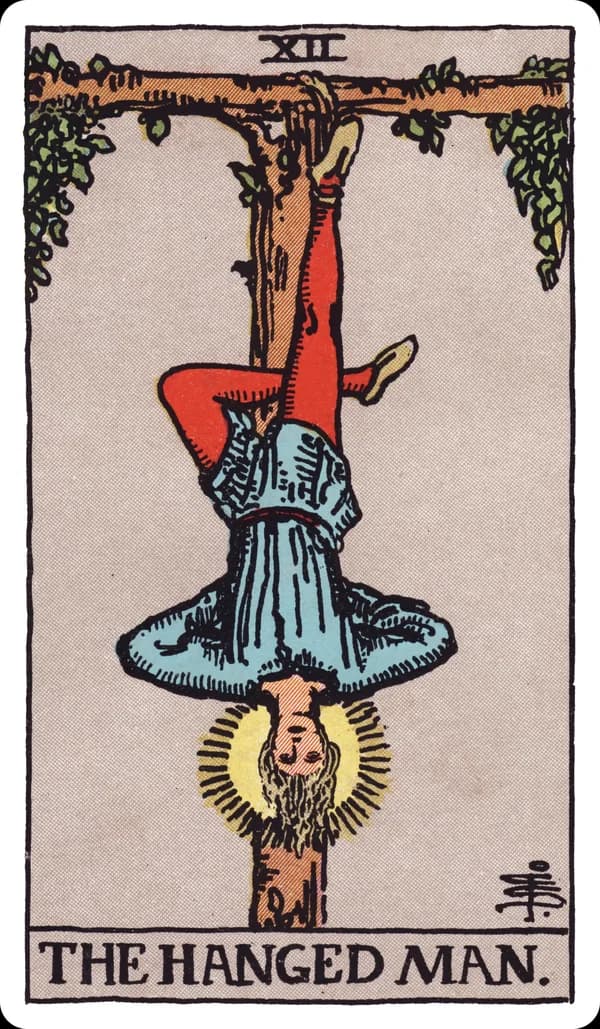
The Hanged Man is one of the deck's most visually unsettling cards at first glance and one of its gentlest in actual meaning — a young man hangs upside down from a living tree, but his face carries no distress at all, and a soft golden glow surrounds his head like a halo rather than a mark of suffering. Numbered XII, right after Justice's clear-eyed weighing of cause and effect, this card represents a deliberate, voluntary pause: not punishment, not failure, but a chosen suspension of normal action in order to see a situation from a genuinely different angle. His legs are crossed in a shape resembling the numeral four, and his hands are calmly folded behind his back rather than straining against restraint — every visual detail argues that this position, however uncomfortable it would look from outside, is being held willingly rather than endured against his will.
- Element
- water
- Ruling planet / sign
- Water
Numerology: Twelve reduces to three (1+2) and echoes the Empress's creative three at a much stiller register — growth not through active nurturing but through voluntary stillness, a paused suspension that, given time, produces its own kind of insight rather than visible movement. Following Justice's clear-eyed accounting, twelve introduces a deliberate pause before any further action is taken.
Upright Meaning
Upright, the Hanged Man favors voluntary surrender and a genuine shift in perspective over forcing an outcome through continued effort. This card often shows up when pushing harder simply isn't working, and the wiser response is pausing, releasing the need to control every variable, and letting a situation reveal something you couldn't see while you were still actively struggling against it. It's a card of productive stillness — not giving up in defeat, but consciously choosing to stop, wait, and see things differently, trusting that this pause will eventually yield real insight or a better path forward. The Hanged Man also favors sacrifice made willingly for something genuinely worthwhile: setting aside a short-term want in service of a longer-term or more meaningful goal, or letting go of a plan, an assumption, or a need to be right in order to actually understand a situation more fully. Unlike the Chariot's forward-driving willpower or the Emperor's active authority, this card's power is entirely in the pause itself — in a reading, the Hanged Man often suggests that the most useful thing you can do right now is nothing at all, at least in the conventional sense, and that real clarity will come from that stillness rather than from more action.
Reversed Meaning
Reversed, the Hanged Man's productive pause either stalls into unproductive delay or curdles into unnecessary self-sacrifice. The most common reading is stalling: staying suspended in indecision or inaction long after the pause has stopped producing any new insight, avoiding a needed choice or action under the excuse of 'waiting for clarity' that isn't actually arriving. A second reading is resistance to surrender: refusing to let go of control even when continued struggle clearly isn't working, fighting against a pause the situation genuinely needs because stillness feels too much like giving up. A third reading is needless self-sacrifice: giving up something valuable — time, energy, your own needs — for a cause or person that doesn't actually deserve or require that sacrifice, playing the martyr rather than making a genuinely worthwhile, freely chosen trade-off. This card reversed is a useful check on whether a pause or a sacrifice is genuinely serving its purpose, or has become either an excuse to avoid action or a pattern of giving up too much for too little in return.
Read the full reversed meaning →Symbolism
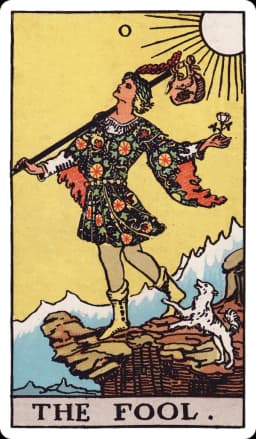
The tree the Hanged Man hangs from is alive, not a dead gallows, and this distinction matters enormously to how the card is traditionally read: he's suspended by something still growing, still connected to life, rather than by an instrument of death. His crossed legs, forming a rough numeral four, are sometimes read as a callback to the Emperor's card (also numbered with a strong association to structure and foundation), suggesting that even this suspended, upside-down state carries its own hidden order rather than being pure chaos. The golden halo around his head is the card's clearest symbol: despite his inverted, physically vulnerable position, he has achieved a kind of illumination or insight that wouldn't have been available from his ordinary, upright vantage point — sometimes the only way to truly see a situation clearly is to stop trying to control it and let your usual perspective be turned upside down instead. His water element attribution — one of the Major Arcana's three 'elemental trumps,' alongside the Fool's air and Judgement's fire — connects him to emotional depth and intuitive surrender rather than active, willed effort, reinforcing that this card's wisdom comes through yielding rather than through struggle.
The Hanged Man from the Rider-Waite-Smith deck: a young man hangs upside down by one foot from a T-shaped wooden gibbet formed from a living tree, his other leg bent to form a numeral four, his hands folded calmly behind his back, a soft golden halo glowing around his head, his expression peaceful rather than distressed.
→ See what Water means in your horoscope on GetMyHoro
→ Find your own life-path number on NumberAngel
In Love
In love, the Hanged Man upright often points toward a relationship benefiting from a pause rather than more active effort or pushing for resolution — stepping back from trying to force a specific outcome and letting a situation settle or reveal itself more clearly with time. For someone single, this card can favor a deliberate break from actively dating or pursuing romance, trusting that stepping back will bring a clearer perspective on what you actually want, rather than continuing to chase something that isn't working. For someone partnered, the Hanged Man can point toward releasing the need to control how a relationship unfolds — letting go of an expectation or a plan you've been gripping tightly, and trusting the relationship (or the process of working through a conflict) to develop on its own timeline rather than yours. Reversed, the caution splits: either a relationship stuck in unproductive limbo, neither moving forward nor genuinely ending, because a needed decision keeps being avoided, or one person sacrificing too much of themselves for a relationship that isn't reciprocating fairly. It can also describe refusing to let go of control over a relationship's outcome even though that grip is clearly making things worse rather than better.
Read the full love meaning →In Career
At work, the Hanged Man favors a deliberate pause over forcing a decision or outcome — stepping back from a stalled project or a career question to see it from a fresh angle, rather than continuing to push against something that clearly isn't moving. This card can point toward the value of patience during a genuinely uncertain professional period: a hiring freeze, a pending decision, a project on hold, where the most useful response is releasing the need to control the timeline and trusting that clarity will come with time. It can also describe a willing sacrifice made for a longer-term professional goal — taking a lower-paying role for the sake of real growth, or setting aside a short-term want in service of a more meaningful career direction. Reversed, the caution points toward professional stalling: staying in career limbo far longer than is actually useful, avoiding a decision that genuinely needs to be made under the guise of 'waiting for the right time.' It can also describe over-sacrificing at work — giving up your own needs, boundaries, or growth for a job or organization that isn't reciprocating that investment fairly, playing the martyr rather than making a genuinely worthwhile trade-off.
Read the full career meaning →Money & Health — Reflection Themes
Money: As a theme for financial reflection, pausing before a decision rather than acting under pressure is where this card lands — releasing the need to force an outcome and giving yourself real time to see a financial situation from a fresh angle before committing. It can also point toward a willing financial sacrifice made for something genuinely worthwhile — cutting back now to build toward a longer-term goal, a trade-off freely chosen rather than resented. Reversed, watch for financial decisions stalled in unproductive indecision, avoiding a choice that actually needs to be made, or a pattern of financial self-sacrifice that isn't serving you — giving up too much for someone or something that isn't reciprocating fairly, or refusing to release a plan that clearly isn't working anymore.
Health: This card favors genuine rest and a shift in perspective over pushing through — releasing the need to control every outcome and allowing your body or mind the pause it's actually asking for, rather than fighting a period of necessary stillness. It can point toward seeing a health pattern from a genuinely new angle — recognizing that an approach that hasn't worked may need a different perspective rather than more force applied to the same method. Reversed, watch for either avoiding a needed health decision under the excuse of more waiting, or pushing through exhaustion or pain rather than allowing the rest your body genuinely needs. A related pattern is self-sacrifice around health — neglecting your own needs for others in a way that isn't sustainable.
Spiritual Meaning
A young man hangs calmly from a living tree, hands folded rather than straining, a soft glow around his head where distress would ordinarily show — the whole image argues that real insight sometimes requires letting your usual, upright vantage point be turned over entirely. Releasing the need to control an outcome, this card suggests, opens a kind of understanding that continued struggle simply can't reach. As one of the Major Arcana's three elemental trumps, its water attribution ties it to emotional depth and yielding rather than active, willed effort — spiritual growth here comes through surrender rather than through more forceful approaches. As the twelfth numbered trump, following Justice's clear-eyed accounting, it marks a deliberate pause before any further action, a chance to let insight settle before moving again. Pulling this card tends to call for conscious surrender: releasing your grip on how things should go, trusting a genuinely new perspective is available if you're willing to stop struggling long enough to receive it.
Yes or No?
For yes/no questions, the Hanged Man is a genuinely ambiguous card, and like the High Priestess and the Hermit, its uncertainty is itself the honest message. This card represents a deliberate pause, and the most truthful answer to a yes/no question it appears in is often 'not yet, and not through more active pushing' — the situation isn't ready to be decided or resolved through continued effort, and the useful response is releasing your grip on the outcome rather than forcing an answer prematurely. It's a genuinely poor fit for anyone hoping for quick, decisive confirmation; the Hanged Man's whole nature works against urgency. Reversed, the uncertainty sharpens into a caution about stalling: the pause may have already served its purpose and is now just avoidance, in which case the honest next step isn't more waiting but actually re-engaging with the decision you've been suspended above. Distinguishing which applies usually comes down to whether the pause still feels genuinely necessary and clarifying, or has become a comfortable way to avoid a choice that's actually ready to be made.
Read the full yes-or-no breakdown →Frequently Asked Questions
Is the Hanged Man a card of punishment or suffering?
No — despite the unsettling image, the card's traditional meaning is about voluntary, willing surrender rather than punishment. The figure's calm expression and glowing halo signal that this suspension is chosen and ultimately illuminating, not a depiction of torment.
What's the difference between the Hanged Man and the Hermit?
Both involve a pause from normal activity, but the Hermit's withdrawal is about active, purposeful solitary reflection — seeking insight through deliberate inward attention. The Hanged Man's pause is about surrender specifically — releasing the need to control an outcome, rather than actively searching for an answer.
Does the Hanged Man mean I should give up?
Not in the sense of defeat — the card favors a willing, conscious pause rather than continuing to force an outcome, which is different from giving up on something entirely. It's about releasing control over how or when something happens, not abandoning the goal itself.
Why is the Hanged Man's element Water instead of a specific zodiac sign?
Compare the three: the Fool's Air suits a card about weightless first movement, Judgement's Fire suits an active summons to rise, and Water suits this card specifically because water takes the shape of whatever contains it rather than pushing back against it, the same yielding quality the suspended figure's whole posture depicts.
Related Cards
Where The Hanged Man sits in the deck
Card correspondences sourced from the Hermetic Order of the Golden Dawn tradition — see our methodology.