Major Arcana · Major Arcana
The Emperor
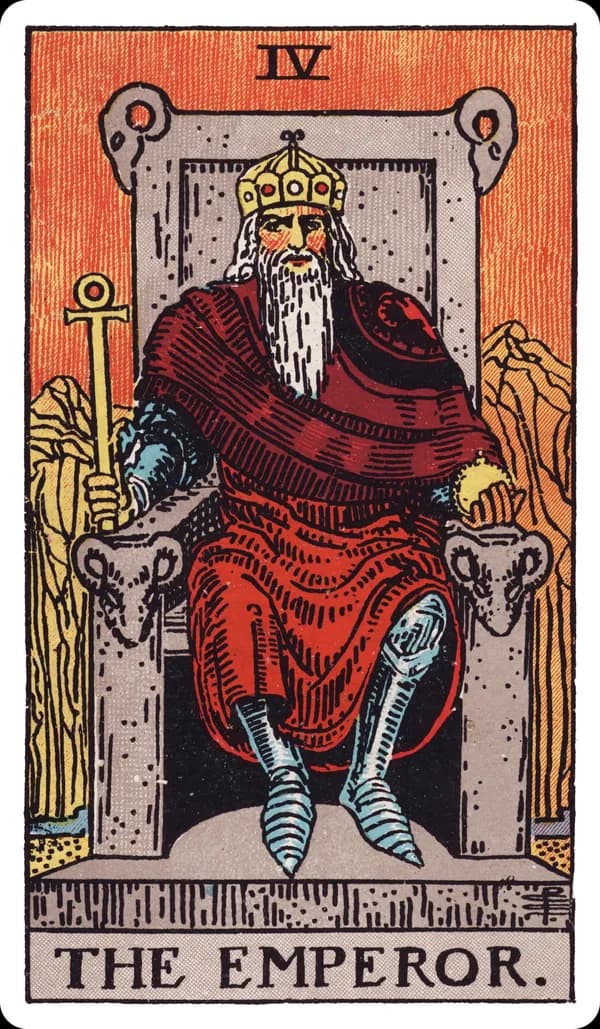
After the Empress's lush, fertile field, the Emperor sits on stone, in front of barren mountains — the deck's clearest visual pivot from organic growth to imposed structure. He's an older, bearded figure in armor beneath his red robe, a detail worth noticing: unlike the Empress, who wears her power openly and comfortably, the Emperor is armored even while seated on his own throne, as though authority here is something actively maintained and defended rather than simply inhabited. Four ram's heads are carved into his throne, tying him directly to Aries, his ruling sign, and to the ram's own associations with headstrong initiative and leadership. He holds an ankh-topped scepter in one hand — life and authority combined — and a golden orb in the other, a classic symbol of dominion over a defined territory. Numbered IV, directly following the Empress, he represents the next necessary step after growth: giving that growth a shape, a boundary, and a set of rules sturdy enough to protect and sustain it once the initial fertile burst has passed.
- Element
- fire
- Ruling planet / sign
- Aries
Numerology: Four is the number of stable structure — four walls, four corners, four seasons — the point where the Empress's organic growth gets shaped into something that can be maintained and defended over time. It's a grounding number in most numerology traditions, associated with order, foundation, and the discipline needed to keep something standing.
Upright Meaning
Upright, the Emperor is tarot's clearest card for structure, authority, and stability actively established and maintained. He favors clear rules, defined boundaries, and disciplined follow-through over spontaneity or improvisation — this is a card that rewards building something durable, even if the process is less exciting than a fresh start. In a reading, he often shows up when a situation genuinely needs more structure: a plan that's been too loose, a boundary that hasn't been clearly set, or a role that calls for you to take charge decisively rather than defer to others. He's strongly associated with fatherhood and father-figures specifically, and more broadly with any protective authority figure — a mentor, a boss, an institution — who provides stability through clear, consistently enforced rules. Aries' fire brings a assertive, forward-driving quality to this otherwise stabilizing card: the Emperor doesn't just maintain order passively, he actively pursues and defends it, which distinguishes him from more purely administrative cards. In a reading about leadership or self-discipline, the Emperor often suggests that the moment calls for you to step into genuine authority — over a situation, a project, or your own habits — rather than waiting for someone else to provide the structure you need.
Reversed Meaning
Reversed, the Emperor's protective structure turns rigid or oppressive. The most common reading is domination — authority used to control rather than protect, rules enforced for their own sake rather than because they genuinely serve the people bound by them. This can describe an actual controlling figure in someone's life, or it can describe your own tendency to grip too tightly onto control when a situation would benefit from more flexibility. A second reading is coldness: emotional distance masked as strength, an authority figure (or your own leadership style) that's technically competent but lacking in warmth, leaving people who depend on that structure feeling managed rather than genuinely cared for. A third reading points the opposite direction entirely: loss of control, a structure that's collapsing or was never properly established in the first place, an authority figure (possibly yourself) failing to maintain the order the situation actually requires. Distinguishing these readings usually comes down to whether the surrounding cards suggest too much rigid control or not enough functioning structure — the Emperor reversed can describe either extreme, and rarely a comfortable middle ground.
Read the full reversed meaning →Symbolism
The barren mountain landscape behind the Emperor is a deliberate contrast to the Empress's flourishing wheat field in the card just before him — a visual argument that structure and fertility are complementary rather than opposed, each incomplete without the other. His stone throne, unyielding and permanent-looking, stands in for the discipline and rules that make lasting achievement possible; nothing about this card suggests spontaneity or improvisation, which is precisely the point. The ram's heads carved into the throne connect him to Aries specifically, a cardinal fire sign associated with assertive, direct leadership rather than patient diplomacy — the Emperor leads by clear decree, not by consensus-building. His full suit of armor beneath the red robe (partially visible at his wrists and legs) signals that his authority isn't passive inheritance; it was won and continues to be actively defended. His advanced age, unusual among the Major Arcana's more youthful figures, marks him as someone who has already been through the tests that earn real authority, distinguishing his rule from a younger figure's raw ambition.
The Emperor from the Rider-Waite-Smith deck: a bearded older man in red robes and armor sits on a stone throne carved with four ram's heads, holding an ankh-topped scepter in one hand and a golden orb in the other, with barren, rocky red mountains rising behind him.
→ See what Aries means in your horoscope on GetMyHoro
→ Find your own life-path number on NumberAngel
In Love
A relationship touched by the Emperor tends to be built on stability and protective care rather than sweep-you-off-your-feet gestures — a partner who shows love through consistency more than drama. Single, this often means being genuinely ready for something serious rather than casual, or noticing you're drawn to someone dependable and grounded in a way you might not have been before. Partnered, the card usually favors making commitments explicit: naming the relationship, talking through long-term plans, or building steadier shared routines and boundaries instead of leaving them assumed. There's also a traditional reading tied to a strong, sometimes father-figure influence on the relationship, worth taking literally only where the question's context actually supports it. Reversed, watch for authority curdling into control: a partner (or your own instinct) managing the relationship through rigid expectations rather than supporting it, warmth cooling into something more transactional, or the opposite problem — no real structure or commitment at all where the relationship genuinely needs one.
Read the full love meaning →In Career
At work, the Emperor is one of the strongest cards for stepping into a leadership role, establishing clear authority, or bringing much-needed structure to a chaotic project. He favors decisive, top-down direction over collaborative consensus-building — this is a card of the executive decision, the clear policy, the boundary firmly set and consistently enforced. It suits founders, managers, and anyone building an organization or system meant to last, since the Emperor's whole nature is about durability rather than a quick, improvised win. A coworker or manager touched by this card leads through clear expectations and consistent follow-through — reliable, if sometimes rigid, and generally more respected than personally warm. Reversed, the caution shifts toward authority mismanaged: a controlling boss or workplace culture that stifles rather than supports, rigid rules applied without regard for actual circumstances, or the opposite, a leadership vacuum where the structure a project genuinely needs simply isn't there. It can also describe your own leadership style tipping into micromanagement, or an organization whose systems have become bureaucratic obstacles rather than useful supports.
Read the full career meaning →Money & Health — Reflection Themes
Money: Aries' cardinal fire brings drive to this card's financial reflection, but it channels into discipline rather than impulse: a budget actually followed, a savings plan set up and maintained, decisions made against a clear strategy rather than in the moment. This is a stabilizing card financially — it favors building durable security through consistent habits over chasing a fast windfall — and can point toward a protective financial structure already in your life, a stable job, a trustworthy advisor, a family setup that provides real security. Reversed, the caution splits: rigidity that's turned counterproductive, over-controlling every expense to the point of stress or refusing to adjust a plan that clearly isn't working, or the opposite, no financial structure at all, spending and saving essentially unmanaged. It can also point to control issues in shared finances, one person dominating decisions that should be made together. Worth checking honestly which failure mode currently describes you before assuming a fix.
Health: Consistency does more here than intensity: a routine kept reliably, a clear recovery plan, the stability that comes from regular habits rather than sporadic bursts of effort. This card favors building durable practices over quick fixes, and can point toward the benefit of clearer boundaries around your own time and energy as a genuine form of self-care. Reversed, watch for rigidity tipping into harm — an overly strict regimen pursued well past the point of benefit, or stress from trying to control every variable rather than allowing some natural flexibility. The opposite failure shows up just as often: no structure where one is genuinely needed, habits that have gone chaotic enough to undermine the stability your body actually needs to recover. Worth checking which side of that line you're actually standing on.
Spiritual Meaning
Where the Empress represents growth flowing freely, the Emperor represents the discipline that keeps a spiritual practice from dissolving — structure, ritual, and consistent commitment rather than only spontaneous inspiration. As the fourth numbered trump, following directly after her, he suggests that once something has been allowed to grow, the next task is sustaining it: a regular practice actually kept, principles genuinely lived rather than merely admired, boundaries that protect your attention for what actually matters. Pulling this card tends to mean it's time to bring more consistency and firmer edges to a practice or belief that's been left too loose, too dependent on fleeting motivation to hold up over the long run.
Yes or No?
For yes/no questions, the Emperor leans toward a firm yes — specifically one that depends on structure, discipline, and clear boundaries genuinely being in place, rather than luck or spontaneous momentum. This card favors outcomes built deliberately and maintained consistently over ones that happen quickly or effortlessly; asked whether a disciplined plan will hold up, the Emperor affirms it will, provided the structure behind it is real. Leadership, commitment, and long-term stability are where this card's yes carries the most weight. Reversed, the honest answer turns cautious: either the structure the plan depends on isn't actually solid, or an existing structure has become so rigid or controlling that it's working against the outcome. Worth checking directly, in that case, whether the situation has too little discipline behind it or too much rigid control — both produce a similar caution but need opposite fixes.
Read the full yes-or-no breakdown →Frequently Asked Questions
Does the Emperor always represent a father figure?
It's one of his traditional associations and a common reading when the question's context genuinely involves a father or paternal authority figure, but more broadly the Emperor represents structure, discipline, and protective authority in any form — a boss, an institution, or your own disciplined leadership, not only a literal father.
Is the Emperor a 'bad' card reversed?
It's cautionary rather than purely bad — reversed, the Emperor points to either rigid, controlling authority or a troubling lack of structure where one is genuinely needed. Both readings are correctable rather than fixed verdicts; the card is naming an imbalance to address, not predicting permanent failure.
How is the Emperor different from Strength or the Chariot?
All three involve some form of willpower, but the Emperor's power is about established structure and authority maintained over time, the Chariot's is about forceful, directed momentum toward a specific goal, and Strength's is about quiet, patient inner resolve rather than external control. The Emperor governs a system; the Chariot pushes through obstacles; Strength holds steady from within.
Why is the Emperor wearing armor under his robe?
It's usually read as a reminder that his authority was won and is actively defended, not simply inherited or assumed — a signal that real, lasting structure requires ongoing effort to maintain, even once it looks stable and secure from the outside.
Related Cards
Where The Emperor sits in the deck
Card correspondences sourced from the Hermetic Order of the Golden Dawn tradition — see our methodology.