Minor Arcana · Cups · Court Cards
King of Cups
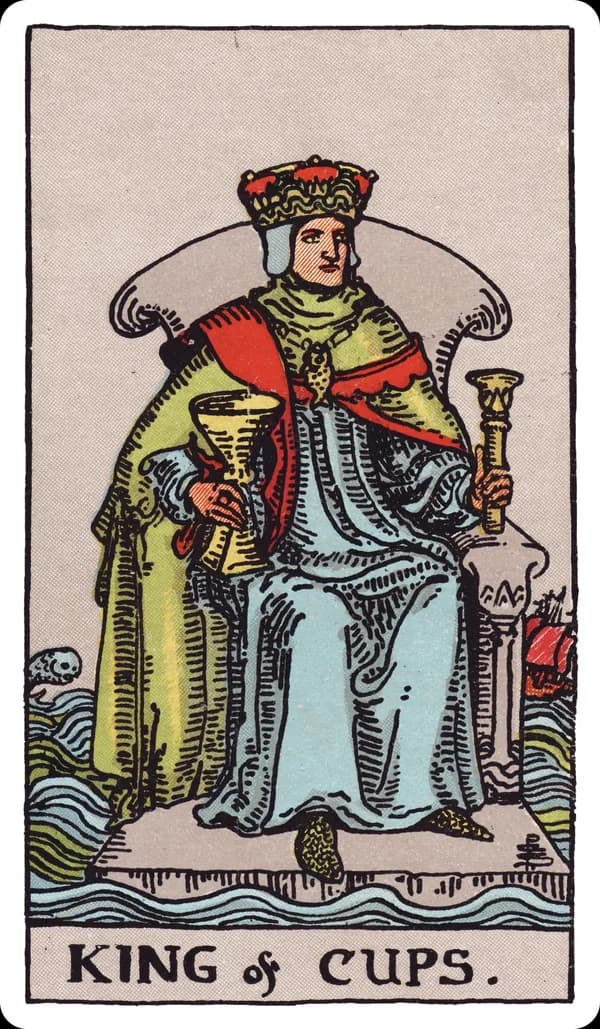
The King of Cups sits on a stone throne that, remarkably, appears to float directly on the open sea — no island, no shore, nothing solid beneath him but water itself, and yet his posture remains entirely composed. In one hand he holds a large golden cup, and in the other, a short scepter, the two symbols of his suit's emotional territory and his own authority held together without either one overwhelming the scene. Around his neck hangs a fish-shaped amulet, a smaller, more personal echo of the fish that appears throughout the suit's other cards, from the Page's surprised discovery to the leaping fish visible near the King's own throne. Behind him, the sea itself is far from calm: to one side, a ship tosses in choppy water, clearly struggling against the waves, while the King himself, seated on his impossible floating throne, remains entirely undisturbed by the same turbulent conditions. This contrast, chaos surrounding him, calm radiating from him, is the entire meaning of the card compressed into a single image.
- Element
- water
- Ruling planet / sign
- Water signs: Cancer–Scorpio–Pisces
- Suit
- cups
- Court rank
- king
Numerology: Kings are the court's fire-natured rank — the suit's energy fully mastered and directed outward with authority. As the King of Cups specifically, that outward mastery is paradoxical: fire ruling water, meaning emotional depth channeled into calm, deliberate command rather than let to overflow.
Upright Meaning
Upright, the King of Cups represents emotional mastery expressed through calm, wise authority — someone who has fully integrated deep feeling and steady leadership, remaining composed and diplomatic even amid genuine chaos or conflict around them. When the card is naming a specific person rather than a mood, picture someone emotionally intelligent, generous, and even-tempered, often a genuinely wise counselor, mentor, or leader whose calm presence helps steady others during turbulent times. Unlike the Queen of Cups' more inward, intuitive focus, the King's emotional mastery is directed outward, toward guiding, advising, and supporting others with real diplomatic skill. The card favors emotional self-regulation specifically — feeling deeply without being controlled by that feeling, and using genuine compassion as a tool for calm, effective leadership rather than letting emotion cloud judgment. In a reading about your own conduct, the King of Cups often encourages responding to a difficult or emotionally charged situation with steady, generous composure, staying grounded even when circumstances around you are genuinely turbulent, the same way the king's throne holds steady on an unsettled sea.
Reversed Meaning
Reversed, the King of Cups often describes emotional volatility beneath a controlled surface — someone whose apparent calm occasionally breaks into moodiness or unpredictable reactions, suggesting the composure isn't as fully mastered as it appears. It can also point to emotional manipulation specifically: using charm, guilt, or a calm, persuasive demeanor to control or influence others rather than to genuinely support them, a colder, more self-serving version of the upright card's diplomatic warmth. A second reversed reading describes someone who suppresses their own feelings so thoroughly that it eventually surfaces as coldness or emotional unavailability, rather than genuine, integrated calm — composure that's actually avoidance dressed up as strength. A third reading can point outward rather than inward: encountering someone else's emotional manipulation or moodiness, and needing to recognize and respond to that pattern rather than continuing to be swayed by it. Self-directed suppression, active manipulation of others, or genuine but occasional emotional volatility — the surrounding cards usually make clear which is actually happening.
Read the full reversed meaning →Symbolism
The King's floating throne is the card's central paradox and its clearest symbolic statement: unlike every other suit's king, who sits on solid, stable ground, this king's foundation is the very element his suit governs, at its most literally unstable and unpredictable. That he remains calm anyway is the whole point — this isn't emotional mastery achieved by avoiding turbulent feeling, it's mastery achieved by staying steady while fully immersed in it. The ship struggling in the background represents everyone still being tossed around by emotional circumstance, a visual contrast to the king's own composure; some readers note the ship specifically as a symbol of practical, worldly affairs continuing to churn even while an emotionally mature person maintains their own inner stability. The leaping fish near his throne, unlike the Page's captive fish inside a cup, moves freely through its own element, suggesting the king's relationship to intuition and feeling is neither contained nor controlling but genuinely at ease, allowed to move as it needs to. His amulet, a smaller fish worn close to his chest, suggests he carries this intuitive, emotional wisdom internally and personally, a private source of guidance rather than something performed outward for others to see. The scepter in his other hand balances the cup, showing that his emotional depth is fully integrated with real, active authority rather than existing instead of it.
The King of Cups from the Rider-Waite-Smith deck: a king sits on a stone throne that appears to float on a choppy open sea, holding a scepter and a large golden cup, a fish-shaped amulet around his neck; a ship tosses in rough water to one side, and a fish leaps from the waves to the other.
→ See what Water signs: Cancer–Scorpio–Pisces means in your horoscope on GetMyHoro
→ Find your own life-path number on NumberAngel
In Love
In a love reading, the King of Cups often describes a partner, or you, offering genuine emotional steadiness and wise, generous support within the relationship — someone who stays calm and diplomatic even during disagreements, and whose emotional maturity makes the relationship feel genuinely secure. For someone single, it can describe being drawn to, or ready for, a partner with real emotional depth and steadiness rather than intensity or drama, someone whose calm presence feels genuinely grounding. It's also a favorable card for handling relationship conflict with real maturity — staying composed and generous even when a disagreement gets heated, rather than escalating or withdrawing. Partnered, expect a relationship where emotional maturity on both sides creates real stability, weathering difficulties together without either person losing their footing. Reversed, the love reading points toward emotional volatility or manipulation — a partner, or you, whose calm exterior occasionally breaks into moodiness or unpredictable reactions, or using emotional persuasion to control rather than genuinely connect. It can also describe suppressing real feelings so thoroughly that a relationship starts to feel emotionally distant despite outward calm.
Read the full love meaning →In Career
At work, the King of Cups often describes calm, emotionally intelligent leadership — a manager or leader who navigates workplace conflict and pressure with genuine composure, diplomacy, and generosity, rather than reactive authority. It's a strong card for leadership roles specifically, where staying steady under pressure and supporting a team's emotional wellbeing are real, valuable skills rather than incidental traits. It can also describe successfully mediating a workplace conflict through calm, wise counsel rather than taking sides or escalating tension. It favors advisory, counseling, or senior leadership roles where emotional maturity and steady judgment matter as much as technical skill. Reversed, the career reading points to emotional manipulation in a professional context — a colleague or leader who uses charm or guilt to control team dynamics rather than genuinely support them, or workplace moodiness breaking through a normally composed professional presence. It can also describe suppressing real professional frustration so thoroughly that it eventually surfaces as coldness or unexpected volatility. Leading or navigating difficulty with genuine, not merely performed, emotional steadiness is what this card is really asking of you at work.
Read the full career meaning →Money & Health — Reflection Themes
Money: Calm, wise financial decision-making is this card's clearest money theme — managing money with steady judgment even during genuinely turbulent circumstances, or offering generous, well-considered financial support to others without letting emotion override sound judgment. It can describe genuine financial diplomacy: negotiating or handling shared financial matters, with a partner, family, or business, with real fairness and calm rather than reactive tension. It's worth reflecting on whether your financial decisions currently come from genuine, steady judgment or from anxiety dressed up as calm control. Financial manipulation — calm persuasion or guilt used to influence someone else's financial decisions for your own benefit — is worth naming directly if this card turns up reversed around money, alongside its subtler cousin: volatility that occasionally breaks through an otherwise composed financial exterior, worth admitting rather than continuing to perform control that doesn't match the reality underneath.
Health: Genuine emotional regulation supporting overall wellbeing is this card's characteristic health theme, taken as reflection rather than anything clinical — staying calm and steady even during a genuinely difficult health situation, or offering others, and yourself, real, generous support without being destabilized by the difficulty. It can describe a wise, calm approach to managing a health challenge, integrating emotional awareness with practical, level-headed action. Reversed, the card can flag suppressed feeling eventually surfacing as physical tension, coldness, or unexpected volatility, since composure that's actually avoidance tends to have a real cost over time. It can also describe emotional manipulation affecting your wellbeing, whether that's someone else using guilt or charm to influence your health decisions, or your own tendency to override genuine feelings with forced calm. No specific condition is the point here so much as checking honestly whether your composure is genuinely integrated or quietly costing you something underneath.
Spiritual Meaning
Spiritually, the King of Cups represents emotional wisdom fully matured and put into service of others — not feeling suppressed for the sake of appearing calm, but feeling fully integrated and used as a genuine source of guidance and steady presence. His floating throne suggests a spiritual mastery achieved specifically by remaining grounded within instability, rather than by avoiding or escaping turbulent circumstances altogether, a distinctly active, engaged kind of peace rather than a withdrawn one. He's often read as representing the mature, giving expression of emotional and intuitive wisdom, using deep feeling to genuinely serve and steady others rather than keeping it purely private, as the Queen of Cups' closed cup does. A stage where inner emotional work is ready to be offered outward — in service, counsel, or leadership, rather than staying a purely private practice — is often what this card marks in a personal-development reading.
Yes or No?
For yes/no questions, the King of Cups upright leans toward a confident 'yes,' particularly for questions about whether calm, wise judgment will prevail, or whether emotional maturity can be trusted to guide a difficult situation well. His steady presence amid genuine turbulence makes him a favorable card for questions asking whether stability is achievable even under pressure. Questions about whether a leader, partner, or advisor can be trusted to handle a difficult situation with genuine composure get an especially confident yes here, since calm, integrated authority is exactly this card's core territory. Reversed, that confidence gives way to a more cautious reading — 'the calm may not be as genuine as it looks' — the reversed card often suggests checking whether composure is masking real volatility or manipulation, either in yourself or in someone else central to the situation. If you draw this card reversed, a person's apparent steadiness is worth a second look — genuinely integrated, or a controlled performance covering something less trustworthy underneath.
Read the full yes-or-no breakdown →Frequently Asked Questions
Does the King of Cups represent a real person?
Frequently, yes — court cards regularly name a real person in a reading, and this one tends to describe someone emotionally mature, diplomatic, and genuinely calm under pressure, often a mentor, leader, or advisor whose steadiness others rely on.
Why does the King of Cups' throne float on water?
It's a deliberate contrast with the other three suits' kings, all seated on visible stone or land — this is the only throne in the court built entirely from the element it governs. Some readers also note that a floating seat, unlike a fixed one, moves with the water rather than resisting it, which fits a mastery based on flexibility rather than rigid control.
Is the King of Cups always a man?
Not necessarily — like all tarot court cards, the King of Cups can represent this energy in a person of any gender. What matters is the quality being described: calm, emotionally mature authority and diplomacy, not the literal gender of whoever it applies to.
How is the King of Cups different from the Queen of Cups?
The Queen's emotional mastery is primarily inward and intuitive, holding deep feeling privately and personally. The King's is primarily outward and applied, using that same emotional depth to guide, advise, and steady others through real, active leadership rather than mostly internal reflection.
Related Cards
Where King of Cups sits in the deck
Card correspondences sourced from the Hermetic Order of the Golden Dawn tradition — see our methodology.