Major Arcana · Major Arcana
The Hermit
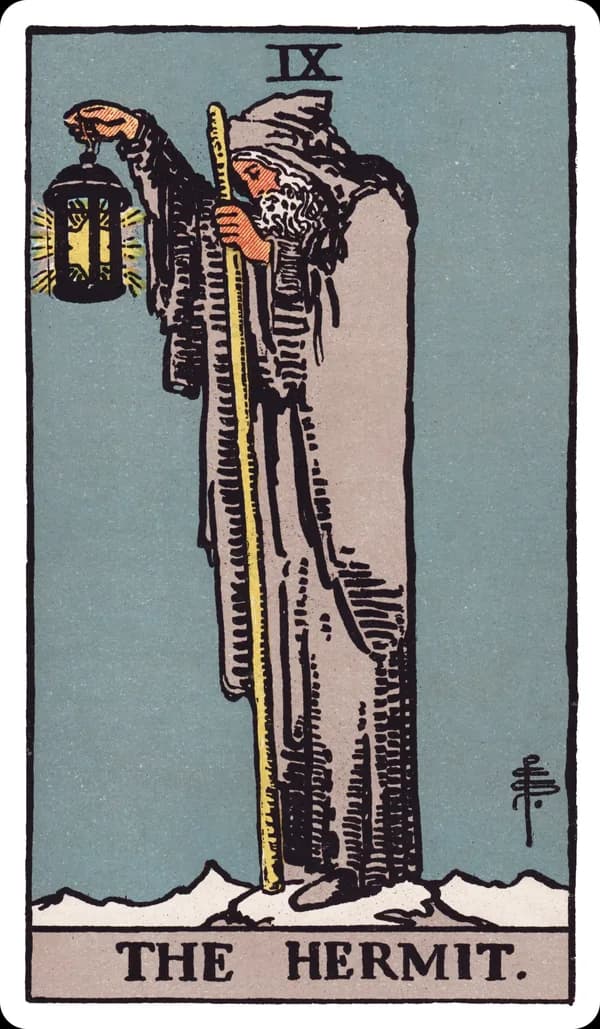
After Strength's calm mastery of the lion, the deck's traveler climbs alone to a mountain peak, and the company disappears entirely — the Hermit is the only figure in the Major Arcana standing in genuine solitude, with no companion, no crowd, no throne to sit on. He holds his lantern high, its light contained within a six-pointed star, and the direction of that light matters: he isn't looking outward at a grand vista, he's illuminating the ground just ahead and, by implication, the path for whoever might follow behind him. Numbered IX, the Hermit represents a deliberate withdrawal from the world in order to gain a clarity that simply isn't available amid noise and company — not permanent isolation, but a purposeful season of solitude undertaken in service of insight that will eventually be shared, the same way his lantern's light is held up rather than kept to himself.
- Element
- earth
- Ruling planet / sign
- Virgo
Numerology: Nine is the number of a cycle nearing its close — one short of the full ten-card arc that ends the Major Arcana's first complete sequence, a stage of solitary reflection before that closing. It's traditionally read as an introspective, wisdom-gathering number, the pause a cycle takes to consolidate what it's learned before moving toward completion.
Upright Meaning
Upright, the Hermit favors deliberate withdrawal in service of genuine insight — stepping back from noise, distraction, and other people's opinions in order to hear your own inner guidance clearly. This card often shows up when a situation calls for solitude rather than more input: taking real time alone to think something through, pausing a busy social or professional pace to reconnect with your own values and direction, or simply recognizing that the answer you need isn't going to come from another conversation but from quiet reflection. Ruled by Virgo, a sign associated with careful analysis and discernment, the Hermit's solitude isn't passive or aimless — it's precise, purposeful introspection aimed at genuinely understanding something rather than merely escaping. This card can also point toward seeking or becoming a mentor: the Hermit's lantern, held up rather than kept to himself, suggests that hard-won wisdom is meant to eventually guide others, even if it's gathered in solitude first. In a reading, the Hermit often suggests that the wisest move right now is less socializing, less input from outside voices, and more genuine time alone with your own thoughts before deciding anything significant.
Reversed Meaning
Reversed, the Hermit's purposeful solitude tips into isolation that no longer serves its original purpose. The most common reading is withdrawing too far — pulling away from people and support you actually need, staying alone past the point where solitude is genuinely helping and starting to compound loneliness instead of resolving it. A second reading is avoidance disguised as reflection: using isolation as an excuse not to face a difficult conversation, decision, or relationship, retreating from the world not to gain insight but simply to escape discomfort. A third reading points to loneliness that's become genuinely painful rather than chosen — circumstances (not deliberate choice) that have left someone more isolated than they want to be, unable to find the connection or support they're actually craving. This card reversed can also describe resisting the Hermit's natural invitation to reflect: staying too busy, too social, or too distracted to actually do the inward work a situation genuinely calls for. The clearest way through is naming plainly whether the real issue is isolation that's already gone too far, or a needed withdrawal being avoided altogether — the two point in opposite directions.
Read the full reversed meaning →Symbolism
The lantern's six-pointed star is widely read as the Seal of Solomon, a symbol historically associated with wisdom and, in some esoteric traditions, protection — its light is small and contained rather than blazing, suggesting the Hermit's insight is focused and hard-won rather than broad and effortless. The snowy, barren mountain peak he stands on strips away every comfort and distraction; there's no wheat field here, no garden, nothing but stone and snow, a setting built entirely for undistracted inward attention. His grey robe and grey beard mark old age and accumulated experience — unlike the youthful Fool at the start of the journey, the Hermit has already lived through the sequence's earlier lessons and now seeks something only solitude and long reflection can offer. His staff, a simple, sturdy walking aid rather than a weapon or scepter, marks him as someone still moving forward despite the isolation, not someone who has given up and stopped; the Hermit's withdrawal is active and purposeful, a journey undertaken alone rather than a retreat from journeying at all.
The Hermit from the Rider-Waite-Smith deck: an old, grey-bearded man in a hooded grey cloak stands alone on a snowy mountain peak, holding a lantern containing a six-pointed star high in one raised hand and a long wooden staff in the other, looking downward as if lighting the way for someone unseen behind him.
→ See what Virgo means in your horoscope on GetMyHoro
→ Find your own life-path number on NumberAngel
In Love
In love, the Hermit upright often signals a genuine need for space — either your own need to step back from dating or an active relationship in order to reconnect with your own priorities, or respecting a partner's need for solitude without reading it as rejection. For someone single, this card can favor a deliberate pause from actively dating: taking real time to understand your own patterns and desires before pursuing a new connection, rather than jumping into something out of loneliness or momentum. For someone partnered, the Hermit can point toward one or both people needing more individual space within the relationship — time apart that isn't a sign of trouble but a genuine, healthy need for solitude that, if respected, tends to strengthen rather than weaken the connection. Reversed, the caution shifts toward isolation that's damaging rather than restorative: withdrawing from a partner in a way that creates real distance and hurt, using solitude to avoid a conversation that actually needs to happen, or loneliness that's become genuinely painful rather than a chosen, temporary retreat. It can also describe a relationship suffering from too much distance, where withdrawal has gone on long enough that reconnecting now requires real, deliberate effort.
Read the full love meaning →In Career
At work, the Hermit favors focused, independent work over collaborative or highly social environments — deep, undistracted concentration on a project, research, or a problem that genuinely benefits from solitude rather than constant input and meetings. This card can point toward a career or role suited to independent expertise: research, writing, specialized technical work, or any field where working alone allows for the kind of careful, precise insight Virgo's rulership favors. It can also describe the value of stepping back from a fast-paced work environment to gain real perspective before making a career decision, rather than deciding reactively in the middle of the noise. As coworker or manager energy, the Hermit describes someone quiet, focused, and often deeply knowledgeable in their specific area — not naturally social at work, but genuinely valuable when their expertise is actually sought out. Reversed, the caution points toward professional isolation that's becoming counterproductive — withdrawing from a team or organization in a way that damages your visibility or working relationships, or avoiding a difficult professional conversation by simply disengaging rather than addressing it directly.
Read the full career meaning →Money & Health — Reflection Themes
Money: Virgo's careful eye shapes this card's approach to money: taking real, undistracted time alone to actually look closely at your finances rather than avoiding the topic or relying entirely on other people's opinions. This card suits deliberate financial planning done with genuine attention — stepping back from social spending pressure or market noise to think clearly about what actually fits your own situation, rather than a hurried or crowd-influenced decision. Reversed, two problems tend to hide behind the same card: avoiding your finances entirely because looking feels overwhelming, or isolating yourself with a money worry rather than seeking guidance that would genuinely help. A related pattern is one person in a relationship or family managing money entirely alone in a way that's become unhealthy rather than genuinely practical. Worth checking honestly whether solitude around money is currently clarifying anything, or has simply become a way to avoid the topic.
Health: This card favors genuine, undistracted attention to your own body and mind — real rest, deliberate time away from stimulation and social demands, or a practice like meditation or solo movement that benefits specifically from quiet rather than a group setting. It suits stepping back from a busy pace long enough to actually notice what you need, rather than staying too distracted to pay attention. Reversed, watch for isolation that's becoming harmful — withdrawing from support in a way that's worsening low mood or stress, or avoiding a needed conversation about your health because reaching out feels harder than staying quiet. A related pattern is burnout from struggling with something difficult entirely alone, without support that would genuinely help. Worth checking whether your current solitude is restoring you or slowly wearing you down.
Spiritual Meaning
The Hermit's lantern, small and focused rather than broad and blazing, holds a six-pointed star traditionally linked to hard-won wisdom — and he holds it up rather than keeping it to himself, suggesting his solitude was never meant to be the whole story. His withdrawal is purposeful: stepping away from the accumulated noise of other people's opinions and expectations specifically to hear his own inner voice clearly, then eventually lighting the way for whoever follows. As the ninth numbered trump, following Strength's compassionate mastery of a difficult inner force, he marks a quieter, more solitary stage of consolidating what's already been learned before the cycle closes at ten. Pulling this card tends to call for real time alone — stepping back from spiritual community or constant input long enough to actually integrate what you already know, trusting your own inner light over any outside voice right now.
Yes or No?
For yes/no questions, the Hermit is a genuinely uncertain card, and like the High Priestess, that uncertainty is the honest answer rather than an evasion. This card represents a genuine need for more time and reflection before a real answer can be reached — pulling it for a yes/no question often means the situation isn't ready to be decided yet, not because the facts are unclear, but because you personally haven't yet taken the quiet, undistracted time needed to know your own mind on the matter. Rushing to a decision now, before that reflection has happened, risks answering from outside pressure rather than genuine inner clarity. Reversed, the uncertainty sharpens into a caution about avoidance: the delay may not be genuine reflection so much as retreat from a decision that actually needs to be faced, in which case re-engaging with the question matters more than continuing to withdraw from it. Whether that's true usually comes down to whether the solitude feels genuinely restorative and clarifying, or feels like hiding from a decision you're not ready to face.
Read the full yes-or-no breakdown →Frequently Asked Questions
Does the Hermit mean I should be alone forever?
No — this card represents a purposeful, temporary season of solitude meant to bring clarity, not permanent isolation. Its whole symbolism (a lantern held up to light the way) suggests the insight gained alone is meant to eventually be shared, not kept in isolation indefinitely.
What's the difference between the Hermit and reversed Hermit isolation?
Upright, solitude is chosen and purposeful, actively serving genuine reflection and insight. Reversed, isolation has either gone on too long past the point of usefulness, become a form of avoidance rather than reflection, or turned into unwanted loneliness rather than a deliberate, restorative choice.
Is the Hermit a bad card to pull?
Not at all — it's often read as a genuinely wise, if quiet, card, favoring introspection and inner guidance over rushed decisions or outside noise. It only becomes cautionary reversed, where withdrawal tips into unhealthy isolation or avoidance.
Why does the Hermit carry a lantern with a six-pointed star?
Notice what he's NOT holding: no book, no staff-mounted banner, nothing that announces a fixed doctrine the way the Hierophant's triple-barred cross does. A small, contained light he carries and can angle at will suggests wisdom that's personally tested and portable, not a fixed system handed down through an institution.
Related Cards
Where The Hermit sits in the deck
Card correspondences sourced from the Hermetic Order of the Golden Dawn tradition — see our methodology.