Major Arcana · Major Arcana
The Chariot
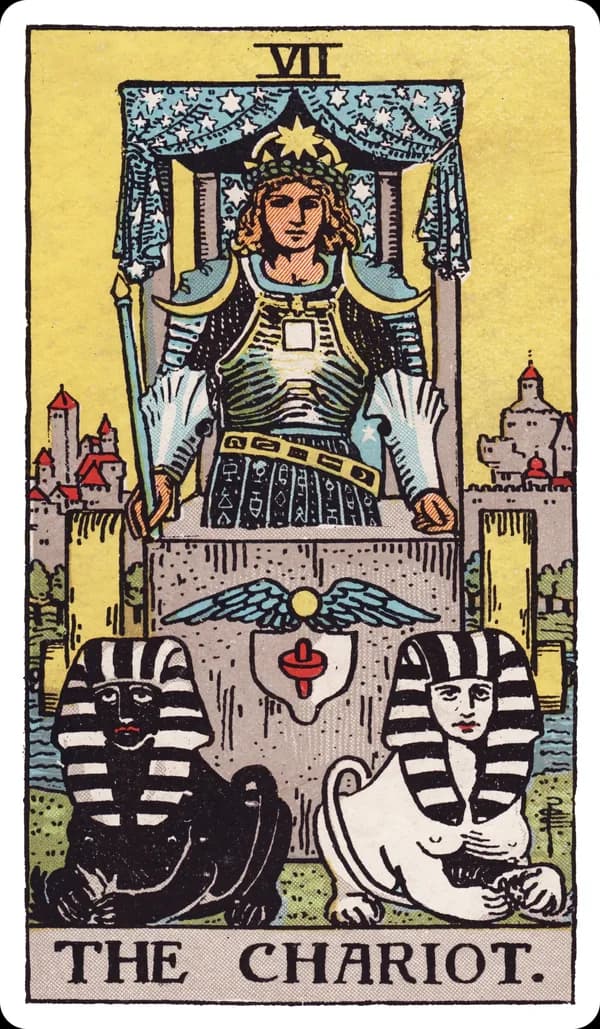
The Chariot's central puzzle is right there in the artwork: the armored figure holding the reins isn't actually holding any reins at all. Two sphinxes, one black and one white, sit harnessed to his chariot, and he controls them entirely through will and presence rather than physical restraint — a detail tarot readers have long treated as the card's whole argument about the nature of willpower. Numbered VII, right after the Lovers' careful, values-tested choice, the Chariot represents that choice finally put into forceful motion: not gentle persuasion, but determined, sustained effort aimed at a clear goal, holding opposing forces (the sphinxes) together through sheer directed will rather than by eliminating the tension between them. His breastplate carries a square symbol, often read as an alchemical mark of the material world he's actively moving through and mastering, and crescent moons rest on each of his shoulders, a small but consistent detail linking him to his ruling sign Cancer despite his outward posture of forceful command.
- Element
- water
- Ruling planet / sign
- Cancer
Numerology: Seven is the number of a single, willful push forward — a break from six's settled harmony into active, directed effort. In most numerology traditions seven carries a restless, striving quality, and here it marks the moment the Lovers' internal alignment gets tested against real external resistance and has to be driven through rather than simply felt.
Upright Meaning
Determined, willpower-driven success is where the Chariot speaks most clearly upright — achieving a goal through sustained effort, focus, and the ability to hold competing pressures in check without letting either one derail you. It favors decisive forward motion: pushing through obstacles rather than waiting for them to clear, and trusting your own resolve to keep two opposing forces (competing priorities, competing people, competing parts of a project) moving in the same direction. This card is strongly associated with victory achieved through control rather than luck — a hard-won success that comes from genuinely mastering a difficult situation, not from things simply falling into place. Unlike the Emperor's established, maintained authority, the Chariot's power is kinetic and situational: it's about winning a specific battle or reaching a specific destination through focused will, not about building a lasting structure. In a reading, the Chariot often shows up when someone has what it takes to succeed but needs to actually commit to the effort — travel, a competitive pursuit, a major push toward a goal that requires real, sustained determination rather than passive hope.
Reversed Meaning
Reversed, the Chariot's forward momentum stalls or scatters. The most common reading is a genuine lack of direction: energy and effort without a clear target, motion for its own sake rather than progress toward something specific, often because competing priorities are pulling in different directions and none has been chosen as the actual focus. A second reading is aggression: force used without the discipline that made the upright card's control possible, pushing too hard, running over other people's needs or boundaries in pursuit of a goal, or losing your temper when patience or diplomacy would have served better. A third, closely related reading is literally being pulled in two directions — like the sphinxes without a strong enough charioteer holding them together, competing obligations, relationships, or ambitions that are genuinely in conflict and haven't been reconciled or prioritized. This card can also point to a loss of confidence specifically: doubting your own ability to control a difficult situation, which then becomes a self-fulfilling problem as the sphinxes sense the weakened will and pull apart. Whichever pattern fits, ask plainly whether the issue is too little direction, too much unchecked force, or a genuine internal conflict that's gone unresolved — each points to a different fix.
Read the full reversed meaning →Symbolism
The two sphinxes, one black and one white, are the card's central visual tension: they represent opposing forces — light and dark, active and passive, or simply two competing impulses — that the charioteer must hold together and direct toward the same goal without either one dominating or bolting free. That he controls them without reins is deliberately significant; this isn't a card about external control mechanisms, it's about internal discipline and force of personality strong enough that opposing energies fall in line through sheer conviction rather than restraint. The starry canopy above him links him to the cosmos and to Cancer, his ruling sign, an unexpected pairing for such an outwardly assertive card — Cancer's nurturing, protective water energy is present here not as gentleness but as the deep emotional conviction fueling his drive, a reminder that the Chariot's forcefulness is rarely random ambition but usually protective of something (a home, a goal, a person) the charioteer genuinely cares about. The walled city receding behind him marks a departure already accomplished — he has left the structured world of the Emperor and Hierophant behind and is moving forward into open, unmapped territory, driven by will rather than following an established road.
The Chariot from the Rider-Waite-Smith deck: an armored figure stands within an open stone chariot beneath a canopy of stars, crescent moons on each shoulder, holding a wand rather than reins, drawn by two sphinxes — one black, one white — seated at rest before him, with a walled city visible in the background.
→ See what Cancer means in your horoscope on GetMyHoro
→ Find your own life-path number on NumberAngel
In Love
In love, the Chariot upright often describes actively pursuing a relationship or pushing through a real obstacle to make it work — long-distance logistics, a busy period both people are determined to get through together, or simply the sustained effort of making a relationship a genuine priority rather than letting it drift. For someone single, this card can favor decisive action: pursuing someone you're genuinely interested in with real focus rather than passive hoping, or actively working toward the kind of relationship you want rather than waiting for it to appear. For someone partnered, it can point to a couple determinedly working through a specific challenge together — moving, a career change, a family transition — where success depends on both people staying focused on the same goal despite real pressure pulling them in different directions. Reversed, the caution shifts toward conflict or scattered energy: a relationship strained by competing priorities that haven't been reconciled, one partner pushing too hard or too aggressively to get their way, or a connection that's lost momentum because neither person has clearly committed to moving it forward. It can also describe genuinely being torn between two romantic options or between a relationship and another major life priority, without yet having chosen a clear direction.
Read the full love meaning →In Career
At work, the Chariot is one of the strongest cards for achieving a goal through sheer determined effort — pushing a project across the finish line, winning a competitive opportunity, or succeeding in a high-pressure situation through focus and sustained will rather than ease or luck. It favors decisive, forward-driving leadership: taking clear control of a difficult situation and directing competing priorities or team members toward a single shared goal, the way the charioteer holds his two sphinxes moving in the same direction. This card suits competitive fields specifically, sales, athletics, entrepreneurship, or any high-stakes pursuit where victory goes to whoever commits fully and doesn't waver under pressure. As coworker or manager energy, the Chariot describes someone driven and focused, often a strong closer or a team leader who thrives specifically under deadline pressure. Reversed, the caution points toward scattered effort — working hard without a clear direction, or a project pulled apart by competing priorities that were never actually reconciled into a single focus. It can also describe aggressive or overbearing behavior at work, pushing a team or a plan too hard without the discipline that makes forceful leadership actually effective rather than merely exhausting.
Read the full career meaning →Money & Health — Reflection Themes
Money: Cancer's protective instinct shows up here as financial effort aimed at defending something specific — a home, a family's stability, a defined goal — rather than accumulation for its own sake. This card favors a determined push toward one clear financial target: paying down a specific debt with real focus, or working steadily toward a defined milestone, more than a passive drift toward vague future security. Reversed, watch for financial effort scattered across too many goals at once, no single priority actually chosen, or decisions driven by impulsive urgency rather than sustained control. A related pattern is being pulled between two competing financial obligations without having clearly decided which one actually comes first right now. Worth naming the one goal you're actually driving toward before spreading effort any further.
Health: This card favors training for something specific, pushing through a plateau with real focus, or finally committing fully to a goal you've circled without ever fully starting. It rewards sustained, willpower-driven discipline more than gentle, gradual change — a genuine push toward a defined target rather than an open-ended intention. Reversed, watch for burnout from pushing too hard without adequate rest, or the opposite — scattered effort across multiple goals at once that undermines progress on all of them. It can also point to a loss of direction in a routine that used to have real momentum, energy without anywhere clear to go. Worth checking honestly which of those two patterns actually describes where you are right now.
Spiritual Meaning
This card's charioteer holds two opposing forces — his black and white sphinxes — together through will alone, no reins in sight, which makes him the deck's clearest image of spiritual discipline as active effort rather than passive receptivity. Where the High Priestess counsels stillness and the Empress counsels organic growth, this card represents deliberately mastering competing inner forces — doubt and conviction, fear and courage — by holding them together and moving forward rather than letting either one win outright. As the seventh numbered trump, following the Lovers' internal alignment, it marks the moment that alignment has to be carried forward against real resistance rather than simply felt. Pulling this card tends to call for genuine, sustained commitment to a path — not just believing in a direction, but actually driving toward it.
Yes or No?
For yes/no questions, the Chariot is a confident 'yes' — specifically a yes earned through determined, sustained effort rather than one that arrives easily. This card affirms that success is achievable, but only with real, focused commitment behind it; it's less a promise of an easy outcome and more a confirmation that you have what it takes to push through and win, provided you actually apply that willpower. It's a particularly strong yes for competitive situations, travel, or any goal that requires holding steady focus against real resistance. Reversed, the answer weakens into genuine caution: either the direction hasn't been clearly chosen yet (competing priorities are pulling in different directions), or the approach has tipped into force without the discipline that makes it effective, which leaves the honest answer at 'not yet — direction and discipline both need to be in place first.' There, clarifying which single goal you're actually driving toward matters more than applying still more effort in an unclear direction.
Read the full yes-or-no breakdown →Frequently Asked Questions
Why does the Chariot control his sphinxes without reins?
It's traditionally read as the card's central point about willpower: real control here comes from internal discipline and force of conviction, not external restraint. The charioteer holds two opposing forces together through sheer will, which is precisely what the card's core meaning is about.
What's the difference between the Chariot and Strength?
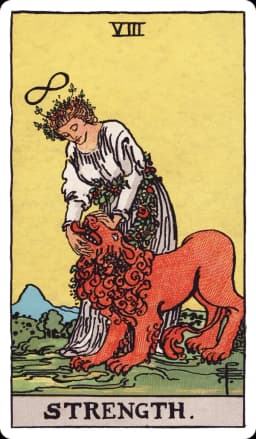
Both involve mastering opposing or difficult forces, but the Chariot's power is outward, forceful, and goal-directed — winning through active push and control. Strength's power is inward, patient, and gentle — mastering a difficult force (traditionally shown as a lion) through calm, sustained resolve rather than force.
Is the Chariot a good card for travel?
Yes — it's traditionally strongly associated with journeys, particularly ones requiring determined effort or a clear destination, and many readers pull it as a favorable sign for travel plans specifically, especially ones tied to a real goal rather than pure leisure.
What does reversed Chariot mean about aggression?
It can point to force used without the discipline that makes it effective — pushing too hard, losing patience, or running over other people's needs in pursuit of a goal. It's a caution about willpower turning into recklessness rather than staying controlled and directed.
Related Cards
Where The Chariot sits in the deck
- Seven of WandsThe Wands card numbered 7
- Seven of CupsThe Cups card numbered 7
- Seven of SwordsThe Swords card numbered 7
- Seven of PentaclesThe Pentacles card numbered 7
- The TowerReduces to the same root number (7)
- The High PriestessAlso water — Moon
- The Hanged ManAlso water, among the Major Arcana
- DeathAlso water — Scorpio
Card correspondences sourced from the Hermetic Order of the Golden Dawn tradition — see our methodology.