Minor Arcana · Wands
Seven of Wands
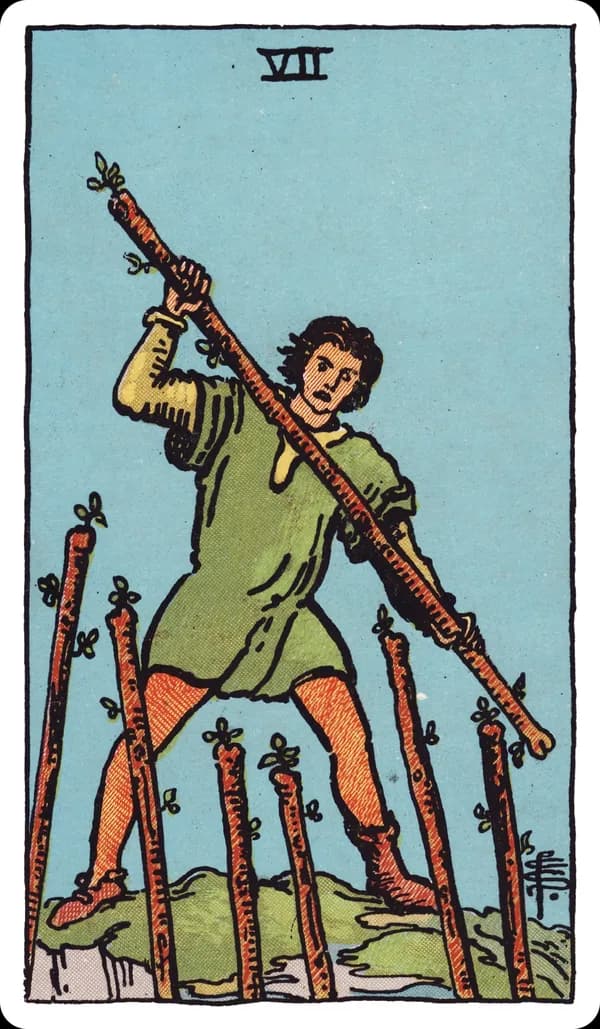
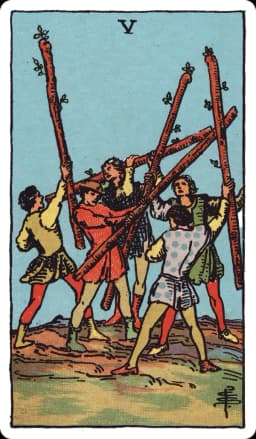
Barely a card after the crowd celebrated the Six of Wands' rider, the Seven of Wands puts a lone figure back on unstable footing, defending a position rather than parading through one. A young man stands above a cluster of wands jabbing up at him from below, his own wand raised and swinging down in response, his stance wide and his weight braced against uneven, rocky ground. His mismatched footwear, one boot notably different from the other, is a small but often-noted detail: he wasn't dressed for a formal fight, he's simply defending what's his with whatever he had on when the challenge arrived. Unlike the Five of Wands' scattered, multi-directional scuffle, this fight has a clear shape: six wands against one, all the pressure coming from below and around him, and one person holding a specific piece of high ground against it. The card doesn't show whether he wins. What it shows is someone who hasn't backed down yet, mid-effort, mid-defense, committed to the position he's already claimed rather than the position he's still trying to reach.
- Element
- fire
- Ruling planet / sign
- Mars in Leo
- Suit
- wands
Numerology: Golden Dawn title "Lord of Valour" — the Mars-in-Leo decan puts Mars' combative drive behind Leo's pride and sense of rightful place, which is exactly what this card's lone defender is fighting to protect. Sevens across the deck introduce a test of what's been built so far; here the test is a direct challenge to a position already won.
Upright Meaning
Upright, the Seven of Wands describes active, effortful defense of a position, an opinion, a boundary, an achievement, that's genuinely worth protecting, even though protecting it takes real, sustained effort. It favors persistence and conviction: standing firm on something you believe in or have earned, even against real pushback from multiple directions at once. This card often shows up when success itself has drawn challenge, being questioned, imitated, or opposed precisely because you've achieved something others want or resent, a dynamic that follows naturally from the Six of Wands' public victory just before it in the suit's sequence. It rewards confidence grounded in the fact that you're on genuinely solid, elevated ground, even if that ground is uneven and effortful to hold. Unlike the earlier Five of Wands' disorganized, multi-party friction, this card's conflict has real clarity: you know what you're defending and why, even if the number of people or forces pushing against it feels like more than you bargained for. Compared with the aggressive, forward motion of the Knight of Wands, this card's energy is defensive rather than offensive, holding rather than advancing.
Reversed Meaning
Reversed, the Seven of Wands most often describes exhaustion from sustained defense, being worn down by having to justify or protect a position for so long that the effort itself starts to outweigh what's being protected. It can point to genuinely giving up ground that was worth holding, backing down from a boundary, an opinion, or a position out of sheer fatigue rather than a change of mind. It can also describe feeling overwhelmed by the sheer number of challenges coming at once, six wands genuinely can feel like too many, especially without support, and this reversed reading takes that overwhelm seriously rather than treating it as simple weakness. A different reversed reading involves a fight that was never actually necessary: defending a position so reflexively that you miss when a genuine compromise or a strategic retreat would actually serve you better than continued resistance. What matters is whether the position being defended is still genuinely worth the cost of defending it, worn down but still worth holding points toward the first reading, while defended out of stubbornness alone points toward the second.
Read the full reversed meaning →Symbolism
The elevation itself is doing real work in this image: unlike the crowd-level scenes of the Four and Six of Wands, this figure stands above his opponents, on rocky, uneven ground that's harder to hold than flat terrain but also harder to take from him. That height advantage matters for how the card is traditionally read — he isn't fighting from a position of weakness, he's fighting from a position worth defending, which is a meaningfully different situation than an even contest. The six wands attacking from below, compared with his single wand held above, is sometimes read less as literal outnumbering and more as the sheer number of small challenges, doubts, or competitors that tend to surround any position worth having: success invites scrutiny and challenge almost by default. His mismatched boots suggest he was caught mid-routine, going about ordinary business, when the challenge arrived, which reframes the whole scene slightly: this isn't a battle anyone planned for or trained specifically toward, it's the ordinary, unglamorous work of holding ground once you already have it, using whatever you happen to have on hand.
The Seven of Wands from the Rider-Waite-Smith deck: a young man stands on uneven, elevated rocky ground gripping a wand and swinging it down defensively at six other wands jabbing up at him from below, one of his boots mismatched with the other.
→ See what Mars in Leo means in your horoscope on GetMyHoro
→ Find your own life-path number on NumberAngel
In Love
In a love reading, the Seven of Wands can describe defending a relationship against outside pressure or doubt, family disapproval, friends' skepticism, or simply the ordinary friction of building something real while other people have opinions about it. It favors standing firmly behind a relationship or a boundary you believe in, even when that means pushing back against people who question it. It can also describe defending your own worth or standards in dating, holding out for what you actually want rather than lowering your expectations just to avoid further conflict or rejection. For someone already partnered, it can describe protecting the relationship's boundaries against a specific outside challenge, an ex reappearing, a meddling family member, a rival for one partner's attention, that needs to be met directly rather than ignored. Reversed, the love reading points to exhaustion from constantly having to defend a relationship or a boundary, wearing down under repeated pressure until you're tempted to give up ground you genuinely didn't want to concede. It can also describe defending a relationship reflexively, out of stubbornness or pride, past the point where honest reflection would suggest it's actually still worth the fight.
Read the full love meaning →In Career
At work, the Seven of Wands frequently describes defending your position, your ideas, or your territory against real challenge, competitors for your role, colleagues pushing back on your approach, or a market position being contested by newer entrants. It favors holding firm on something you've genuinely earned or built, backed by real conviction rather than simple stubbornness, and it often follows recent success (echoing the Six of Wands) with the ordinary, less glamorous work of protecting that success once it's drawn attention and competition. This card can also describe being the established figure that newer or hungrier competitors are actively trying to unseat, a position that requires real, sustained effort to maintain even after the initial achievement is behind you. Reversed, the career reading points to burnout from constant defense, being worn down by repeatedly justifying your role, your ideas, or your position until the effort of defending starts to cost more than the position itself is worth. It can also describe caving to pressure you didn't need to cave to, or, conversely, digging in on a professional stance that a more honest look would suggest is no longer worth the fight.
Read the full career meaning →Money & Health — Reflection Themes
Money: Defending a financial position against real pressure, holding firm on a price, a negotiation, or a financial boundary while multiple parties push back at once, is this card's clearest money-focused reading. It favors conviction backed by real preparation: knowing your position is sound and defending it accordingly, rather than caving simply because the pushback feels uncomfortable. It can also describe protecting existing financial gains from new competition or risk, a business position, an investment, a market share that other people are actively trying to take from you. Reversed, it can point to financial exhaustion from constantly defending a budget, a boundary, or a position, wearing down until you concede ground (a bad deal accepted, a boundary dropped) you genuinely didn't want to give up. It can also describe holding a financial position purely out of stubbornness past the point where a clear-eyed look would suggest renegotiating or letting go actually serves you better. Either way, this card rewards checking honestly whether what you're defending is still worth the real effort defending it currently costs.
Health: Sustained effort to protect your own wellbeing against competing demands is where the Seven of Wands most often lands in a health-adjacent reading, holding firm on boundaries around rest, food, or self-care even when work, family, or other obligations keep pushing against them. It favors persistence: continuing to defend a healthy routine or boundary even when it feels like everyone and everything around you is working against it. It can also describe recovering or maintaining ground already gained, a fitness level, a mental health boundary, that takes ongoing, active maintenance rather than one-time effort to actually hold. Reversed, the same card can point to genuine exhaustion from that sustained defense, burning out from constantly protecting a boundary until you finally give it up, skipping the routine, dropping the boundary, simply out of fatigue. It can also describe defending a health habit or belief long past the point where it's actually still serving you, worth an honest look at whether continued resistance to change is protecting something valuable or just protecting familiar habit. This card carries no link to a specific condition; its subject is sustained defense and its real cost.
Spiritual Meaning
A single figure holding uneven ground against six directions of pressure is a genuinely useful spiritual image for the ordinary, unglamorous work of maintaining a belief, a practice, or a boundary once other people start questioning it. Drawn for a spiritual question, the Seven of Wands often marks a stretch where your own convictions, a practice, a value, a sense of what actually matters to you, are being tested by outside skepticism or competing views, and the real work is holding your ground with genuine confidence rather than either capitulating just to avoid friction or digging in purely out of ego. It can also describe the specific spiritual challenge of staying grounded once other people start paying attention to your growth, fielding doubt, envy, or well-meaning but unwelcome advice from people who haven't walked the same path. There's a real lesson in the figure's imperfect readiness, mismatched boots and all: spiritual conviction doesn't require perfect preparation, it requires actually standing your ground with what you have when the moment to defend it arrives. Whether upright or reversed, the underlying question is the same: is what you're defending still genuinely worth the sustained effort of defending it?
Yes or No?
The Seven of Wands leans toward 'yes,' but a conditional, effortful one: the position you're asking about can hold, provided you're genuinely willing to defend it against real pushback rather than expecting an easy, uncontested outcome. It answers questions about whether you can maintain a position, a boundary, or an advantage with real confidence, as long as the underlying position is actually sound to begin with, since this card describes successful defense of solid ground, not a guaranteed win regardless of the position's merits. It's a less confident fit for questions about starting something entirely uncontested, since its whole premise involves resistance already present and needing to be met. Reversed, the yes weakens toward 'possibly, but you may be too worn down to hold it much longer without support' — the underlying position often remains defensible in principle, but the reversed card is honest that sustained pressure has a real cost, and continuing to defend alone, without reinforcement or rest, isn't free. If the reversed reading feels discouraging, it's worth asking directly whether the fight is still worth having, or whether a strategic step back would actually serve you better than continued resistance.
Read the full yes-or-no breakdown →Frequently Asked Questions
Why does the man in this card have mismatched boots?
The mismatched footwear suggests he was caught in the middle of ordinary activity when the challenge arrived, not specially prepared or dressed for a formal fight. It reframes the scene as the ordinary, unglamorous work of defending an existing position rather than a planned, dramatic battle.
Is the Seven of Wands a good card to draw?
It's generally favorable, since it describes successfully defending something genuinely worth protecting, though it's an effortful card rather than an easy one. The pressure it depicts is real, and the card rewards persistence and conviction rather than promising an uncontested win.
What's the difference between the Seven of Wands and the Five of Wands?
The Five of Wands shows scattered, multi-party friction with no clear side or leader. The Seven of Wands shows a clear, single defender holding a specific position against pressure from multiple directions, a more focused and purposeful kind of conflict than the Five's disorganized scuffle.
Does the Seven of Wands mean I'm being attacked by enemies?
Not necessarily literally — the pressure it describes is often competitive or circumstantial rather than personal hostility, competitors, skeptics, or simply the ordinary scrutiny that follows success. It's worth reading the specific context of your question rather than assuming outright enmity.
Related Cards
Where Seven of Wands sits in the deck
Card correspondences sourced from the Hermetic Order of the Golden Dawn tradition — see our methodology.