Minor Arcana · Cups
Seven of Cups
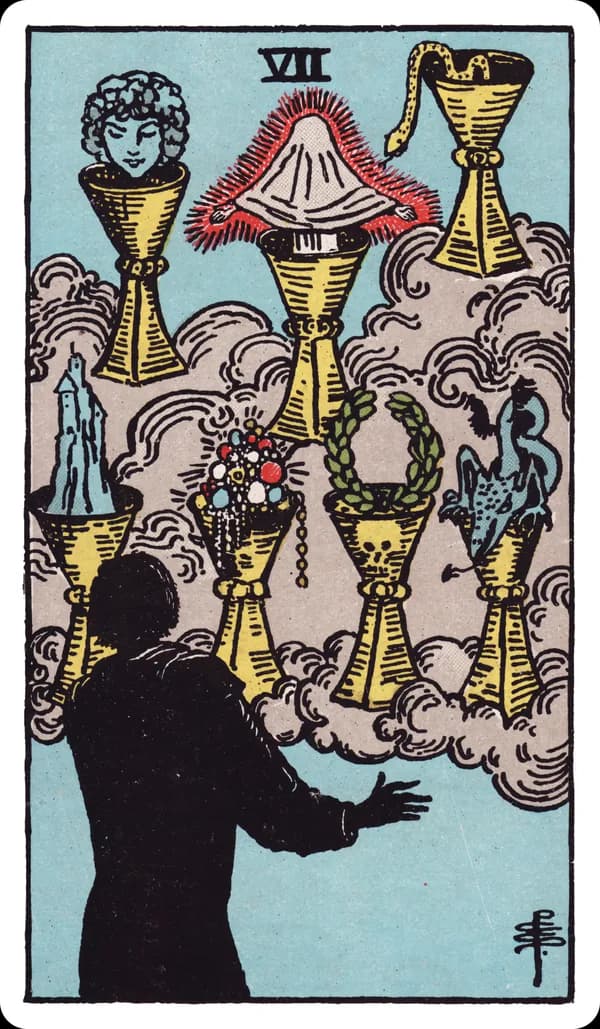
A figure stands in silhouette, back to the viewer, facing seven cups suspended in clouds at eye level — and each cup holds something different: a pale, glowing face; a figure wrapped in a shroud; a snake coiling in on itself; a fortified castle on a hill; a pile of jewels; a wreath of laurel, the traditional mark of victory; and a strange, dragon-like creature. None of these visions is grounded in anything solid — the whole array floats in mist, without a single cup resting on the ground or in a hand. The figure's posture, arms slightly raised, suggests the moment just before a choice, caught between seven radically different possible futures rather than committed to any one of them yet. Unlike the Two of Cups' clear, direct exchange between two grounded figures, or the Ace's single overflowing gift, the Seven of Cups presents abundance without clarity — plenty to choose from, but nothing solid enough yet to actually hold onto.
- Element
- water
- Ruling planet / sign
- Venus in Scorpio
- Suit
- cups
Numerology: Seven interrupts the suit's steady progression with a distinctly mental challenge — where the Fours through Sixes dealt in feeling, Seven asks the water element to reckon with imagination and discernment. The Golden Dawn's title for this decan, "Lord of Illusionary Success," pairs Venus's gift for allure with Scorpio's taste for intensity, describing a glittering array of options that may promise more than any one of them can actually deliver.
Upright Meaning
Upright, the Seven of Cups describes a moment thick with options but thin on clarity — daydreaming, brainstorming, or genuinely weighing several different paths without yet having committed to testing any of them against reality. It's a card that takes imagination seriously as a real and valuable stage of decision-making, not a wasted one, but it also carries a built-in caution: some of what looks appealing in this stage is illusion, exaggerated by wishful thinking rather than accurately assessed. The card frequently shows up during a period of genuine possibility — multiple paths, offers, or directions genuinely available — paired with a warning not to mistake the excitement of possibility itself for an actual plan. In a reading about a decision, the Seven of Cups often suggests slowing down before committing, since the sheer number of appealing options can itself become a kind of paralysis, or worse, a path chosen for its glamour rather than its substance. Distinguishing which of the seven visions represents a genuine opportunity, and which is closer to the dragon hidden among more attractive choices, is usually the card's real, unstated challenge.
Reversed Meaning
Reversed, the Seven of Cups typically describes clarity finally cutting through the fog — narrowing a wide field of options down to one genuine choice, or seeing through an illusion that had previously looked more appealing than it actually was. It's often a relief-bringing reversal: the paralysis of too many options resolving into an actual decision, made with clearer eyes than the upright card's dreamier state allowed. A second reversed reading describes the opposite outcome: choosing based on illusion anyway, despite having had the chance to see more clearly, or continuing to chase an appealing fantasy after it's already become apparent that it doesn't hold up under scrutiny. A third, related reading involves disillusionment specifically — the discomfort of realizing a previously exciting option was never as solid as it looked, which is painful in the moment but is also, functionally, the clarity the reversed card describes arriving in a harder form. Whether a genuine decision has actually been made, or the same fog is simply persisting in a different shape, is usually visible in the cards drawn alongside it.
Read the full reversed meaning →Symbolism
Each of the seven visions carries its own traditional shorthand, though tarot commentators have varied somewhat in exactly how they interpret a few of them. The glowing face is usually read as vanity or a beloved person, idealized rather than real. The shrouded, veiled figure suggests something hidden or a mystery not yet revealed — sometimes read as death or the unknown, sometimes simply as secrecy. The snake represents temptation or danger disguised as opportunity, echoing serpent imagery's long association with deception across many traditions. The castle stands for ambition and material security, a goal that looks solid from a distance despite being made of the same insubstantial cloud as everything else in the scene. The jewels represent wealth and material gain, appealing but shallow if pursued for its own sake. The laurel wreath signals achievement and victory, the kind of external success that can look identical to genuine fulfillment without necessarily being the same thing. The dragon-like creature is the array's most overtly threatening image, usually read as a real danger disguised among the more attractive options, a warning that not every option here is actually worth choosing even though all seven are presented with equal visual weight. The card's real subject isn't any single vision — it's the fog surrounding all seven of them equally, and the risk of mistaking imagination, however vivid, for something you can actually build a life on before doing the work of testing it against reality.
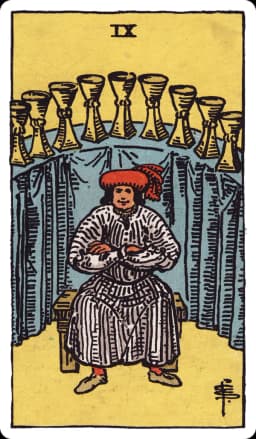
The Seven of Cups from the Rider-Waite-Smith deck: a silhouetted figure stands before seven cups floating within clouds, each holding a different vision — a shrouded figure, a snake, a castle, jewels, a laurel wreath, a dragon-like creature, and a glowing face.
→ See what Venus in Scorpio means in your horoscope on GetMyHoro
→ Find your own life-path number on NumberAngel
In Love
In a love reading, the Seven of Cups often points to romantic options or fantasies that haven't yet been tested against reality — multiple people you're interested in without having committed to pursuing any of them seriously, or an idealized version of someone you barely know standing in for who they actually are. For someone single, it can describe the appeal of dating app abundance specifically: plenty of options creating a strange kind of paralysis rather than clarity, or falling for a curated, idealized image rather than a real, known person. For someone partnered, it can point to comparing your actual relationship against a fantasy — an idealized alternative, a version of romance seen in media, or a nostalgic memory of an earlier relationship — in a way that's unfair to the real relationship you're actually in. Reversed, the love reading shifts toward clarity: finally choosing one genuine option instead of endlessly weighing several, or seeing through a romantic illusion that had been more appealing in imagination than it would be in practice. It can also describe disillusionment about a specific person or relationship, painful but ultimately clarifying.
Read the full love meaning →In Career
At work, the Seven of Cups often describes a stage of brainstorming or considering multiple career paths without yet having committed to testing any of them seriously — several job offers, business ideas, or directions that all look appealing from a distance, without a clear sense yet of which is actually solid. It can point to the excitement of possibility itself becoming distracting, spending more energy imagining different futures than doing the concrete work needed to pursue any one of them. It's also a fitting card for creative work involving genuine imagination, provided that imaginative stage eventually gets tested against practical reality rather than staying purely hypothetical. Reversed, the career reading shifts toward decisiveness: finally choosing one specific direction after a period of scattered consideration, or seeing clearly that a previously appealing opportunity doesn't actually hold up once examined closely. It can also describe disillusionment with a job or path that looked more impressive from the outside than it turned out to be in practice. Testing appealing options against real evidence, before committing serious time or resources to any one of them, is the discipline this card is quietly recommending.
Read the full career meaning →Money & Health — Reflection Themes
Money: Financial fantasy is this card's clearest money theme — daydreaming about wealth, an investment that promises more than it can likely deliver, or spending decisions driven more by an appealing image than a realistic plan. It can describe genuinely having multiple financial options available, which is a good problem to have, paired with a caution against choosing based on which option sounds most exciting rather than which one is actually sound. It's worth checking whether a specific financial opportunity you're drawn to has been examined closely, or whether its appeal is still mostly imaginative. Financial clarity finally arriving is the more hopeful side of this card's reversal — recognizing which option is genuinely solid versus which was mostly illusion, and making a grounded decision after a period of scattered daydreaming. It can also describe the discomfort of realizing a financial opportunity you'd been excited about doesn't actually hold up under scrutiny.
Health: Being drawn to several different wellness approaches at once, without committing seriously to any of them, is this card's clearest health theme, worth holding as reflection rather than diagnosis — or chasing an idealized image of health rather than a realistic, sustainable one. It can also point to the value of genuine imagination in healing or motivation — picturing a healthier version of yourself as a real, useful first step, provided it eventually translates into concrete action. Reversed, the card can describe finally choosing a specific, realistic health approach after a period of scattered consideration, or seeing clearly that a particular wellness trend or promise doesn't actually hold up the way it initially seemed to. It can also point to disillusionment with an approach that looked appealing but wasn't grounded in anything sustainable. Rather than any specific condition, what actually matters here is testing appealing ideas against realistic follow-through before investing further in them.
Spiritual Meaning
Spiritually, the Seven of Cups represents the necessary but sometimes misleading role imagination plays in any genuine spiritual search — the idea that envisioning many possible paths is a real and valuable stage, but that not every vision that appears compelling is actually true or worth following. The card's array of symbols, some genuinely valuable, some outright dangerous, mirrors the real spiritual challenge of discernment: learning to tell a genuine insight from an appealing illusion, since both can arrive with the same emotional intensity. It can mark a period of genuine spiritual exploration, trying on different practices, teachers, or belief systems, paired with a caution against mistaking novelty or glamour for actual depth. Testing an appealing spiritual path against real, sustained practice, rather than staying permanently in the imaginative stage its floating cups depict, is the growth this card tends to point toward when it turns up in a personal-development reading.
Yes or No?
For yes/no questions, the Seven of Cups upright leans toward a genuine 'maybe' — not evasive, but honest: the situation currently involves too many unresolved options or too much untested fantasy for a confident answer either way. This card is one of the more legitimately ambiguous draws in the deck, since its whole subject is a choice not yet made and possibilities not yet tested against reality. If your question assumes a single clear outcome, this card is often saying that outcome hasn't been determined yet, and won't be until the daydreaming stage gives way to an actual decision. Reversed, the reading tends to sharpen into a clearer answer, though which direction it sharpens toward depends on the surrounding cards: it can mean a confident yes, now that clarity has replaced illusion, or a clearer no, now that a previously appealing option has been seen through. What reversed reliably signals is the end of the ambiguity itself, the fog lifting one way or the other, rather than the situation staying open-ended much longer.
Read the full yes-or-no breakdown →Frequently Asked Questions
Why is the Seven of Cups a 'maybe' card?
Because its actual subject is a decision that hasn't been made yet, surrounded by options that haven't been tested against reality. Rather than forcing a false yes or no, the card is honestly naming that the outcome depends on which option, if any, actually gets pursued.
What do the seven cups' individual images mean?
Traditionally: a face for vanity or an idealized person, a shrouded figure for mystery or the unknown, a snake for hidden danger, a castle for ambition, jewels for material wealth, a laurel wreath for victory or achievement, and a dragon-like creature for a real threat disguised among more appealing options.
Does the Seven of Cups mean I'm being unrealistic?
It can, particularly upright, where it often points to daydreaming or wishful thinking that hasn't yet been checked against reality. It's not necessarily a criticism — imagining possibilities is a valid first stage — but the card does suggest it's time to test the appealing ideas rather than stay in pure imagination indefinitely.
How is the Seven of Cups different from the Two of Swords?
The Two of Swords describes a difficult decision being deliberately avoided, often between two clear but hard options. The Seven of Cups describes a different kind of stuckness: too many appealing, unclear options, several of which may be illusions, rather than a hard choice between two known ones.
Related Cards
Where Seven of Cups sits in the deck
Card correspondences sourced from the Hermetic Order of the Golden Dawn tradition — see our methodology.