Minor Arcana · Pentacles
Seven of Pentacles
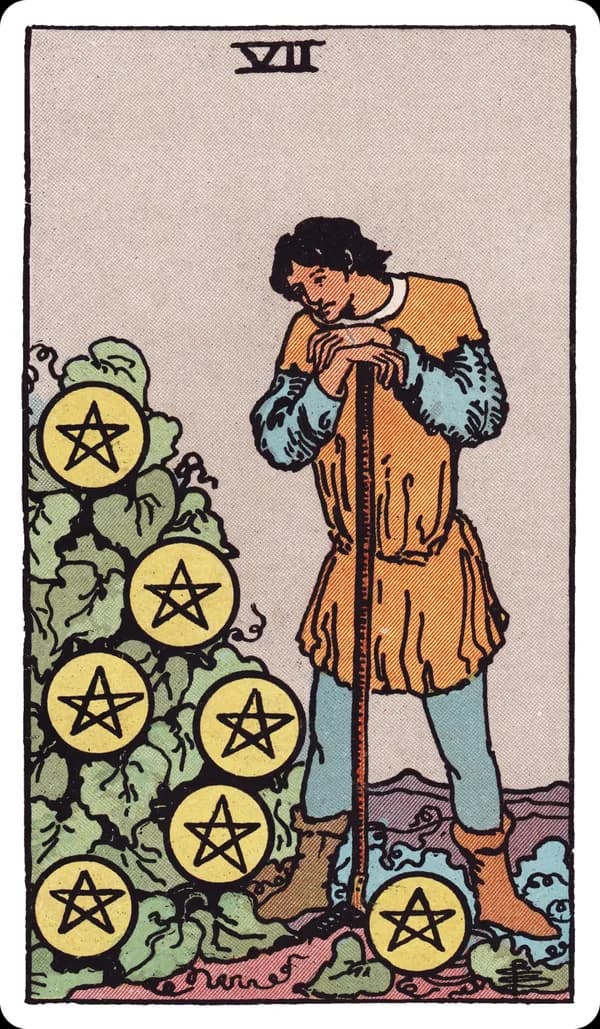
A farmer stands in his field, hoe planted in the ground, leaning his weight against it in a posture of genuine pause rather than either fresh energy or exhaustion. In front of him, a leafy bush has grown seven gold pentacles among its leaves, like fruit ready — or nearly ready — for harvest. This is a card of the in-between moment: work has clearly already been done (the bush didn't grow itself), and more work presumably remains, but right now the figure has stopped to actually look at what's grown rather than continuing to labor without checking. Where the Eight of Pentacles will show active, focused craft and the Nine will show the finished reward enjoyed at leisure, the Seven captures the specific, less glamorous middle stage most projects spend the majority of their time in: not starting, not finished, just growing, and worth a genuine look before deciding what to do next.
- Element
- earth
- Ruling planet / sign
- Saturn in Taurus
- Suit
- pentacles
Numerology: Golden Dawn's "Lord of Success Unfulfilled" puts disciplined, patient Saturn into steady, growth-oriented Taurus — a decan about effort that hasn't finished paying off yet, not effort that's failed. Seven, across the deck, tends to mark a pause for genuine assessment; here that assessment is agricultural and literal: has this actually grown enough yet.
Upright Meaning
Upright, the Seven of Pentacles describes a long-term investment — of time, money, effort, or care — that's still maturing, paired with a genuine pause to assess whether it's growing the way you hoped. It's a card of patience specifically, not passivity: the farmer has stopped to look, not to give up, and the pause itself is presented as valuable and necessary rather than as procrastination. This card often shows up during the unglamorous middle stretch of any long project — a degree, a business, a relationship, a creative work, a savings goal — when the initial burst of energy has faded and the eventual payoff isn't visible yet, but the work put in so far genuinely has produced something, even if it's not yet ready to harvest. It favors staying the course when the underlying growth is real, while also encouraging honest evaluation rather than blind persistence: is this bush actually bearing fruit, or is it worth reconsidering the approach. In a reading about a slow-moving goal, the upright Seven of Pentacles is often reassurance that the waiting is productive, not wasted — provided you're actually checking in periodically rather than working on autopilot.
Reversed Meaning
Reversed, the Seven of Pentacles points to impatience undermining a process that genuinely needed more time, or, in a harder reading, effort that's been invested without the long-term payoff ever materializing. This can look like abandoning a slow-growing project right before it would have paid off, switching strategies too often to let any one approach actually mature, or simply losing faith in a long-term investment because the timeline feels unbearable, even though the underlying growth is real. It can also describe the opposite problem: continuing to pour effort into something that genuinely isn't working, mistaking stubbornness for patience, and refusing to honestly reassess a plan that's stopped producing real results. A third reading concerns wasted effort more directly — work invested in something that simply didn't pan out, whether from bad luck, a flawed plan from the outset, or circumstances that changed underneath the project after the effort had already been committed. The specific situation itself usually settles which reading applies: is there real, if slow, growth happening that's simply being abandoned too early, or has the growth genuinely stalled in a way persistence alone won't fix?
Read the full reversed meaning →Symbolism
The farmer's tired, thoughtful posture is doing more work in this image than the pentacles themselves — his slightly slumped shoulders and the way he leans fully into the hoe rather than standing upright suggest real fatigue from real labor, not idle daydreaming. That the pentacles grow directly on the bush, rather than being harvested or displayed, matters too: this is wealth still attached to its source, still in the process of ripening, distinct from money already banked or spent. Seven pentacles is one short of the suit's completed ten, which some readers take as a deliberate signal that the harvest, whatever form it eventually takes, isn't finished yet even at this reflective pause. The hoe itself, planted upright in the dirt rather than actively swinging, marks a genuine break in labor rather than either the start of work or its completion — an intentional stopping point, not a collapse. Unlike the Eight of Pentacles' clearly focused, still-working craftsman, the Seven shows someone stepping back to assess, which is itself a distinct and necessary kind of labor most tarot cards don't otherwise depict — the work of evaluating whether continued effort in the same direction is actually worthwhile.
The Seven of Pentacles from the Rider-Waite-Smith deck: a farmer leans on his hoe, pausing to study a leafy bush heavy with seven gold pentacles growing on it like fruit, a distant field and hills visible behind him.
→ See what Saturn in Taurus means in your horoscope on GetMyHoro
→ Find your own life-path number on NumberAngel
In Love
In a relationship reading, the Seven of Pentacles describes a partnership in its slow, unglamorous middle stretch — past the initial excitement, not yet at any dramatic milestone, simply continuing to grow through ordinary, sustained effort that doesn't always feel rewarding in the moment. For someone partnered, it can mark a genuinely healthy pause to assess where the relationship actually stands: has the investment of time and care you've both put in produced real closeness, or does the relationship need a different kind of attention than it's been getting. For someone single, it can describe the patient, less exciting work of building toward readiness for a relationship — personal growth, healing, or simply time passing — that doesn't produce an immediate romantic payoff but is nonetheless real progress. This card doesn't promise the relationship (or the readiness for one) is definitely working; it asks you to actually look honestly at what's grown so far rather than assuming either the best or the worst by default. Reversed, the love reading points toward impatience derailing something that needed more time — ending a relationship right before it would have deepened, or conversely, staying in a relationship that's genuinely stopped growing out of a refusal to honestly assess it, mistaking stubborn persistence for patience.
Read the full love meaning →In Career
At work, the Seven of Pentacles describes a long-term professional investment — a business, a skill, a slow-building reputation — that's maturing but hasn't fully paid off yet, paired with a moment worth pausing to genuinely evaluate rather than simply pushing forward on autopilot. It's a fitting card for the middle stretch of a business that hasn't yet turned reliably profitable, a career built patiently over years rather than through a single lucky break, or a project whose real payoff is still months or years away despite substantial work already invested. It favors continued patience when the underlying growth is genuinely real — client relationships deepening, skills compounding, a reputation slowly building — while also encouraging an honest gut-check about whether the current strategy is actually working or simply familiar. Reversed, the career reading turns toward impatience costing real progress: leaving a slow-building venture right as it was about to turn a corner, changing strategies too frequently to let any one approach mature, or conversely, continuing to invest effort into a professional direction that's genuinely stopped producing results out of sheer inertia. It can also describe effort that's been wasted outright — a project or career move that, in hindsight, wasn't going to pay off regardless of how much patience was applied to it.
Read the full career meaning →Money & Health — Reflection Themes
Money: This card describes money in its slowest, least dramatic form — an investment, a savings plan, or a long-term financial goal that's genuinely growing but hasn't yet reached the point where the growth is obvious or spendable. Read as a theme for reflection, it favors patience paired with periodic honest review: checking in on a retirement account, a business's slow build toward profitability, or a debt being paid down gradually, rather than either ignoring the progress entirely or panicking over its slow pace. It's worth asking directly, when this card comes up: based on an honest look at the numbers or the trajectory, is this actually working, just slowly, or has it genuinely stalled in a way that calls for a different approach. Reversed, the financial reading points toward impatience undermining a plan that needed more time — pulling money out of a long-term investment too early, abandoning a savings goal right before it would have compounded meaningfully, or switching financial strategies so often that none of them ever get the chance to mature. It can also describe the harder reading of genuinely wasted financial effort — money or time invested in something that, on honest reflection, was never going to pay off the way it was hoped.
Health: The upright Seven of Pentacles, taken as a theme for reflection, can describe a slow, gradual health improvement — the kind of progress from consistent exercise, a long-term treatment plan, or a sustained lifestyle change that doesn't show dramatic results overnight but is genuinely accumulating over weeks or months. It favors patience paired with honest tracking: checking in periodically on whether a routine or treatment is actually working, rather than either abandoning it too soon out of frustration or continuing indefinitely without ever assessing whether it needs adjustment. Reversed, this card can point to impatience undermining a health plan that needed more time to show results — quitting a program right before real progress would have become visible, or repeatedly switching approaches before giving any one of them a fair chance to work. It can also describe the harder reading of effort that genuinely isn't paying off, a routine or treatment that needs honest reassessment rather than continued blind persistence. No particular diagnosis rides along with this card; treat it here as a prompt to check in honestly on a slow-moving health goal rather than assuming either automatic success or failure.
Spiritual Meaning
This is a card about the discipline of tending something without demanding it bloom on your timeline — a genuinely difficult spiritual practice in a culture generally oriented toward fast, visible results. The farmer's paused, weary posture suggests that patience here isn't passive waiting; it's active, ongoing tending that simply hasn't produced its final form yet, which many contemplative traditions treat as one of the harder disciplines to sustain precisely because it offers so little immediate reward. This card is worth sitting with honestly alongside a long, slow personal or spiritual project — inner healing, a practice, a relationship with faith or meaning — and ask whether you're actually still tending it, or whether you've either quietly given up on it or stopped checking in on its progress at all. It's also a card that values honest assessment over either blind faith or premature abandonment: real spiritual patience, in this card's imagery, looks like periodically stopping to genuinely look at what's grown, not like refusing to look at all out of fear of what you might find.
Yes or No?
For yes/no questions, the Seven of Pentacles is a genuine 'maybe, but not yet' — the card describes something still in progress, not a finished outcome, so a question demanding a clean yes or no often needs to be reframed around timing instead. If your question is close to 'is this worth continuing,' the upright card leans encouraging, provided there's real evidence of growth so far, even if it's slow and not yet fully visible. If your question is closer to 'is this ready now,' the honest answer is usually not yet, since the card's entire imagery is built around something still ripening rather than already harvested. Reversed, the leaning shifts toward caution: either impatience is at risk of ending something before it matures, or, in the harder reading, the growth genuinely has stalled and continued waiting won't fix it on its own. A more productive move than sitting with the uncertainty as an unsatisfying non-answer is checking what evidence exists right now of real progress.
Read the full yes-or-no breakdown →Frequently Asked Questions
Why does the farmer in the Seven of Pentacles look tired instead of proud?
His weary, leaning posture signals genuine, ongoing labor rather than either a fresh start or a finished achievement. It grounds the card in the reality of long-term effort — the fatigue is honest, and it coexists with real growth on the bush in front of him rather than contradicting it.
Should I read the Seven of Pentacles as encouragement to start a brand-new investment?
It's a better fit for something already underway and maturing than for a brand-new start — its core message is about patience with existing growth, not initiating something new. For a fresh financial beginning, the Ace of Pentacles is a more natural fit.
How is the Seven of Pentacles different from the Eight of Pentacles?
The Seven shows a pause to assess long-term growth already underway — stepping back to look rather than actively working. The Eight of Pentacles shows focused, hands-on skill-building in progress, actively working rather than pausing. They often appear near each other in a reading about a long project's different stages.
Does reversed Seven of Pentacles mean I should give up?
Not automatically — it can mean impatience is at risk of ending something prematurely, which would actually argue against giving up. It can also mean genuine reassessment is overdue because the effort truly isn't paying off. The card asks for honest evaluation rather than dictating a single answer either way.
Related Cards
Spreads that read Seven of Pentacles
- Astrological Zodiac Wheel Spread — 12 positions, advanced
- Career Change Spread — 6 positions, intermediate
Where Seven of Pentacles sits in the deck
Card correspondences sourced from the Hermetic Order of the Golden Dawn tradition — see our methodology.