Minor Arcana · Cups
Six of Cups
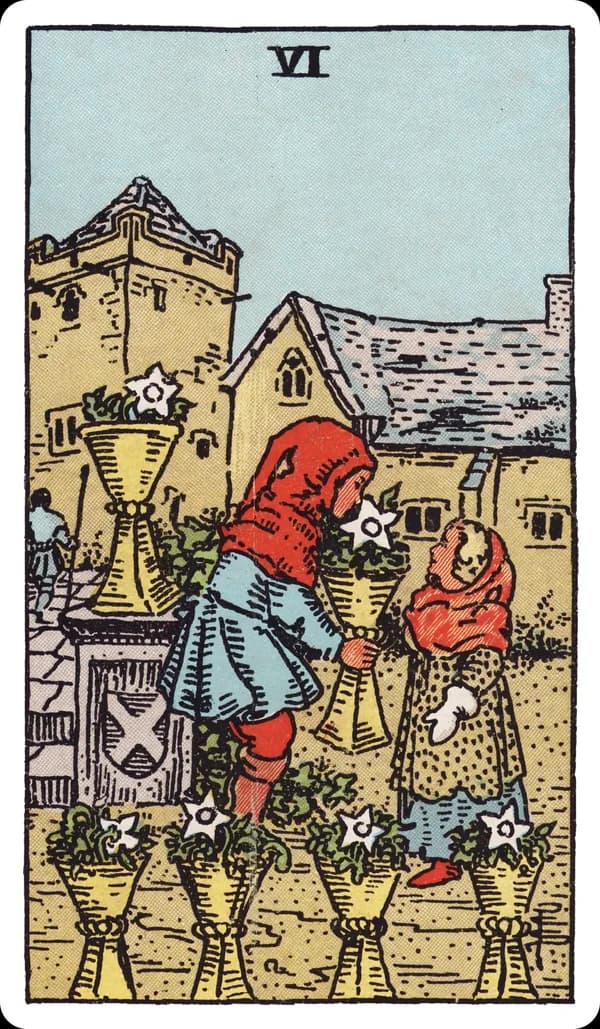
Two children stand in an old, walled garden, and the entire gesture of the card passes between them: a boy, slightly taller, hands a girl a cup overflowing with white, star-shaped flowers. Four more cups, each filled with the same flowers, stand nearby on a stone pedestal, arranged with a kind of careful, domestic order that reads as safe rather than showy. In the background, past a low wall, a cloaked adult figure walks away from the scene toward a distant house, small and half-turned from the viewer, present but clearly not part of the children's exchange. The light throughout most printings sits low, suggesting late afternoon — the specific, golden quality of light that tends to accompany memory rather than the present moment. Nothing in the scene suggests danger or urgency; the whole card is composed around gentleness, familiarity, and a kind of protected innocence that belongs distinctly to childhood, before the suit's later cards introduce romantic complexity, loss, or ambition.
- Element
- water
- Ruling planet / sign
- Sun in Scorpio
- Suit
- cups
Numerology: Six restores balance after Five's disruption, but restores it by looking backward rather than forward — the suit's warmest, most sentimental number. This decan's Golden Dawn title, "Lord of Pleasure," pairs the Sun's warmth and vitality with Scorpio's emotional depth, producing a pleasure that's gentle and remembered rather than urgent or new.
Upright Meaning
Upright, the Six of Cups is tarot's clearest single symbol for nostalgia in its gentlest, most positive form — happy memories, a childhood recollection, a reunion with someone from your past, or simply a wave of warmth connected to an earlier, simpler chapter of your life. It often shows up when something from the past resurfaces in a genuinely welcome way: an old friend reconnecting, a favorite place revisited, a family tradition observed again. The card carries a note of innocence too, distinct from more adult, complicated forms of connection found elsewhere in the suit — it favors sincerity, simple kindness, and generosity given without any strategic motive behind it, the way children exchange gifts without calculating the exchange. In a reading about the present, the Six of Cups can suggest that an answer or comfort worth having is found by looking backward — revisiting an old skill, reconnecting with an earlier version of a relationship or plan, or drawing on childhood values that still hold up. It's a gentle card, rarely urgent, and its message is almost always about warmth rather than any pressing decision.
Reversed Meaning
Reversed, the Six of Cups usually describes nostalgia that's tipped from comforting into limiting — living too much in the past, idealizing an earlier chapter of your life at the expense of engaging with the present, or measuring current relationships and opportunities unfavorably against a rose-tinted memory that may not have been quite as perfect as it's now remembered. It can also point to being emotionally stuck at an earlier developmental stage — avoiding adult responsibility or complexity by retreating into simpler, more comfortable patterns from childhood. A more hopeful reversed reading describes the opposite movement: consciously choosing to move forward, letting go of an idealized past in order to fully engage with the present, which is itself a healthy, deliberate use of this card's energy. A third reading involves someone from the past reappearing in a way that isn't entirely welcome — an ex or an old dynamic resurfacing and pulling you backward rather than adding genuine warmth. Whether the past, in this instance, is being drawn on as a resource or used as an avoidance is usually the deciding factor.
Read the full reversed meaning →Symbolism
The white flowers filling every cup on the card are usually identified as a stylized five-petaled bloom — visually close to the flowers found elsewhere in Pamela Colman Smith's Pentacles suit, which some readers take as a quiet visual bridge between emotional and material abundance, though this reading is interpretive rather than confirmed by any documented statement from the artist. What's clearer is the flowers' overall effect: unlike a bouquet given for romantic courtship, these read as an offering of simple, uncomplicated affection, fitting the childlike figures exchanging them. The walled garden setting matters too — walls in tarot imagery generally signal safety and containment, a bounded, protected space distinct from the open cliffs and roads found on cards like the Fool or the open water behind the Queen of Cups; this garden is enclosed, private, and specifically nostalgic rather than adventurous. The departing adult figure in the background is one of the card's more debated details: some readers see a guardian or parent, quietly present but giving the children their space; others read it as a symbol of adulthood itself, walking away from the scene of childhood innocence, a visual reminder that this protected garden belongs to a stage of life that doesn't last. Either reading supports the card's central theme — a warm, safe memory, framed as something that has already, gently, begun to recede.
The Six of Cups from the Rider-Waite-Smith deck: in an old walled garden, a boy hands a girl a cup filled with white star-shaped flowers; four more flower-filled cups stand nearby on a stone ledge, and a cloaked adult figure walks away toward a distant building under a low afternoon sun.
→ See what Sun in Scorpio means in your horoscope on GetMyHoro
→ Find your own life-path number on NumberAngel
In Love
In a love reading, the Six of Cups often points toward a reunion — reconnecting with someone from your past, rekindling an old relationship, or a new relationship that feels unusually familiar, almost like coming home. It's also a strong card for a relationship built on genuine, uncomplicated affection rather than intensity or drama, favoring sincerity and simple kindness over grand romantic gestures. For someone single, it can describe an ex or a childhood friend re-entering your life with real romantic potential, or simply a nostalgic longing for a simpler, earlier kind of connection. Partnered, expect real comfort drawn from shared history and long familiarity, or a couple revisiting the earliest, sweetest days of their relationship together. Reversed, the love reading shifts toward being stuck in the past in a way that's actively unhelpful — comparing a current partner unfavorably to an idealized ex, an old relationship resurfacing in a way that complicates rather than enriches your present, or difficulty moving forward from a relationship's earlier, simpler stage into its more complex present reality.
Read the full love meaning →In Career
At work, the Six of Cups can describe a return to familiar territory — going back to a former employer, reconnecting with an old professional contact who opens a new opportunity, or returning to an earlier career path or skill set that still genuinely suits you. It favors work that draws on established strengths rather than entirely unfamiliar new territory, and it can point toward mentorship, since the card's imagery of an older figure and younger figures exchanging something valuable maps naturally onto that kind of professional relationship. It's also a fitting card for nostalgic industries or work connected to childhood, memory, or tradition. Reversed, the career reading points to being professionally stuck in outdated methods or an old identity that no longer fits your current skills or ambitions — relying on how things used to be done rather than adapting, or hesitating to take on more complexity because an earlier, simpler role felt safer. It can also describe an old professional relationship or reputation resurfacing in a way that complicates your current situation rather than helping it. The card's broader lesson for career questions is to check whether familiarity is genuinely serving you, or simply feels safer than growth.
Read the full career meaning →Money & Health — Reflection Themes
Money: Money connected to family, tradition, or the past is this card's characteristic financial theme — an inheritance, a financial habit learned in childhood, or simply the comfort of returning to a simpler, less complicated relationship with money after a period of financial stress. It can describe generosity given without calculation, in the spirit of the card's simple exchange of flowers, or gratitude for financial support received earlier in life that's still shaping your habits today. It's worth reflecting honestly on whether your current money habits, learned early, still genuinely serve your present circumstances. Outdated financial habits carried forward from childhood without being reexamined is one common reversed reading here, alongside a kind of financial nostalgia that romanticizes an earlier, simpler situation in a way that avoids facing present, more complex realities.
Health: Comfort found in familiar, established wellness routines is this card's characteristic health theme, taken as reflection rather than any clinical claim — returning to an activity or practice that brought you genuine peace earlier in life, or drawing emotional support from long-standing relationships during a difficult stretch. It can also describe the simple, real wellbeing benefits of nostalgia itself: revisiting happy memories as a genuine source of comfort during a hard time. Reversed, the card can flag relying on outdated approaches to your own wellbeing that no longer actually fit your current needs, or avoiding a needed, more complex approach to health because an earlier, simpler routine feels safer to return to. It can also describe a health-related memory or old pattern resurfacing in a way that complicates rather than supports your present wellbeing. No specific condition is really the concern here — checking honestly whether a familiar comfort is still genuinely helping is.
Spiritual Meaning
Spiritually, the Six of Cups represents the value of innocence and simplicity as genuine spiritual qualities, not merely a phase to be outgrown — the idea that the uncomplicated sincerity of childhood, generosity given without strategy, gratitude without conditions, remains available and worth returning to at any age. It can mark a spiritual practice that draws on memory and tradition specifically, honoring earlier teachers, family spiritual practices, or childhood wonder as a genuine source of present-day insight rather than something to be intellectually surpassed. The card's walled garden also carries a specific spiritual invitation: to protect and tend an inner space of simple peace, distinct from the busier, more complicated concerns of adult life, and to visit that space deliberately rather than only stumbling into it by accident. Healing or insight, drawn this way, doesn't always require a new, more advanced practice — sometimes it's available simply by reconnecting honestly with an earlier, more innocent version of yourself, which is the specific suggestion this card tends to carry into a personal-growth reading.
Yes or No?
For yes/no questions, the Six of Cups upright leans toward a gentle 'yes,' particularly for questions about reunions, reconnecting with someone from the past, or whether something familiar and comforting will come through. It's a warm, low-key favorable card rather than a dramatic one — its yes tends to describe something sincere and simple rather than large or urgent. Reversed, that warmth turns conditional: only if you can let go of the idealized version first. The reversed card often flags that a hoped-for outcome is being complicated by nostalgia or comparison to the past, and the honest answer depends on whether you're able to engage with the present situation on its own terms rather than measuring it against an earlier, rose-tinted memory.
Read the full yes-or-no breakdown →Frequently Asked Questions
Does the Six of Cups mean an ex will come back?
It's one of the cards most associated with reunions and reconnecting with someone from the past, so it's a reasonable reading in that context — though whether the reconnection is healthy or simply nostalgic depends heavily on the surrounding cards and on whether the original relationship's issues have actually been addressed.
What do the white flowers in the Six of Cups mean?
They're usually read as a symbol of simple, sincere affection — an offering given without strategy or expectation, fitting the childlike figures exchanging them. Some readers note their visual similarity to flowers found on cards in the Pentacles suit, though this connection is interpretive rather than a documented intention.
Is the Six of Cups only about childhood?
No — while childhood memory is its clearest imagery, the card applies to any warm reconnection with the past, including adult friendships, professional relationships, or simply revisiting an earlier version of your own life that still holds real value.
How is the Six of Cups different from the Four of Cups?
The Four of Cups describes apathy toward the present, missing what's currently being offered. The Six of Cups describes warmth directed toward the past — nostalgia and memory, rather than disengagement with what's happening now. One looks away out of boredom; the other looks backward out of genuine fondness.
Related Cards
Spreads that read Six of Cups
- Weekly Spread — 7 positions, intermediate
- Soulmate Spread — 5 positions, intermediate
Where Six of Cups sits in the deck
Card correspondences sourced from the Hermetic Order of the Golden Dawn tradition — see our methodology.