Minor Arcana · Pentacles
Six of Pentacles
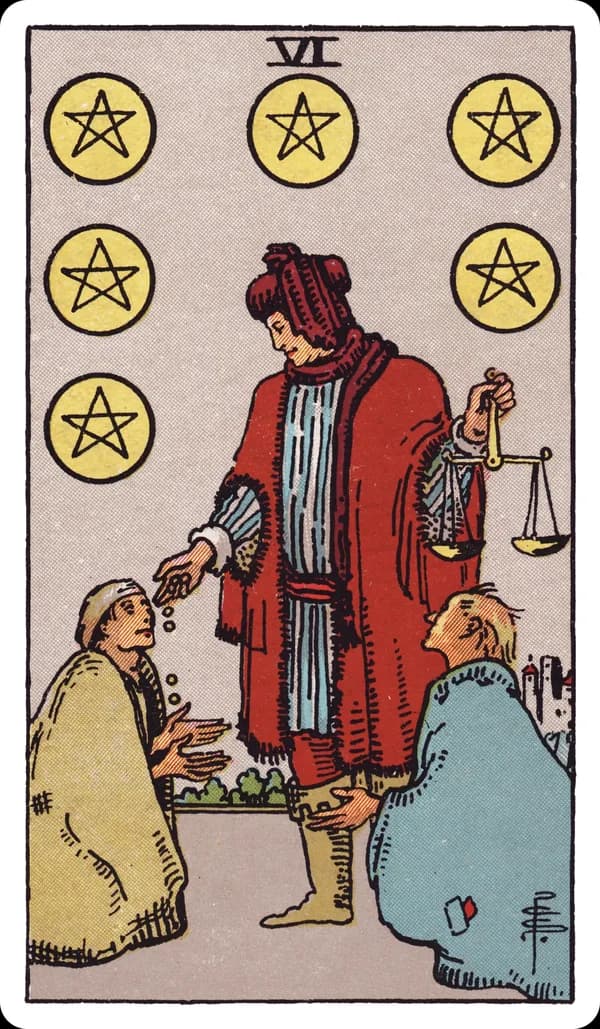
A well-dressed merchant stands with his feet planted, a set of balance scales held in one hand, dropping coins from the other into the open palm of a kneeling figure below him. A second kneeling figure waits alongside the first, hands also raised, evidently next in line. Where the Five of Pentacles showed two figures shut out in the cold, the Six answers directly: here is the moment help actually arrives, rendered as a specific, visible exchange rather than an abstract idea of charity. The scales in the merchant's other hand are doing real work in this composition — they belong to a figure who is measuring the giving, not simply dispensing wealth at random, which sets this card apart from a purely sentimental image of generosity.
- Element
- earth
- Ruling planet / sign
- Moon in Taurus
- Suit
- pentacles
Numerology: Golden Dawn's "Lord of Material Success" pairs the Moon's responsiveness to others with Taurus's steady abundance — success measured here by what moves between people, not what one person keeps. Six is the deck's number of harmony restored after the Five's disruption; in Pentacles that harmony takes the specific form of a transaction that actually balances.
Upright Meaning
Upright, the Six of Pentacles describes a healthy exchange of resources — giving generously to someone who genuinely needs it, or standing on the other side of that exchange and accepting real, timely support yourself, in either case, a form of balance being actively restored. It favors situations where help flows appropriately: enough to matter, given with genuine care rather than performative display, and received without shame, since the card shows the transaction working cleanly in both directions. This is a strong card for charitable giving, mentorship, financial support between family members, or simply a moment where you have more than enough and choose to share it meaningfully with someone who has less. It can equally describe being the one who receives — a loan, a gift, help with a bill, mentorship from someone more established — without that reversing the card's positive charge, since receiving well is as much a part of this card's balance as giving well. The scales matter here too: this card favors giving and receiving that's proportionate and thoughtful, not simply generous in volume, which is part of why it reads as more mature than a card about pure abundance alone.
Reversed Meaning
Reversed, the Six of Pentacles points to the exchange becoming unbalanced — generosity with strings attached, help given in a way that creates obligation or leverage rather than genuine support, or a one-sided relationship where giving and receiving have stopped moving in both directions over time. This can describe a benefactor whose help comes loaded with expectation (gratitude performed on demand, compliance, an unspoken debt to be called in later), turning what looked like generosity into a form of control. It can also describe the recipient's side of that same imbalance: dependency that's become uncomfortable, receiving help in a way that feels diminishing rather than supportive, or debt — financial or emotional — that's accumulating faster than it's being repaid. A third reading concerns generosity withheld unfairly: resources that could genuinely help someone being deliberately denied, or charity offered selectively in a way that plays favorites rather than responding to actual need. Whichever version applies, the reversed card usually points back to the scales tipping — help that's stopped being proportionate and mutual, in favor of one side holding real power over the other.
Read the full reversed meaning →Symbolism
Those scales are the single most important detail in the card, and it's worth resisting the urge to read past them to get to the warmer image of coins changing hands. A scale implies judgment, proportion, and fairness — this giving isn't impulsive or unconditional, it's measured, which raises a genuinely useful question the artwork doesn't answer for you: is that measuring wise discernment about need, or a subtler form of control dressed up as charity? The standing merchant and kneeling recipients create a clear power asymmetry that the coins alone don't resolve — one figure has the resources and the position to give, the other two are positioned literally lower, dependent on that decision. Two beggars rather than one matters too: it shows the giver choosing between or among people in need, which is a different, more complicated situation than a single act of aid, and hints at the uneven distribution that runs through the whole of the Pentacles suit's material world. Unlike the Three of Pentacles' collaboration among equals, the Six depicts an explicitly unequal exchange — which doesn't make it a bad card, but does mean generosity, obligation, and power are genuinely tangled together in its imagery rather than presented as simply good news.
The Six of Pentacles from the Rider-Waite-Smith deck: a wealthy merchant in a red robe holds a set of scales in one hand while dropping coins into the palm of a kneeling beggar with the other, a second kneeling figure waiting beside the first.
→ See what Moon in Taurus means in your horoscope on GetMyHoro
→ Find your own life-path number on NumberAngel
In Love
In a relationship reading, the Six of Pentacles describes emotional and practical give-and-take — a partnership where support flows in both directions over time, even if it isn't perfectly equal in any single moment. For someone partnered, this can mark a season of real generosity between you and a partner: financial support during a hard stretch, emotional care given freely, or simply a relationship where both people give what they can and receive what they need without keeping score in a way that damages trust. For someone single, it can describe a connection where one person is currently in a position to give more (time, resources, emotional steadiness) while the other receives, which isn't inherently a red flag as long as it doesn't calcify into a permanent, unquestioned imbalance. This card asks a fair, specific question of any relationship: is what's being given and received here actually proportionate over time, or has one person quietly become the permanent giver and the other the permanent taker? Reversed, the love reading turns toward that imbalance becoming a real problem — a partner who gives generously but expects control or gratitude in return, a relationship where one person's needs are consistently prioritized over the other's, or a dynamic where receiving help has started to feel like a debt rather than a gift.
Read the full love meaning →In Career
At work, the Six of Pentacles favors situations involving mentorship, fair compensation, and resources distributed with genuine care — a boss or senior colleague who supports your growth without expecting something uncomfortable in return, or your own position to mentor, fund, or otherwise support someone earlier in their career. It's a strong card for negotiations and financial exchanges that end up feeling fair to both sides: a raise that reflects real value delivered, a client relationship where payment and work are proportionate, a company that reinvests fairly in the people who generate its success. It can also describe accepting real professional support from the other side of that exchange — training, a reference, a connection made on your behalf — accepted without unnecessary guilt, since accepting help well is part of what this card values. Reversed, the career reading points toward exchanges that have become lopsided: being underpaid for real value delivered, help offered by a mentor or employer that comes with uncomfortable strings attached, or a professional relationship where one side is consistently extracting more than it gives. It can also describe favoritism — resources, opportunities, or credit distributed unevenly in a way that doesn't reflect actual merit or need, echoing the card's image of a giver choosing between people rather than helping everyone equitably.
Read the full career meaning →Money & Health — Reflection Themes
Money: This is one of the deck's clearest cards for a fair, healthy financial exchange — money given or received in a way that actually helps, proportionate to what's needed and what's available, rather than either extreme of hoarding or reckless overextension. Notice which side of this card's imagery you're currently standing on: are you the one with more than enough, deciding how and to whom to give, or are you the one receiving, and how comfortable are you with that position? Neither role is better than the other in this card's logic — the scales only work if both sides are functioning honestly. It can also describe charitable giving specifically, or financial support between family and friends done well: enough to matter, given without resentment, received without shame. Reversed, the financial exchange has tipped: money given with strings attached that make it feel more like leverage than generosity, financial dependency that's become uncomfortable or exploitative, or debt — a loan that's turned into an ongoing source of tension rather than a temporary bridge. It's worth asking honestly, if this card comes up reversed: is a financial relationship in your life currently proportionate, or has one side quietly gained power over the other through money.
Health: The upright Six of Pentacles, read as a theme for reflection, can describe a healthy give-and-take around care — accepting support from a doctor, caregiver, friend, or family member without shame when you genuinely need it, or being the one able to offer real, practical help to someone else who's struggling physically or mentally. It favors a balanced relationship with care generally: neither refusing help out of pride when you need it, nor giving so much of your own energy to caring for others that your own wellbeing goes unattended. Reversed, this card can point to that balance tipping — caregiving that's become one-sided and depleting, accepting help in a way that feels uncomfortably dependent, or a support system (medical, financial, or personal) that comes with conditions attached rather than being offered freely. No particular diagnosis attaches to this card; use it here as a prompt to check whether the care flowing in and out of your life — given and received — is currently proportionate, or whether one side of that exchange has quietly taken on too much weight.
Spiritual Meaning
Generosity and receptivity are treated as equally important spiritual disciplines in this card, which is a genuinely useful corrective for anyone who's absorbed the idea that giving is virtuous and receiving is somehow weaker or more suspect. The scales in the merchant's hand suggest that mindful giving — attentive to actual need, proportionate, offered without needing anything back — is a real practice, not simply an instinct to be followed without reflection. Use this card to examine your own comfort with both roles: how easily you give when you have more than enough, and, just as importantly, how easily you receive when you're the one who needs help. Many people find one side of that exchange far more comfortable than the other, and this card asks which side you tend to avoid. It's also a reminder that generosity done with real awareness of power — not simply performing charity, but staying honest about who's positioned where in a given exchange — is a more mature and more sustainable practice than generosity offered without any self-examination at all.
Yes or No?
For yes/no questions, the Six of Pentacles upright leans toward 'yes,' particularly for questions about receiving help, securing financial support, or being able to give something meaningful to someone else — the card's whole imagery is built around an exchange actually going through successfully. It's a genuinely favorable card for a specific loan, gift, grant, or piece of mentorship coming through, provided the underlying need is real and the exchange stays proportionate rather than becoming lopsided. Reversed, the yes weakens considerably, shifting toward a caution that whatever is being offered or requested comes with conditions worth examining closely before accepting — not necessarily a flat no, but a signal that the terms of the exchange deserve real scrutiny rather than grateful acceptance on faith. If this card comes up reversed for a question about accepting financial or practical help from someone else, the more useful next step is usually getting the actual terms of that help stated plainly before committing to it.
Read the full yes-or-no breakdown →Frequently Asked Questions
Why does the merchant in the Six of Pentacles hold a scale while giving away coins?
The scale signals that the giving shown here is measured and deliberate rather than impulsive — the merchant is weighing something (need, worthiness, proportion) before deciding how much to give. It raises a genuine question the artwork leaves open: whether that measuring reflects wise discernment or a form of control over who receives help and how much.
Is it bad to be the one receiving help in the Six of Pentacles?
No — receiving well is treated as just as valuable in this card's imagery as giving well. The card describes a healthy, balanced exchange, and being on the receiving end at a given moment doesn't diminish that; most people occupy both positions over the course of a real relationship or life.
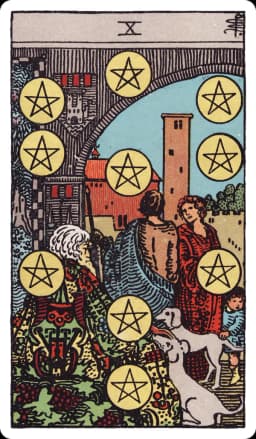
How is the Six of Pentacles different from the Ten of Pentacles?
The Six describes an active, specific exchange of resources between two parties — a give-and-take happening right now. The Ten of Pentacles describes long-term, settled material security and legacy, a broader and more permanent kind of wealth rather than a single moment of giving or receiving.
Does reversed Six of Pentacles always mean someone is being manipulative?
Not always — it can describe manipulative or controlling generosity, but it can equally describe an imbalance that developed without bad intent, like a caregiving relationship that quietly became one-sided, or a debt that grew uncomfortable over time. It's worth checking the specifics of the situation rather than assuming the worst read automatically applies.
Related Cards
Spreads that read Six of Pentacles
- Full Moon Spread — 4 positions, beginner
- Money & Abundance Spread — 5 positions, intermediate
Where Six of Pentacles sits in the deck
Card correspondences sourced from the Hermetic Order of the Golden Dawn tradition — see our methodology.