Minor Arcana · Cups
Ten of Cups
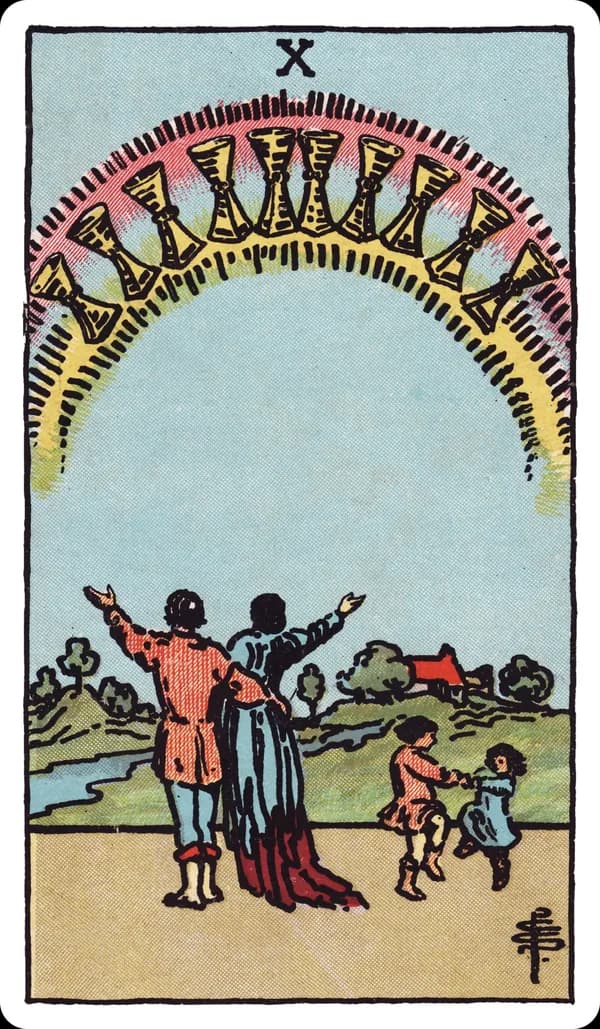
A rainbow arcs across the top of this card, and ten cups are suspended within it, each one glowing rather than resting on any physical surface — the suit's entire numbered journey, from the Ace's single overflowing gift through every stage of connection, loss, and reflection since, gathered into one radiant arc overhead. Below, a man and a woman stand together on a hillside, backs mostly to the viewer, arms raised toward the sky in open, unguarded joy. Two children dance nearby, hand in hand, oblivious to anything but their own delight. In the background, a small cottage sits beside a gently flowing river, a settled, modest home rather than a castle or grand estate. Nothing in the scene is staged or performed for an audience — the family's joy is directed upward, toward the rainbow, rather than outward toward the viewer, suggesting gratitude aimed at something larger than any one person's individual achievement.
- Element
- water
- Ruling planet / sign
- Mars in Pisces
- Suit
- cups
Numerology: Ten closes the suit's cycle exactly as it closes each Minor Arcana suit — not with more of the same, but with the whole journey's emotional promise realized as a lasting, shared state. The Golden Dawn calls this decan "Lord of Perfected Success," pairing Mars's active drive with Pisces' boundless emotional depth, describing fulfillment that took real effort to build and has, at last, fully arrived.
Upright Meaning
Upright, the Ten of Cups is tarot's clearest single image of lasting emotional fulfillment — not a fleeting high point, but a settled, sustainable happiness built with other people over real time. It's the suit's completion card, and it favors family harmony, a deeply happy home life, and relationships that have grown into their fullest, most stable form. Unlike the Nine of Cups' self-contained personal satisfaction, the Ten of Cups' joy is explicitly relational and shared: it requires other people, and it's most often read in terms of family, marriage, or a close-knit chosen community rather than solitary contentment. The card can mark reaching a long-hoped-for milestone in family or relationship life, or simply the ongoing, unremarkable-sounding but genuinely rare experience of a happy, peaceful home. In a reading about the future, the Ten of Cups is one of the more reassuring cards available, suggesting that whatever difficulties preceded it, the suit's arc — through loss, nostalgia, illusion, and departure — genuinely can resolve into lasting, shared happiness rather than remaining forever unsettled.
Reversed Meaning
Reversed, the Ten of Cups usually describes a gap between the appearance of family or relationship harmony and the reality underneath it — a household that looks fine from the outside while carrying real, unaddressed tension or disconnection within. It can point to values misalignment between partners or family members, unmet expectations about what home or family life was supposed to feel like, or a specific rupture disrupting what had previously felt stable. It can also describe prioritizing an idealized image of family happiness over the honest, sometimes messier work of actually building it, chasing the picture rather than the substance. A gentler reversed reading simply describes fulfillment delayed rather than absent — a family or relationship still working toward this level of harmony, genuinely on the way there but not fully arrived yet. Active conflict, a slow ongoing process, or a comfortable illusion not yet tested — the surrounding cards usually make clear which of the three you're actually looking at.
Read the full reversed meaning →Symbolism
The rainbow itself carries deep, near-universal symbolic weight: across many traditions it marks a covenant, a promise, or a bridge between the human and the transcendent, and its appearance here transforms the ten cups from a simple tally into something closer to a blessing received rather than merely accumulated. Unlike the Nine of Cups' cups, displayed like trophies on a shelf, the Ten's cups float freely within the rainbow's arc, ungrounded and unclaimed by any single hand — fulfillment here belongs to the whole family, not to any one figure's personal effort or possession. The modest cottage in the background is a deliberate contrast to the castles and towers that appear elsewhere in the Minor Arcana, the distant castle of the Five of Cups, for instance: this card's version of having everything is specifically domestic and relational, not a display of wealth or status. The two dancing children complete the scene's emotional register — their presence signals not just partnership between the two adults but a full, generational continuity, the suit's original, undirected water (the Ace) having, by this final card, grown into something that sustains an entire family across time rather than a single relationship in a single moment.
The Ten of Cups from the Rider-Waite-Smith deck: a rainbow arcing across the sky holds ten cups; below it, a man and woman stand on a hillside with arms raised toward the sky, while two children dance nearby beside a cottage and a river.
→ See what Mars in Pisces means in your horoscope on GetMyHoro
→ Find your own life-path number on NumberAngel
In Love
In a love reading, the Ten of Cups is one of the strongest, most reassuring cards in the entire deck — lasting emotional fulfillment, a deeply happy and stable relationship, or a family life built on genuine harmony rather than mere appearance. It's frequently read as a marker of a relationship's long-term potential specifically: where the Two of Cups confirms mutual attraction and the Nine of Cups confirms personal satisfaction, the Ten of Cups confirms durable, shared happiness sustained over real time. For someone single, it can describe a genuine longing for that kind of lasting, family-oriented partnership, or a signal that such a relationship is achievable and worth holding out for. Partnered, this often names a relationship that has reached, or is close to reaching, its fullest, most stable and joyful form — a happy home, a strong extended family or chosen community, a partnership built to last. Reversed, the love reading points to a gap between appearance and reality — a relationship or family that looks happy from the outside while carrying real, unaddressed tension underneath, unmet expectations about what a shared life was supposed to feel like, or a specific rupture disrupting previously stable harmony.
Read the full love meaning →In Career
At work, the Ten of Cups is less directly about career achievement and more about how your work life fits into a broader sense of home and family fulfillment — a career that supports, rather than competes with, a genuinely happy personal life, or work that allows real time and energy for the people you care about most. It can describe finding a workplace that feels like a genuine, supportive community, though its stronger association remains with family and personal life rather than professional achievement specifically. It's a favorable card for questions about work-life balance directly, since its whole message is about sustainable, shared wellbeing rather than individual accomplishment. Reversed, the career reading points to work that's crowding out family or personal happiness — a demanding job creating real strain at home, or professional priorities and family priorities pulling in conflicting directions in a way that's gone unaddressed. It can also describe an idealized picture of having it all that isn't matching the honest, lived reality of trying to balance both. Whether your work is genuinely supporting the life you actually want, rather than quietly working against it, is the honest check this card keeps returning to.
Read the full career meaning →Money & Health — Reflection Themes
Money: Financial stability in service of family and home life is this card's characteristic money theme — enough resources to support a genuinely happy household, rather than wealth pursued for its own sake or for status. It can describe a family's shared financial security, built together over time, or the emotional satisfaction that comes specifically from providing well for people you love. It's worth reflecting on whether your financial goals are actually oriented toward the shared life you want to build, or toward external markers of success that don't necessarily serve that deeper goal. Financial stress creating real strain within a family or household is a common reversed reading here — disagreements about money disrupting an otherwise stable home life, or an outwardly comfortable financial picture masking real tension about how money is actually being handled.
Health: The genuine wellbeing benefits of a happy, stable home life are this card's characteristic health theme, held as reflection rather than anything clinical — emotional resilience drawn from strong family support, and the real, documented health value of feeling genuinely connected to the people closest to you. It can describe recovery supported by a loving household, or simply the steady, sustained sense of wellbeing that comes from a home life that feels safe and settled. Reversed, the card can flag the health cost of ongoing, unaddressed tension at home — stress from family conflict or a strained household affecting your wellbeing more than you may be consciously registering, or the exhaustion of maintaining an appearance of a happy home while privately struggling. Rather than any specific condition, what matters here is honestly checking whether your home environment is currently supporting your wellbeing or quietly working against it.
Spiritual Meaning
Spiritually, the Ten of Cups represents heaven made tangible and domestic — the idea that the deepest spiritual fulfillment doesn't have to be found in isolation or grand mystical experience, but can be fully present in an ordinary, happy home shared with people you love. The rainbow arcing overhead, a symbol across many traditions of covenant and promise, reframes this family's happiness as something closer to grace received than achievement earned, echoing the Ace of Cups' original, freely-given gift now grown into something that sustains an entire household. It can mark a genuine sense of having arrived somewhere spiritually significant, not through solitary practice but through sustained, loving relationship with others. The deepest available fulfillment may be closer and more ordinary than it seems — found in shared, everyday life rather than only in dramatic breakthroughs — which is the suggestion this card tends to carry when it turns up in a personal-growth reading.
Yes or No?
For yes/no questions, the Ten of Cups upright is one of the strongest, most reassuring yes cards in the deck, particularly for questions about lasting happiness, family harmony, or whether a relationship has real long-term potential. Its yes carries a specific weight of durability: this isn't a card about a fleeting positive moment, it's about sustained, shared fulfillment, which makes it a particularly strong confirmation for questions with a long time horizon rather than an immediate one. Reversed, that confidence narrows into 'not yet, or not as it currently appears' — the underlying potential for lasting happiness may still be genuinely there, but something, unaddressed tension, unmet expectations, or a gap between appearance and reality, is currently standing in the way of it being fully realized. It's worth treating a reversed Ten of Cups as an invitation to look honestly beneath a situation's surface rather than as confirmation that lasting happiness isn't possible at all.
Read the full yes-or-no breakdown →Frequently Asked Questions
Is the Ten of Cups only about family with children?
No — while the card's imagery includes children, its deeper meaning is lasting emotional fulfillment and harmony in close relationships broadly, which applies just as much to a couple without children, a close chosen family, or any deeply bonded community, not only a traditional nuclear family.
What does the rainbow symbolize in the Ten of Cups?
Across many traditions, a rainbow marks a covenant, promise, or bridge between the human and the transcendent. Here it transforms the ten cups from a simple accumulation into something closer to a blessing received, reframing the family's happiness as grace rather than only individual achievement.
How is the Ten of Cups different from the Nine of Cups?
The Nine of Cups describes personal, self-contained satisfaction, enjoyed alone. The Ten of Cups describes a wider, shared fulfillment specifically built with and experienced alongside other people — family and relationship harmony rather than individual contentment.
Does reversed Ten of Cups mean my family is broken?
Not necessarily broken, but it often points to a gap between how a family or relationship appears and how it actually feels underneath — unaddressed tension, unmet expectations, or fulfillment that's still a work in progress rather than fully realized yet.
Related Cards
Spreads that read Ten of Cups
- Decision-Making Spread (Two Paths) — 7 positions, intermediate
- Weekly Spread — 7 positions, intermediate
Where Ten of Cups sits in the deck
Card correspondences sourced from the Hermetic Order of the Golden Dawn tradition — see our methodology.