Minor Arcana · Wands
Six of Wands
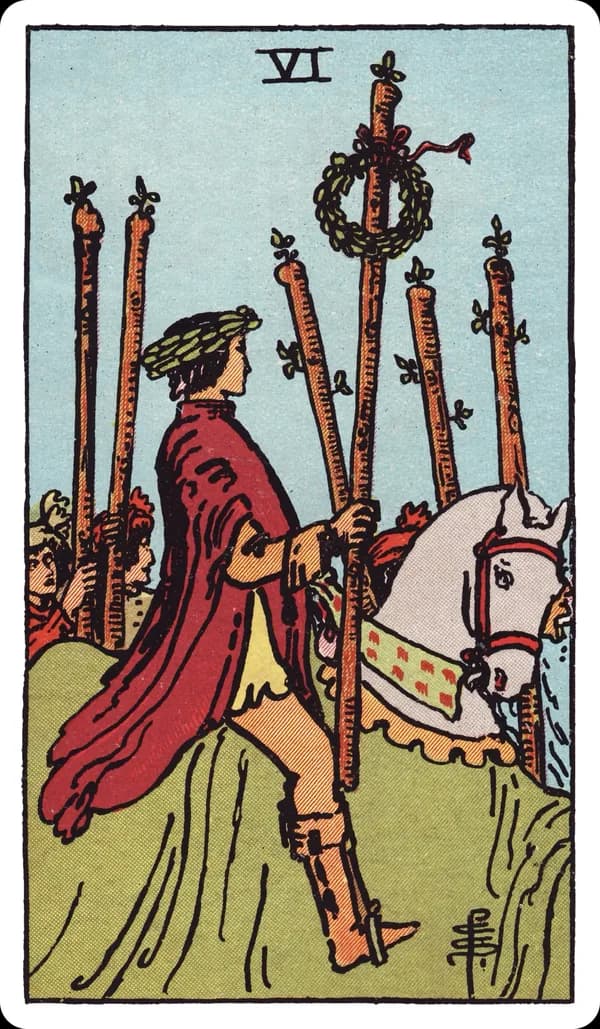
The scattered, inconclusive scuffle of the Five of Wands resolves, in the very next card, into a clear and public win: a rider on a white horse moves through a crowd, a laurel wreath on his own head and a second laurel wreath tied to the top of the wand he carries upright before him. The people on foot around him aren't fighting anymore — they're raising their own wands in what reads as celebration or salute, not competition, and the whole scene has the unmistakable rhythm of a procession rather than a battle. Where the Five of Wands showed five people at cross-purposes, the Six of Wands shows a crowd unified around a single, agreed-upon outcome: someone has clearly won, and everyone present seems to accept it. The rider's posture is upright and composed rather than triumphant in any showy way, which matters for how this card is usually read — the confidence here comes from a genuinely earned result, not from performance for its own sake, even though the card's whole scene is, undeniably, a performance being watched by a crowd.
- Element
- fire
- Ruling planet / sign
- Jupiter in Leo
- Suit
- wands
Numerology: Golden Dawn title "Lord of Victory" — the Jupiter-in-Leo decan pairs Jupiter's expansive good fortune with Leo's love of being seen, producing this card's public, celebrated triumph. Sixes across the deck mark a return to balance after a five's disruption; here that balance arrives specifically as recognition after a hard-won contest.
Upright Meaning
Upright, the Six of Wands is one of the more straightforwardly confident cards in the deck: real success, publicly recognized and genuinely earned, often after real effort or a real contest of some kind (echoing the friction of the Five of Wands just before it in the suit's sequence). It favors situations where your work or your position is being validated in front of other people, not just privately satisfying to you, an award, a promotion announced publicly, a competition actually won, good news that other people get to celebrate alongside you. This card also carries genuine confidence as a quality in itself, distinct from the achievement: the rider's composed posture suggests self-assurance that isn't dependent on the crowd's approval even though the crowd happens to be giving it. It can also describe a general season of being well-regarded, respected, or looked to for leadership, riding high in others' estimation as much as in any single specific accomplishment. Compared with the more private, personal contentment of a card like the Nine of Cups, the Six of Wands' satisfaction is explicitly and specifically public.
Reversed Meaning
Reversed, the Six of Wands most often describes a real achievement that isn't getting the recognition it deserves, success that stays private rather than publicly acknowledged, sometimes by choice and sometimes because the recognition simply isn't forthcoming from the people or institutions that should be offering it. It can also point to self-doubt undercutting a genuine win, second-guessing an achievement that's actually solid, or feeling like an impostor in a position you've legitimately earned. A more dramatic reading involves an actual fall from grace: a public reputation or standing that takes a real hit, praise that turns to criticism, or a victory that proves more fragile or temporary than it initially appeared. It can also describe excessive dependence on external validation, needing the crowd's approval so badly that a genuine, quieter success feels hollow without it. What matters is whether the underlying achievement is real but unrecognized (the first, more common reading) or whether the achievement itself has genuinely been undermined or reversed (the second, less common but real reading).
Read the full reversed meaning →Symbolism
The double laurel wreath, one on the rider's head, one on his wand, doubles down on a single classical symbol of victory rather than introducing a second one, emphasizing that this triumph is complete and unambiguous rather than partial or contested. The white horse carries its own long tradition across the tarot (echoed later by Death's pale horse and the Sun's white steed) as a symbol of purity of purpose or a particularly clean, uncomplicated kind of success — this isn't a victory won through compromise or trickery, but one earned directly. The crowd's raised wands mirror the rider's own, suggesting that his victory is, in some sense, shared or at least publicly endorsed rather than resented; nobody in the scene appears to be a sore loser. His elevated position on horseback, above the crowd on foot, is worth reading alongside the earlier Wands cards' recurring interest in vantage points (the Two of Wands' battlement, the Three of Wands' cliff): here, for the first time in the suit, the elevated position is being actively witnessed and celebrated by others, rather than occupied alone.
The Six of Wands from the Rider-Waite-Smith deck: a rider on a white horse wears a laurel wreath and carries a wand topped with another laurel wreath, moving through a crowd of people on foot who raise their own wands as he passes.
→ See what Jupiter in Leo means in your horoscope on GetMyHoro
→ Find your own life-path number on NumberAngel
In Love
In a love reading, the Six of Wands often describes a relationship that others recognize and celebrate openly, a couple who are visibly, publicly happy together, or a personal romantic confidence that draws genuine, positive attention. It can mark a specific romantic win worth noting: finally being noticed by someone you've admired, a relationship reaching a stage worth announcing to friends and family, or simply feeling good about how your love life looks and feels right now. For someone single, it can describe a season of real romantic confidence, feeling genuinely attractive and self-assured rather than anxious or unsure, which itself tends to draw positive attention. Reversed, the love reading points to a relationship or a romantic success that isn't being outwardly acknowledged the way it deserves, kept private, unrecognized by family or friends, or simply lacking the confidence to be shown openly. It can also describe self-doubt undercutting a genuinely good relationship, second-guessing a connection that's actually solid, or needing constant outside validation about a relationship's worth rather than trusting your own read on it.
Read the full love meaning →In Career
At work, few cards match the Six of Wands for genuine public professional recognition: a promotion, an award, a completed project that earns visible praise, or simply being the person whose work colleagues and leadership actively point to as a model. It favors confidence backed by real, demonstrated results rather than either false modesty or unearned bravado, and it often follows a competitive or effortful stretch (echoing the Five of Wands' friction) with a clear, satisfying resolution in your favor. This card can also describe stepping into a genuine leadership position, being looked to by others for direction, not necessarily because of a formal title but because your track record has earned that trust. Reversed, the career reading points to real accomplishment going unrecognized, solid work that doesn't get the credit, promotion, or acknowledgment it's earned, sometimes because of office politics, sometimes simply because of bad timing. It can also describe professional self-doubt undermining a genuinely strong track record, or, in its more dramatic reading, an actual setback to your professional reputation that requires honest attention to address.
Read the full career meaning →Money & Health — Reflection Themes
Money: A financial win worth actually acknowledging is this card's clearest money-focused reading, a bonus earned and paid out, a negotiation that goes your way, an investment or venture that pays off visibly and satisfyingly. It favors confidence about money grounded in real, demonstrated results, trusting a financial decision that's already proven itself rather than continuing to second-guess a genuinely sound outcome. It can also describe financial success that other people notice and respect, being seen as someone who's good with money or who's achieved something worth others' genuine admiration. Reversed, it can point to a real financial success that isn't being properly recognized or credited, work that generates genuine value without the acknowledgment or reward that should follow it. It can also describe financial self-doubt undermining a decision that's actually sound, or, less commonly, an actual financial setback following an earlier win, a reversal of fortune worth taking seriously rather than dismissing. Either way, this card rewards trusting real, demonstrated results over either false modesty about your own financial competence or anxious second-guessing of a win that's already landed.
Health: A genuine, visible milestone in a health or fitness journey is this card's most common wellbeing reading, a goal actually reached and worth feeling proud of, a recovery that others notice and comment on, or simply a season of feeling confident and strong in your own body after real, sustained effort. It favors letting that confidence show rather than downplaying real progress out of habit or discomfort with being noticed. It can also describe being looked to by others as an example, inspiring people around you through visible, hard-won improvement in your own health or fitness. Reversed, the card can point to real progress that isn't being acknowledged, by yourself or by others, genuine improvement that goes unnoticed or uncelebrated, which can make it harder to sustain motivation over time. It can also describe health-related self-doubt undermining a genuinely solid track record, or, less commonly, a real setback following earlier progress, a relapse or regression worth taking seriously and addressing directly rather than treating as a personal failure. No particular diagnosis attaches to this card; its territory is earned confidence and whether that confidence is being seen.
Spiritual Meaning
A rider crowned and witnessed by a crowd offers a specific spiritual challenge worth naming honestly: how do you hold genuine spiritual growth or insight when other people start to notice and respond to it? The Six of Wands in a spiritual context often marks a stretch where real inner work becomes visible from the outside, a calmer presence people comment on, a clarity or confidence others are drawn to, and the real task becomes carrying that recognition without either performing for it or letting it inflate into something ungrounded. It can also describe being recognized as a guide or a source of wisdom by people around you, stepping into a role of spiritual leadership, formal or entirely informal, that others have effectively conferred on you through their trust. There's a genuine tension worth sitting with in this card's imagery: real victory earned through real effort, publicly celebrated, and the ongoing spiritual work of staying grounded and humble even as that celebration happens. Reversed, the same tension can tip toward either needing that outside validation too badly or having earned real growth that nobody around you is currently acknowledging, both worth examining honestly rather than assuming either extreme is a permanent state.
Yes or No?
The Six of Wands gives one of the more confident 'yes' answers in the deck, and its specific flavor is worth naming: not just a favorable outcome, but one that's publicly confirmed and recognized rather than privately, quietly true. It answers questions about winning, succeeding, or being validated by other people with real assurance, provided real effort or a real contest genuinely preceded the question, since this card's victory is earned rather than handed over for free. A question about something not yet attempted asks more than this card readily gives, since its confidence is grounded in a result already achieved or clearly within reach, not raw potential. Reversed, the yes weakens considerably: either the achievement in question is real but going unrecognized, worth pursuing acknowledgment for directly rather than assuming it won't come, or self-doubt is currently clouding a situation that's actually more solid than it feels. In its more serious reversed reading, an actual setback or reversal of an earlier win is possible, worth taking seriously if other cards in the same reading independently point the same direction rather than dismissing purely on this card's reversed showing alone.
Read the full yes-or-no breakdown →Frequently Asked Questions
Why does the rider wear two laurel wreaths?
Only one wreath was strictly necessary to signal victory; a second, matched wreath on the wand he carries is a deliberate redundancy, the kind of visual repetition tarot artists used sparingly and specifically to remove any ambiguity about whether the win was partial or contested.
Is the Six of Wands always about a competition?
Not literally, though its imagery draws on a victorious procession. Its broader meaning covers any publicly recognized success, a promotion, an award, a well-regarded reputation, whether or not it involved a literal contest against other people.
What does it mean if the Six of Wands appears reversed after a big effort?
It most often suggests the effort itself was real but the recognition hasn't yet followed, worth pursuing directly rather than assuming the work wasn't good enough. Less commonly, it can point to an actual setback, which other cards in the same reading usually help confirm or rule out.
How is the Six of Wands different from the Six of Pentacles?
The Six of Wands describes public recognition and confidence following your own personal achievement. The Six of Pentacles describes a different kind of balance entirely, giving and receiving material resources between people, generosity and support rather than individual triumph.
Related Cards


Spreads that read Six of Wands
- Celtic Cross Spread — 10 positions, advanced
- Pros and Cons Spread — 5 positions, beginner
Where Six of Wands sits in the deck
Card correspondences sourced from the Hermetic Order of the Golden Dawn tradition — see our methodology.