Minor Arcana · Cups
Four of Cups
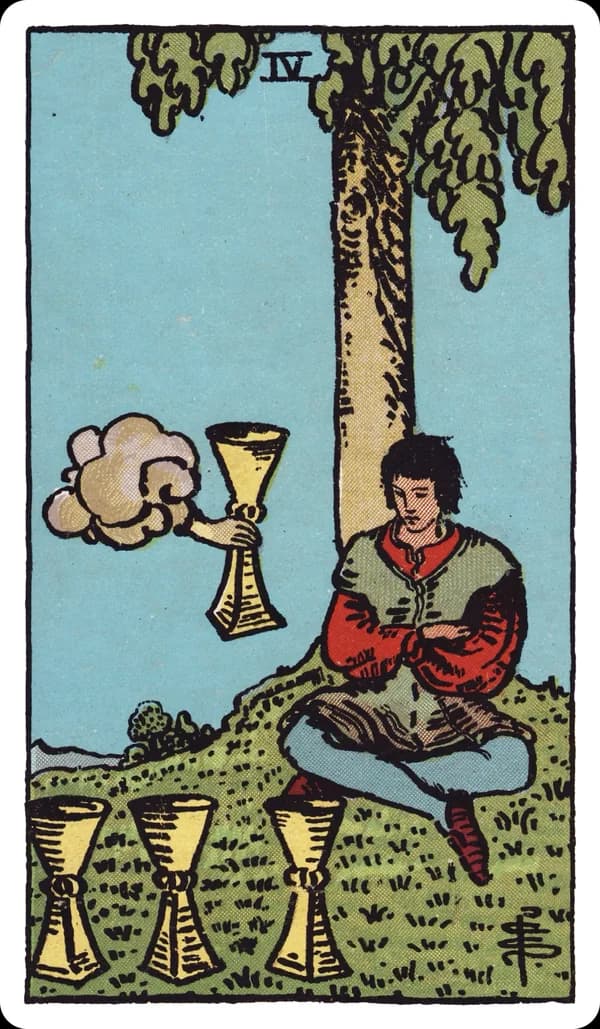
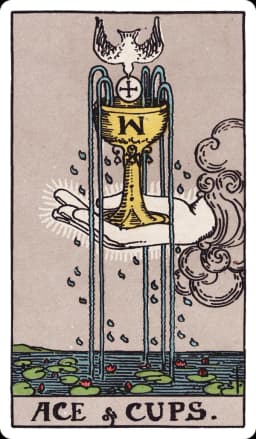
A young man sits beneath a tree with his arms and legs crossed, a posture of closed-off withdrawal rather than relaxed rest, staring down at three cups arranged in a neat row on the grass in front of him. His expression, in most printings, reads as somewhere between bored and dissatisfied — not devastated, just quietly unmoved by what's directly in front of him. To his right, a hand emerges from a cloud, offering a fourth cup, and the man doesn't appear to notice it at all; his gaze stays fixed on the ground rather than lifting toward the new offer entering the scene. The three cups already present are usually read as things he already has — resources, relationships, or opportunities already secured — while the fourth, cloud-offered cup represents a new possibility arriving from outside his current field of attention. Unlike the Ace of Cups, where the same cloud-and-hand device signals a gift being actively received, here it signals a gift being actively missed, simply because the man isn't looking up.
- Element
- water
- Ruling planet / sign
- Moon in Cancer
- Suit
- cups
Numerology: Fours across the Major and Minor Arcana share a common thread of structure and stability, but the Cups suit turns that stability into stagnation when it isn't questioned. The Golden Dawn's title for this decan, "Lord of Blended Pleasure," pairs the Moon's changeable inwardness with Cancer's homebound comfort, describing a satisfaction that has curdled into something too comfortable to move.
Upright Meaning
Upright, the Four of Cups describes a specific, recognizable state: not crisis, not loss, but a flat, low-grade dissatisfaction with a situation that, from the outside, looks perfectly fine. It's the card of taking something for granted — a relationship, a job, an opportunity — simply because it's familiar, without any specific complaint driving the discontent. It frequently shows up during a period of contemplation or withdrawal, where someone has pulled back from active engagement with life to sit with their own thoughts, which isn't inherently negative but can tip into missing genuinely good opportunities if it goes on too long. The card's central tension is the gap between the man's inward focus and the offer he's not noticing: it asks whether you're overlooking something worthwhile because you've stopped paying attention, distracted by low-grade boredom with what's already familiar. In a reading about a decision, the Four of Cups often suggests taking a step back to actually reassess rather than continuing to coast on autopilot, since autopilot is precisely the state the card depicts.
Reversed Meaning
Reversed, the Four of Cups typically describes the shift out of that apathy — noticing the offer that was previously overlooked, snapping out of a withdrawn or checked-out period, or finally engaging with an opportunity that had been sitting there, ignored, for a while. It's often read as a genuinely positive reversal: reawakened interest in something, or someone, that had gone stale, or simply the return of curiosity and engagement after a flat period. A second reversed reading points the other direction: continuing to withdraw and refuse good options even after the apathy has been named and recognized, a more stubborn version of the same closed-off posture. Honest self-assessment settles it more reliably than the surrounding cards alone: if you've recently noticed yourself pulling out of the disengagement, the more hopeful reading fits; if the discontent has been named repeatedly without any real change in behavior, the more stubborn reading is likely closer to the truth. Either way, reversed Four of Cups marks a turning point around attention and engagement.
Read the full reversed meaning →Symbolism
The crossed arms and legs are the card's clearest emotional signal, a closed body posture that reads as self-protective withdrawal rather than genuine contentment — someone who has pulled inward, whether from boredom, disappointment, or simple overfamiliarity with what's already available to him. The tree he sits beneath offers shade and shelter, suggesting his discontent isn't coming from any lack of basic comfort or safety; if anything, the surrounding comfort may be part of the problem, since there's little pushing him to look up and notice what else might be available. The three cups arranged in a tidy row, rather than scattered or overturned, suggest resources that are stable and accounted for, not at risk — his apathy isn't caused by scarcity. The cloud-and-hand offering the fourth cup is the same visual device used across all four Aces, marking this as a genuine gift rather than a mundane, ordinary option; the tragedy the card depicts, if it is one, is specifically the mismatch between how significant the new offer actually is and how little attention the man is currently giving it. Some readers note the number's placement in the suit's arc as significant too: after the expansion of Three, Four turns inward and stalls, mirroring the way the Major Arcana's own Four, the Emperor, represents structure that can become rigid if left unquestioned.
The Four of Cups from the Rider-Waite-Smith deck: a young man sits cross-armed and cross-legged beneath a tree, staring at three cups lined up on the grass before him, apparently unmoved by a fourth cup being offered to him by a hand emerging from a cloud at his side.
→ See what Moon in Cancer means in your horoscope on GetMyHoro
→ Find your own life-path number on NumberAngel
In Love
In a love reading, the Four of Cups upright often describes taking a relationship for granted — not actively unhappy, but coasting on familiarity rather than genuinely engaging with a partner, or feeling a flat, low-grade dissatisfaction that hasn't been named out loud. For someone single, it can point to overlooking a genuine romantic possibility because you're too withdrawn or too focused on what hasn't worked before to notice someone new showing real interest. It can also describe deliberately taking a step back from dating to sit with your own thoughts, which can be healthy if chosen consciously, but risks becoming a habit of disengagement if it isn't examined. Reversed, the reading turns toward reawakened interest: noticing a partner, or a potential partner, with fresh eyes after a period of taking them for granted, or finally opening up to an opportunity that had been sitting unnoticed. It can also describe finally accepting an act of care or a gesture of interest that had previously been dismissed or ignored.
Read the full love meaning →In Career
At work, the Four of Cups often describes a role that's become routine to the point of disengagement — competent, secure, unremarkable, and quietly unsatisfying in a way that's hard to name precisely because nothing is actively wrong with it. It can point to overlooking a genuine opportunity, a new project, a role change, an offer from elsewhere, because you're too checked out to notice it's actually significant, distracted by low-level boredom with your current, familiar situation. It's also a fitting card for a deliberate pause between roles or projects, provided that pause is chosen consciously rather than drifted into by default. Reversed, the career reading shifts toward re-engagement: noticing and pursuing an opportunity you'd previously dismissed, or finally addressing a stagnant situation instead of continuing to coast through it. It can also describe accepting an offer or a piece of feedback you'd initially brushed off. Checking honestly whether your current disengagement is a genuine signal something needs to change, or simply a temporary lull worth riding out, matters more here than any other single career question.
Read the full career meaning →Money & Health — Reflection Themes
Money: A passive, disengaged relationship with money is this card's most common financial theme — not mismanagement exactly, just a lack of active attention, coasting on a financial situation that's stable but unexamined. It can describe overlooking a genuinely useful financial opportunity, a better savings option, a chance to renegotiate a cost, an offer worth actually considering, simply because you haven't been paying close attention to your own finances lately. It's worth asking honestly whether your current financial habits reflect deliberate choices or simple inertia. Finally reviewing an account you'd been ignoring, or actually taking up an opportunity you'd previously waved off, is what this card's reversal tends to describe — renewed financial engagement replacing the earlier drift. It can also describe snapping out of a period of financial avoidance, where checking a balance or reading a statement had started to feel like something to put off rather than a normal, manageable task.
Health: A flat, low-energy period is what this card often names as a health theme, worth taking as reflection rather than diagnosis — not illness exactly, but a general sense of disengagement from your own body and routine, going through the motions of self-care without much genuine investment in it. It can also point to overlooking a genuinely useful piece of advice or support that's been offered, simply because you weren't in a receptive frame of mind when it arrived. The card's contemplative quality isn't automatically negative; a deliberate period of rest and inward focus can be genuinely restorative, provided it doesn't tip into prolonged avoidance of things that would actually help. Reversed, the card can describe a return of energy and engagement — noticing and finally acting on a wellness opportunity or piece of advice that had been sitting unused, or simply feeling motivation return after a flat stretch. Rather than pointing at any specific condition, this card is really asking you to notice whether your current low energy is a needed pause or a pattern worth actively interrupting.
Spiritual Meaning
Spiritually, the Four of Cups represents the discipline, and sometimes the trap, of introspection — a period of turning inward that can either deepen self-understanding or, taken too far, become a way of shutting out genuinely valuable input from outside yourself. The man's crossed arms suggest a self-protective posture worth examining honestly: is this a needed retreat for genuine reflection, or has withdrawal itself become the comfortable, avoidant habit? The card's central image, a real gift being offered and simply not noticed, carries a specific spiritual lesson about receptivity: insight, grace, or growth often arrives quietly and from an unexpected direction, and a mind too preoccupied with its own dissatisfaction may miss it entirely. Whether this card marks a genuinely useful pause for reflection, or a nudge that the reflection has gone on long enough, is usually the real question a spiritual reading built around it needs to answer — something worth engaging with may currently be sitting overlooked.
Yes or No?
For yes/no questions, the Four of Cups upright leans toward a 'no' — or more precisely, a 'not with this level of engagement.' This card describes apathy and overlooked opportunity rather than active refusal, so the honest reading is less that the answer is fundamentally negative and more that the necessary attention or enthusiasm isn't currently there for a genuine yes. It's a particularly telling draw for questions like whether to take an opportunity when your own motivation feels flat — the card is naming that flatness rather than predicting the opportunity's actual quality. Reversed, the reading shifts toward a more hopeful 'yes, now that you're actually paying attention' — the card describes reawakened interest and engagement, which often flips a stalled situation toward a genuine yes once you've stopped coasting and started actually considering the offer in front of you. If you drew this card upright, it's worth checking honestly whether your own disengagement, rather than anything about the situation itself, is producing the negative-leaning read.
Read the full yes-or-no breakdown →Frequently Asked Questions
Does the Four of Cups mean I'm missing an opportunity?
It can — the card's central image is a real, meaningful offer being made and simply not noticed, because the person in the scene is too absorbed in his own dissatisfaction to look up. It's worth asking honestly whether something worthwhile has been in front of you for a while without your really engaging with it.
Is the Four of Cups always a bad card?
Not necessarily. A period of contemplation and withdrawal can be genuinely useful and restorative if it's chosen deliberately. The card becomes a caution specifically when that withdrawal tips into missing real opportunities or taking good things for granted without noticing.
What's the difference between the Four of Cups and the Five of Cups?
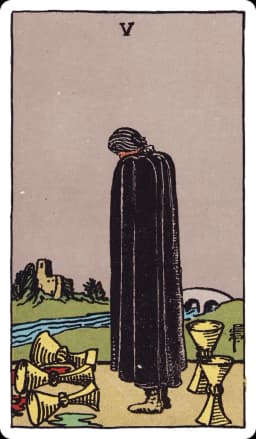
The Four of Cups describes apathy toward what you already have — boredom or discontent with resources that are actually fine. The Five of Cups describes active grief over something genuinely lost. One is about undervaluing what's present; the other is about mourning what's gone.
Why doesn't the man notice the fourth cup?
His crossed arms and downward gaze suggest he's turned inward, preoccupied with his own dissatisfaction rather than paying attention to his surroundings. The card uses this as its central lesson: real opportunities can arrive quietly, and a mind too absorbed in its own discontent may miss them even when offered directly.
Related Cards
Spreads that read Four of Cups
- Relationship Spread (Two-Person) — 6 positions, intermediate
- Shadow Work Spread — 5 positions, advanced
Where Four of Cups sits in the deck
Card correspondences sourced from the Hermetic Order of the Golden Dawn tradition — see our methodology.