Minor Arcana · Cups
Ace of Cups
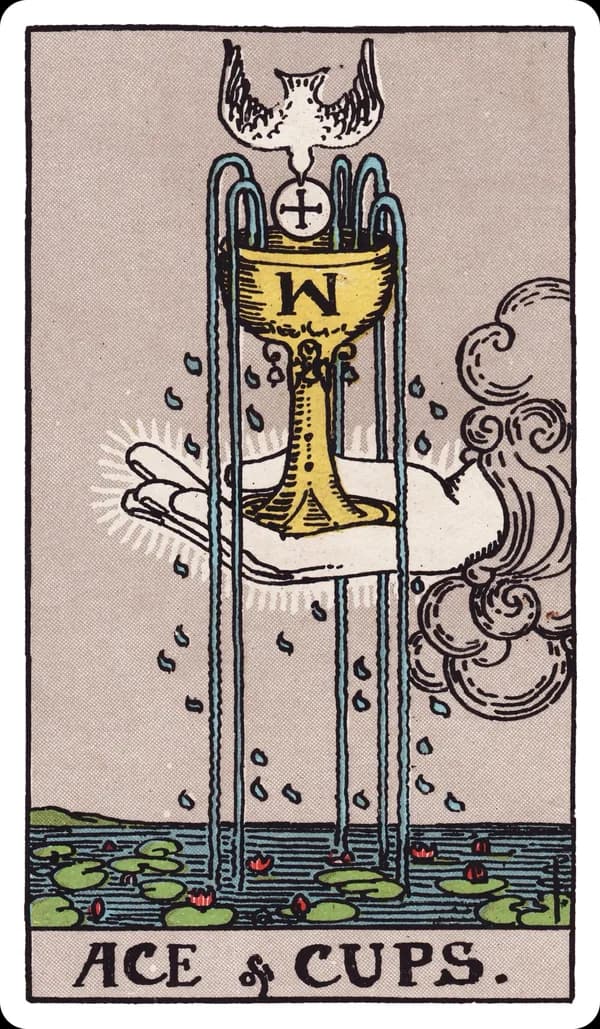
The Ace of Cups is the purest expression of the Cups suit's emotional, intuitive territory — the suit's root card, arriving before love, grief, friendship, or any of the more complicated variations the rest of the suit explores. In the Rider-Waite-Smith artwork, a hand extends from a cloud (the same visual device used across all four Aces, signaling that this gift comes from beyond ordinary circumstance) offering a golden chalice. The cup overflows with five distinct streams of water, cascading down into a lotus-covered pond below. A white dove descends from above, carrying a small wafer marked with a cross toward the cup's rim — an image with clear roots in Christian eucharistic symbolism, though the card's meaning has broadened well past that specific reference over more than a century of tarot use. Where the suits' pip cards (Two through Ten) show the water element being shaped by circumstance — partnership, celebration, loss, choice — the Ace shows it in its rawest, least complicated form: an emotional capacity that hasn't yet been directed anywhere in particular.
- Element
- water
- Ruling planet / sign
- Water (root force, no decan)
- Suit
- cups
Numerology: Aces are the suit's root number — the raw, undivided potential of the water element before it takes any shape. Every other Cups card is a variation on what this Ace contains in seed form.
Upright Meaning
Upright, the Ace of Cups marks a genuine emotional opening — the start of love, a renewed capacity for compassion, or a wave of intuitive clarity arriving without much conscious effort on your part. It's one of the most straightforwardly positive cards in the deck for anything concerning the heart: new relationships, reconciliation, the birth of a wanted pregnancy, or simply a period where your emotional life feels unusually full and generous rather than guarded. Because it's an Ace, the card represents potential rather than a finished outcome — the water is offered, but what happens next (whether it becomes a Two of Cups partnership, a Ten of Cups lasting happiness, or something else) depends on choices made further down the suit's numbered sequence. In readings unrelated to romance, the Ace of Cups can also describe a moment of creative or spiritual inspiration, since the suit governs intuition broadly, not exclusively romantic love — an idea, a piece of art, or a spiritual insight that arrives with the same unearned, overflowing quality as the card's imagery. The consistent thread across all these readings is receptivity: this is a card about something being offered to you, and the invitation is to actually let it in rather than deflect or intellectualize it away.
Reversed Meaning
Reversed, the Ace of Cups describes an emotional capacity that's being blocked rather than absent — the water is still there, but something (a defense mechanism, a past hurt, sheer exhaustion) is preventing it from flowing freely. This can look like a genuine opportunity for connection arriving and being turned away, consciously or not, out of self-protection. It can also describe emotional numbness after a difficult period: not the absence of feeling, but feeling that's been sealed off because it briefly felt safer that way. In a relationship reading, the reversed Ace of Cups sometimes points to one person's genuine offer of love or reconciliation not being received or believed by the other, creating a mismatch between what's being extended and what's being felt. A less common but real reading is emotional overflow in the negative sense — feelings so intense they become overwhelming rather than nourishing, spilling out in ways that are hard to control rather than generous and freely given. The surrounding cards are the practical tell for telling the two apart: ones suggesting stagnation or old patterns point toward blockage, while ones suggesting chaos or volatility point toward overflow that needs containing rather than released further.
Read the full reversed meaning →Symbolism
The overflowing cup is the card's central image, and it's deliberately excessive — five streams rather than one, more water than the vessel can actually hold. That overflow is usually read as generosity and abundance: an emotional capacity so full it spills outward rather than staying contained. The dove is a long-standing symbol of peace and the Holy Spirit in Western religious art, and its presence here frames the card's love not as passionate or possessive but as something closer to grace — offered rather than earned or fought for. The wafer marked with a cross reinforces that reading: this is a blessing extended, not a prize won. Beneath the hand, a pond covered in lotus flowers (in some printings, water lilies) represents the fertile emotional and spiritual ground the gift lands on — lotus flowers specifically carry a long cross-cultural symbolic history of purity and awakening rising out of murky water, echoing the card's theme of something clean and new emerging. Unlike most of the suit's later pip cards, no other figures appear — no one is depicted receiving the cup, which leaves the recipient position open for whoever draws the card, a deliberate design choice repeated across all four Aces.
The Ace of Cups from the Rider-Waite-Smith deck: a hand emerges from a cloud holding a golden chalice overflowing with five streams of water, a white dove descends carrying a wafer marked with a cross toward the cup, and a lotus-covered pond lies below.
→ See what Water (root force, no decan) means in your horoscope on GetMyHoro
→ Find your own life-path number on NumberAngel
In Love
In a love reading, the Ace of Cups upright is one of tarot's clearest signals of a fresh emotional beginning — new love arriving, an existing relationship entering a genuinely renewed, more open phase, or your own heart becoming ready for connection after a guarded period. For someone single, it frequently marks the actual start of a meaningful romantic or emotional connection, sometimes appearing right before or during a first real spark with someone. For someone partnered, it can describe rediscovered tenderness in a relationship that had gone a little flat, or the early emotional stage of a deepening bond — falling more in love with someone you already know. Because the card emphasizes something offered rather than pursued, it also asks a genuine question: are you letting yourself receive this, or are you keeping a wall up out of habit even when the opportunity is real. Reversed, the love reading turns toward emotional unavailability — yours, a partner's, or a mutual one — where real feeling exists but isn't being expressed or accepted. It can describe holding back from a new connection because an old hurt hasn't fully healed, or a relationship where love is present but has become difficult to feel because of built-up resentment, exhaustion, or unspoken hurt. It's rarely a card about love being absent; it's almost always a card about love being present but obstructed in some way.
Read the full love meaning →In Career
At work, the Ace of Cups is less common than the Pentacles suit but still meaningful when it appears — it usually points to work that feels genuinely fulfilling on an emotional or creative level, rather than purely a paycheck. It can describe finding a job or project you're excited about for reasons beyond compensation: a mission you believe in, a team you feel connected to, or creative work that lets you express something real. It's also a strong card for collaborative, caring, or creative professions — counseling, healthcare, the arts, hospitality, teaching — where the ability to genuinely connect with people is part of the job itself, not incidental to it. Reversed, the career reading points toward emotional disconnection at work: doing a job that no longer feels meaningful, working in an environment where authentic connection with colleagues or clients feels impossible, or burnout that has left you numb to work you used to care about. It can also describe an opportunity that would genuinely fulfill you emotionally being overlooked or turned down in favor of a safer, more conventional option — worth reflecting on honestly if that pattern feels familiar. The card's general message for career questions is to notice how much your current work life actually engages your heart, not just your skills or your schedule.
Read the full career meaning →Money & Health — Reflection Themes
Money: As a theme for financial reflection — not financial advice — the Ace of Cups is an unusual card to see in a money-focused spread, since the Cups suit generally governs emotion rather than material resources; when it does appear, it's often worth asking whether the real subject is less about the money itself and more about the feelings attached to it. It can describe a financial gift given generously, without strings, or a financial decision made from genuine care for someone else (supporting a partner, family member, or cause) rather than from strategy. It's also sometimes read as a nudge to notice whether your spending or saving habits are actually aligned with what genuinely matters to you emotionally, rather than habit or obligation. Reversed, it can point to money being withheld emotionally — a financial gift or support that's been offered half-heartedly, or resentment building around money that was given, lent, or spent under emotional pressure rather than clear agreement. As with every card on this site, treat this as a starting point for your own reflection on the emotional side of your financial choices — for any decision with real financial consequences, that reflection isn't a substitute for speaking with a qualified financial professional.
Health: As a theme for reflection — not a medical reading — the Ace of Cups upright often points toward emotional and mental wellbeing specifically: a sense of renewed emotional resilience, a wave of genuine calm, or the start of feeling more connected to your own feelings after a numb or overwhelmed period. It can also describe the emotional dimension of healing broadly — the comfort of a support system, therapy, or simply allowing yourself to feel and process something you'd been avoiding. Reversed, the same card can flag emotional suppression as a pattern worth noticing: pushing feelings down rather than processing them, which can eventually show up as stress, fatigue, or a general sense of being emotionally 'stuck' even when nothing specific seems wrong. It has no fixed association with any specific physical condition or outcome, and it isn't a card about physical health directly — its territory is the emotional and intuitive dimension of wellbeing. If a real health concern (physical or mental) is on your mind, this reading is not a substitute for talking to a qualified healthcare professional — see our full disclaimer.
Spiritual Meaning
The heart chakra, in traditions that map tarot onto that system, opens here — and more broadly, this is one of tarot's clearest single images of grace: something good arriving not because it was earned through effort, but because it was offered freely, the way the dove offers the wafer without any transaction attached. A softening after a guarded stretch, a renewed capacity for compassion toward others or toward yourself, or a moment of unearned peace landing in the middle of a difficult chapter — any of these can mark this card showing up in a season of genuine spiritual opening. It's often read as an invitation to trust your own intuitive and emotional life as a source of guidance, alongside logic and planning rather than beneath them. The lotus pond under the overflowing cup is sometimes read as a reminder that this kind of grace tends to land on ground already prepared by earlier difficulty — the flowers grow because of the water, not despite it.
Yes or No?
For yes/no questions, the Ace of Cups upright is a warm 'yes,' and its whole visual argument — a cup too full to hold its own contents — makes it a natural fit for any question asking whether a genuine emotional or creative opening is actually available to you. Because it's an Ace, treat the yes as 'yes, the opportunity or capacity is genuinely there,' rather than a guarantee about exactly how things unfold from here — the Ace offers the water, but the rest of the suit's numbered journey determines what's built from it. Questions shaped like 'is there real feeling here' or 'am I ready to open up to this' get an especially confident answer, since that's precisely the card's core territory. Reversed, the honest reading softens to a 'not yet' rather than a flat no: the emotional capacity or opportunity the question is about is very likely real, but something is currently blocking it from being felt or received fully — worth reflecting on what that block actually is (fear, timing, an unresolved hurt) before assuming the underlying answer is negative. In most reversed-Ace-of-Cups situations, the block is more temporary and internal than it first appears, which is worth sitting with before writing off the question's answer entirely.
Read the full yes-or-no breakdown →Frequently Asked Questions
Is the Ace of Cups always about romantic love?
No — the Cups suit governs the whole emotional and intuitive dimension of life, not just romance. The Ace of Cups regularly shows up in readings about creative inspiration, self-compassion, friendship, spiritual openness, or simply a period of unusually full emotional wellbeing. Romance is one common reading, especially in a relationship-focused spread, but it's not the card's only or even necessarily primary meaning.
What does the dove in the Ace of Cups symbolize?
The dove draws on a long tradition (particularly Christian iconography) of representing peace, purity, and grace — something offered rather than fought for or earned. In the card, it carries a wafer marked with a cross toward the overflowing cup, reinforcing a reading of blessing and unearned gift rather than romantic pursuit or conquest. The symbol has broadened in meaning across a century of general tarot use, but that gentle, offered quality remains central to how the card is read.
Why does the cup overflow instead of just being full?
The overflow is a deliberate emphasis on abundance and generosity — the water is not just present, it's more than the vessel can contain, spilling into the pond below. This is usually read as a sign of genuine emotional surplus: love, compassion, or inspiration so full it naturally extends outward to others rather than staying contained to just one person or purpose.
How is the Ace of Cups different from the Two of Cups?
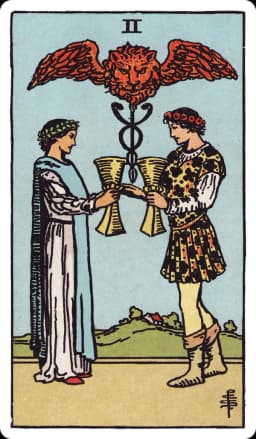
The Ace represents raw emotional potential before it's directed anywhere specific — a capacity, not yet a relationship. The Two of Cups represents that same water element specifically shaped into mutual connection between two people: a partnership, an attraction returned, a bond forming. In a reading, the Ace often precedes the Two — an opening of the heart that then finds a specific person or situation to connect with.
Related Cards

Where Ace of Cups sits in the deck
Card correspondences sourced from the Hermetic Order of the Golden Dawn tradition — see our methodology.