Minor Arcana · Cups
Three of Cups
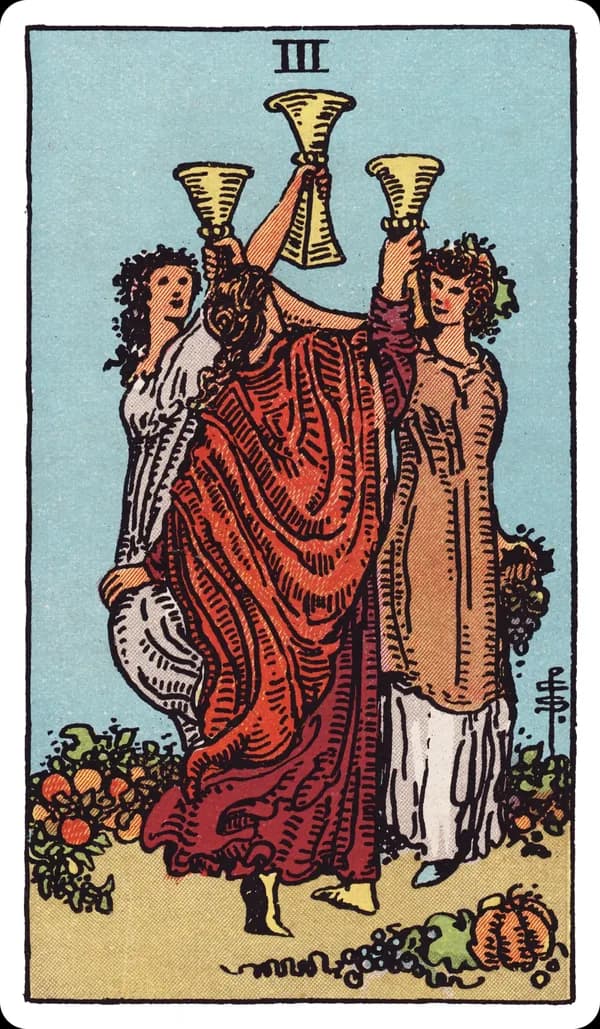
Three women dance in a loose circle at the center of this card, each lifting a cup overhead in a shared toast rather than aiming it at any one companion — a meaningfully different gesture from the Two of Cups' paired, face-to-face exchange. All three wear crowns woven from flowers and fruiting vines, and the ground around their feet is scattered with the season's harvest: grapes, gourds, and small pumpkins, marking this specifically as a celebration tied to abundance actually gathered rather than abundance merely hoped for. Their raised arms and lifted cups form an open, outward gesture, in contrast to the Two's more contained, private exchange between just two people — where that card is about a bond between individuals, the Three of Cups is about what happens once that bond widens into a group. Nothing in the image suggests hierarchy: all three women dance at the same height, in the same rhythm, none positioned as host or guest. The scene reads less like a formal gathering and more like a spontaneous, shared outpouring of joy — the kind of celebration that erupts naturally once there's genuinely something worth celebrating together.
- Element
- water
- Ruling planet / sign
- Mercury in Cancer
- Suit
- cups
Numerology: Three multiplies the Two's private mutual bond outward into a wider circle — partnership becoming community. The Golden Dawn calls this decan "Lord of Abundance," pairing Mercury's gift for communication and exchange with Cancer's nurturing warmth, the same combination that turns a private toast into a shared celebration.
Upright Meaning
Upright, the Three of Cups is one of the most straightforwardly joyful cards in the deck — genuine celebration shared among friends, a reunion, a wedding, a birth announcement, or any gathering where the underlying reason for joy is real and mutual rather than performed. It favors community specifically over the one-on-one intimacy the Two of Cups describes: this is the card of your closest circle showing up for you, and you showing up for them, at a moment that genuinely calls for it. Because the harvest imagery ties the celebration to something already achieved, the card often marks a shared effort's successful completion being properly acknowledged — a project finished together, a milestone reached as a group rather than alone. It can also simply describe the value of maintaining strong friendships during good times, since a common pattern the card points toward is people forgetting to celebrate together once life gets busy. In a reading about a decision, the Three of Cups tends to favor involving your friends or community rather than handling something in isolation, and it's a genuinely strong card for events, parties, and any gathering meant to mark good news.
Reversed Meaning
Reversed, the Three of Cups points to celebration curdled into excess — overindulgence at a gathering, drinking or spending beyond what actually feels good the next day, or losing yourself in a crowd rather than genuinely connecting with it. It can also describe the less generous side of group dynamics: gossip, cliques, or a friend group where loyalty has started running in the wrong direction, with people talking about each other rather than supporting each other directly. A specific reversed reading involves being the odd one out in an uneven situation — feeling like an outsider within a group that used to feel welcoming, or a friendship strained by one person's changed circumstances leaving another person on the outside. It can also mark isolation from your usual community during a period when you'd genuinely benefit from their support, whether by circumstance or by your own withdrawal. Whether the surrounding cards point toward excess (too much connection, badly directed) or toward absence (too little connection, when it's needed most) is usually the clearest way to tell the two apart.
Read the full reversed meaning →Symbolism
The number of figures matters as much as their gesture. Three recurs across the Major Arcana as the number of creative synthesis — the Empress, card III, represents growth born from the union of two forces — and the Three of Cups applies that same principle to friendship rather than romance or creation: two people's private bond becomes something qualitatively different once a third joins, no longer a pair but a genuine community. The harvest imagery at their feet situates the celebration at a specific point in a cycle: grapes and gourds mark a harvest actually completed, tying the card's joy to something concretely earned rather than to celebration for its own sake. Some readers connect this scene to the biblical Wedding at Cana, where Mary, Elizabeth, and Salome are sometimes read as its three background figures, given the card's wine imagery — though this connection is a later interpretive layer added by some tarot commentators rather than an intention Pamela Colman Smith is known to have documented herself, worth holding as one reading among several rather than a settled fact. What is clear from the artwork alone is the absence of any male figure or romantic framing — this is specifically a card about the joy of community and friendship, distinct from the romantic and family-oriented cards found elsewhere in the suit.
The Three of Cups from the Rider-Waite-Smith deck: three women dance in a circle in a garden, each raising a cup high in a toast, wearing crowns of flowers and fruit; gourds, grapes, and pumpkins lie scattered at their feet.
→ See what Mercury in Cancer means in your horoscope on GetMyHoro
→ Find your own life-path number on NumberAngel
In Love
In a love reading, the Three of Cups is less commonly about a romantic partner directly and more about the role friendship plays around a relationship — meeting a partner's close friends for the first time and it going well, a wedding or engagement celebrated by people who genuinely care about the couple, or simply the reminder that a healthy romantic relationship usually has room for outside friendships too, not just the two people in it. For someone single, this card can describe finding romance through your existing social circle — a setup by mutual friends, or a spark that begins as part of a group gathering rather than a one-on-one search. It's also a favorable card for a friendship that's quietly becoming something more, since it places romantic possibility inside a context of established warmth and trust rather than pursuing it cold. Reversed, the love reading shifts toward a relationship crowded or complicated by a third party — genuine jealousy, an ex or friend whose presence creates real tension, or a couple whose relationship has started to isolate them from the friends who once supported it. It can also describe love and friendship pulling in competing directions.
Read the full love meaning →In Career
At work, the Three of Cups favors team environments over solitary roles — a workplace culture built on genuine camaraderie, a project celebrated properly once it's finished, or a professional network of colleagues who actually support each other rather than compete constantly. It's a strong card for team-based work specifically: creative collaborations, group projects, or any role where morale and mutual encouragement genuinely affect output. It can also describe the value of celebrating a professional win properly rather than immediately moving on to the next task — acknowledging a team's accomplishment together, rather than letting good results pass unmarked. Reversed, the card points to workplace dynamics gone sour: office gossip, cliques that exclude certain colleagues, or a team culture where socializing has crowded out actual productivity. It can also describe feeling like an outsider within a workplace's social fabric, left out of an informal network that quietly influences who gets opportunities, or overindulging at a work event in a way that affects your professional reputation. The card's broader lesson here is to notice whether your professional relationships are genuinely supportive, or whether the social layer of your work life has become either excessive or exclusionary.
Read the full career meaning →Money & Health — Reflection Themes
Money: Money spent on shared experiences is where this card's financial reflection tends to point — celebrations, group trips, gifts marking a milestone, or simply prioritizing spending that strengthens community over spending that's purely individual. It can describe the genuine value, not strictly measurable in dollars, that comes from investing in relationships and shared experiences rather than treating every financial decision as a solitary calculation. It's also sometimes read as a nudge to notice whether your social spending currently feels celebratory and worthwhile, or obligatory and draining. Overspending tied to social pressure is a common reversed reading here — keeping up with a friend group's habits past what's genuinely comfortable, or financial strain from one-sided generosity within a group where the giving isn't being reciprocated. It can also point to money-related tension within a friend group specifically, like an uneven split on a shared expense that's gone unaddressed and quietly soured the relationship.
Health: The genuine wellbeing benefits of community are this card's clearest health theme, offered as reflection rather than anything clinical — the well-documented emotional and even physical value of maintaining close friendships, and the specific boost that comes from celebrating good news with people who are truly happy for you. It can describe recovery supported by a strong circle of friends showing up consistently, or the simple, real benefit of laughter and shared joy during a stressful period. Reversed, the card can flag overindulgence as a pattern worth noticing — one drink or one late night becoming a repeated habit tied to a social scene rather than genuine enjoyment, or burnout from a social calendar that's become obligation rather than pleasure. It can also point to the cost of social isolation, when community that would normally offer real support isn't currently available or hasn't been reached out to. Its core message here is less about any specific condition and more about honestly checking whether your social life is currently nourishing you or quietly wearing you down.
Spiritual Meaning
Spiritually, the Three of Cups represents the sacred dimension of shared joy — the idea that celebration experienced together carries a different, deeper quality than the same joy experienced alone, and that community itself can be a genuine spiritual practice rather than a distraction from one. Many traditions treat communal ritual, feasting, and shared gratitude as central spiritual acts rather than incidental ones, and this card's harvest imagery ties directly into that lineage: gratitude expressed together, for something genuinely received. It can mark a spiritual community forming or deepening — a group of people who support each other's growth, not just each other's good moods — and it often appears as encouragement to actually show up for communal practice rather than pursuing growth in isolation. The card's absence of any single central figure is itself worth sitting with: unlike much of the deck's solitary imagery, such as the Hermit's single lantern or the Star's kneeling figure, the Three of Cups locates meaning specifically in the space between people, not within any one of them alone.
Yes or No?
For yes/no questions, the Three of Cups upright leans toward a warm 'yes,' particularly for questions involving groups, celebrations, or whether good news is worth sharing — this card describes joy that's real and communal rather than merely hoped for, which makes it a strong sign when the question concerns whether something is genuinely going well. It's a weaker fit for narrowly one-on-one questions, since its actual strength is in describing group dynamics rather than an individual outcome; a question about one specific relationship or decision may need a more targeted card to answer it precisely. Reversed, the honest reading softens toward 'yes, but watch the excess or the exclusion' — the underlying situation may still be positive, but something is complicating a clean reading of it. In most reversed-Three-of-Cups situations, the core good news still holds; what's changed is how cleanly you'll be able to enjoy it.
Read the full yes-or-no breakdown →Frequently Asked Questions
Is the Three of Cups always about a party?
Not literally, though celebration is its central image. It more broadly describes genuine shared joy and community support — that can be a literal party, but it can equally be a group of friends rallying around good news, a team celebrating a shared success, or simply a strong support network being present when it matters.
Who are the three women in the Three of Cups meant to represent?
Pamela Colman Smith didn't leave a documented explanation of specific identities for the figures. Some later readers connect them to the Wedding at Cana's background women, given the card's wine and celebration imagery, but this is an interpretive layer added afterward rather than a confirmed original intention.
What's the difference between the Two of Cups and the Three of Cups?
The Two of Cups describes an intimate bond between exactly two people, facing each other directly. The Three of Cups widens that same warmth into a group — friendship and community rather than a private pairing, with the figures oriented outward toward each other in a circle rather than paired off.
Does reversed Three of Cups mean my friends are talking about me?
It can point in that direction, since gossip and clique behavior are genuine reversed readings for this card, but it's equally likely to describe your own overindulgence at a gathering or a general sense of feeling excluded from a group, so it's worth checking which register actually matches your situation.
Related Cards
Spreads that read Three of Cups
- Chakra Spread — 7 positions, intermediate
- Full Moon Spread — 4 positions, beginner
- Pros and Cons Spread — 5 positions, beginner
Where Three of Cups sits in the deck
Card correspondences sourced from the Hermetic Order of the Golden Dawn tradition — see our methodology.