Minor Arcana · Pentacles
Four of Pentacles
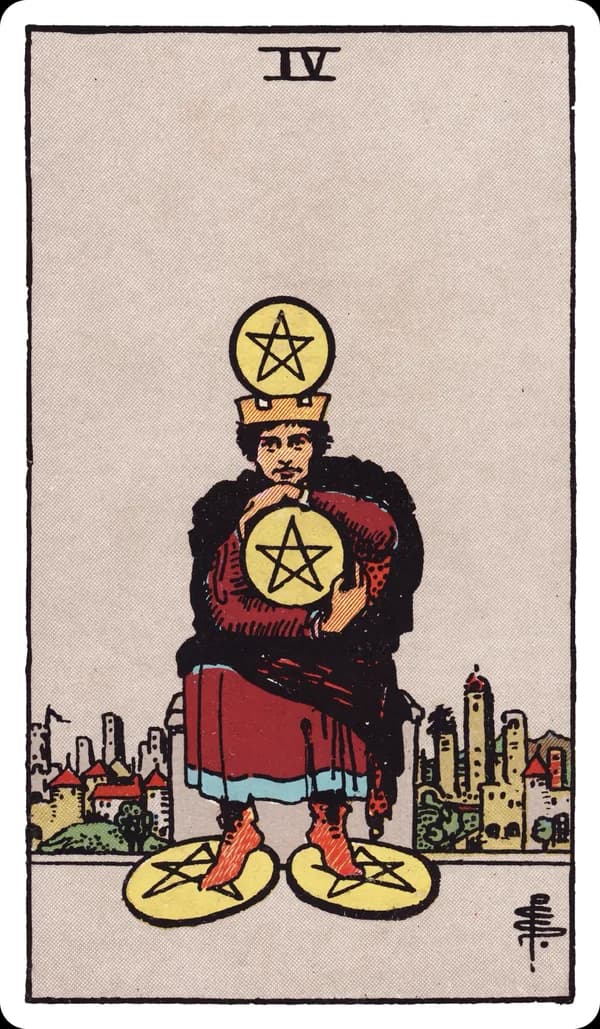
A crowned figure sits rigidly on a stone bench, a city skyline behind him, holding one gold pentacle clutched against his chest with both arms while a second balances precariously on top of his crowned head and his feet press down on two more resting on the ground. It's one of the most physically awkward poses in the entire deck — every limb occupied, nothing free to move, no hand available to reach for anything else. The city behind him implies he's part of a functioning economy and society, yet he sits apart from it, entirely focused on the four objects he's already secured rather than on anyone or anything beyond them. Where the Three of Pentacles showed collaboration and openness to others, the Four closes that door: this is a solitary figure, and unlike the Ace's open hand extended outward or the Six's figure giving generously, every gesture here is inward and defensive.
- Element
- earth
- Ruling planet / sign
- Sun in Capricorn
- Suit
- pentacles
Numerology: Golden Dawn calls this decan the "Lord of Earthly Power," the Sun's confident radiance filtered through Capricorn's caution until it hardens into control. Four is the tarot's number of structure and foundation across every suit, but in Pentacles that structure turns inward here — walls built not to house something but to guard it.
Upright Meaning
Upright, the Four of Pentacles describes genuine financial security achieved through discipline, saving, and careful management — the tangible payoff of resisting impulsive spending and building a real cushion rather than living close to the edge. It's a legitimately positive reading in that sense: this card can mark someone who has worked hard for stability and is finally, justifiably, holding onto it. But the card's rigid, joyless posture is doing real work too, and even upright it carries a caution the deck rarely states this plainly: security bought at the cost of flexibility, generosity, or connection to others has its own price, even when the underlying discipline is sound. This card often shows up when someone's relationship with control — over money, but also over people, plans, or outcomes — has tightened past what's actually useful, holding on so firmly that nothing new can come in either. In a reading about finances specifically, the upright Four of Pentacles is genuinely encouraging; in a reading about relationships, flexibility, or growth, the same rigid grip reads less favorably, and the card is often asking which of those two registers actually applies to your situation.
Reversed Meaning
Reversed, the Four of Pentacles can point in two quite different directions depending on what preceded it. It can describe the rigid control finally loosening — releasing an overly tight grip on money, possessions, or a controlling relationship dynamic, letting go of scarcity thinking that's outlived its usefulness, or becoming more generous after a period of defensive hoarding. This reading is often a relief: the walls the upright card built are coming down, and something new (connection, spending on genuine joy, trust in others) is becoming possible again. But reversed can also describe the opposite: actual financial insecurity, where the upright card's disciplined saving has curdled into real scarcity, or where holding on tightly has failed to prevent genuine loss anyway. It can point to material instability after a period of assumed security, or an attachment to control that's become so extreme it's actively pushing people and opportunities away rather than protecting anything meaningful. Look at what else is in the spread to tell the two apart: cards suggesting relief or openness favor the release reading; cards suggesting stress or scarcity favor the harder reading of insecurity finally breaking through the illusion of control that was covering it.
Read the full reversed meaning →Symbolism
The sheer physical impossibility of the pose is the card's whole argument: a person literally cannot do anything else while holding a coin against his chest, balancing one on his head, and pinning two more under his feet. Nothing can be added, and — more pointedly — nothing can be given away without first letting go of something already held, which is precisely the tension this card is built to dramatize. The crown signals status and achieved authority, yet it's put to an odd use here, propping up a coin rather than resting freely, suggesting that even the figure's rank has been repurposed in service of guarding wealth rather than exercising real power with it. The city in the background is rendered at a slight remove, softly blurred compared to the sharply detailed figure and coins in the foreground — a visual cue that the wider world of trade, relationship, and exchange the city represents has effectively receded from this person's field of attention. Unlike the Five of Pentacles' figures who are shut out from resources against their will, this figure has resources and has chosen — consciously or not — to wall himself off with them rather than move through the world holding them more loosely.
The Four of Pentacles from the Rider-Waite-Smith deck: a crowned figure sits on a stone bench in front of a city, clutching one pentacle tightly against his chest with both arms, balancing another on top of his head, and standing with a foot planted firmly on each of two more pentacles on the ground.
→ See what Sun in Capricorn means in your horoscope on GetMyHoro
→ Find your own life-path number on NumberAngel
In Love
In a relationship reading, the Four of Pentacles describes emotional or material control shaping how love is being held — a partner (possibly you) who loves genuinely but expresses it through possessiveness, financial control, or an unwillingness to be vulnerable enough to let the relationship change and grow. A partnered reading often turns up a relationship that's financially or materially stable but emotionally guarded, where security has been prioritized over openness, sometimes to the point that real intimacy struggles to get through. For someone single, it can describe holding back from new connection specifically out of a need to protect what you already have — your independence, your resources, your current stability — even when part of you wants something more. This card asks a genuinely uncomfortable question in a love context: is what's being protected here actually the relationship, or is it really just control itself, dressed up as caution. Reversed, the reading can go either way — a welcome loosening of a guarded, controlling dynamic that finally allows real closeness in, or a relationship's stability genuinely cracking, revealing insecurity (financial or emotional) that the tight grip had been covering up rather than actually resolving. Either way, this card rarely describes love's absence; it describes love complicated by a fear of loss so strong it starts to resemble the very loss it's trying to prevent.
Read the full love meaning →In Career
At work, the Four of Pentacles describes holding tightly to a stable position, a set of resources, or a specific way of doing things — sometimes wisely, when real discipline and hard-won security are being protected, and sometimes at real cost, when rigid control is preventing growth, delegation, or reasonable risk. It can mark someone who has genuinely earned their current stability through years of careful, disciplined work and is understandably reluctant to risk it on something unproven. It can equally describe a manager or business owner who won't delegate, share credit, or invest in anything beyond guarding what's already been built, which tends to stall growth even while it protects the status quo. Reversed, the career reading can mean loosening a controlling grip that's been holding a team or business back — finally delegating, investing in growth, or taking a reasonable risk after a long stretch of defensive caution. It can also mean the opposite: a position or business that seemed financially secure turning out to be more precarious than it looked, or a controlling management style finally driving away the people and opportunities it was meant to protect. The corrective this card usually points toward, in either orientation, is the same underlying question: is your current grip actually protecting something worth protecting, or has holding on itself become the goal.
Read the full career meaning →Money & Health — Reflection Themes
Money: This is one of the most directly financial cards in the deck, and upright it usually describes real, disciplined saving — money set aside deliberately, debt avoided through genuine restraint, and a stable financial position built through consistent, unglamorous choices rather than luck. What is the security you're building actually for? the upright card's rigid posture suggests that saving can become an end in itself, holding onto money so tightly that it never gets spent on anything that would actually improve your life, which is its own kind of imbalance even though the underlying discipline is sound. It can also point to scarcity thinking driving financial choices even when the numbers no longer justify that level of caution — treating every dollar as under threat long after real security has actually been achieved. Reversed, the card can describe either a healthy loosening of an overly tight budget once security is genuinely established, or the harder reading of real financial insecurity — savings that looked solid revealing themselves to be insufficient, or a scarcity-driven grip on money that's become so extreme it's damaging relationships and opportunities rather than protecting anything. Worth asking honestly, whichever way this card lands: is the current relationship with money actually serving your life, or has holding on become the whole point.
Health: Sticking to a routine, maintaining healthy boundaries around your time and energy, or simply protecting a hard-built wellness practice — that's the disciplined, consistent side of the upright Four of Pentacles as a theme for reflection — sticking to a routine, maintaining healthy boundaries around your time and energy, or simply protecting the stability of a wellness practice that's taken real effort to build. It can also point to something more restrictive: a rigid grip on control around food, exercise, or routine that's tightened past the point of being healthy, where discipline has started to resemble anxiety rather than genuine care for the body. Reversed, this card can describe a welcome loosening of overly strict rules around health — allowing more flexibility, rest, or ease after a period of rigid self-management that had stopped serving its original purpose. It can also point to health stability that seemed secure turning out to be more fragile than assumed, or a controlling relationship with your own body or routine that's become counterproductive. No specific diagnosis rides along with this card; treat it here as a prompt to notice whether your current level of control around health genuinely supports you, or has become a defensive grip that's actually costing you flexibility and ease.
Spiritual Meaning
Attachment is the specific territory this card opens for spiritual reflection — not attachment in a vague sense, but the very concrete, physical kind depicted in the image: hands and feet fully occupied holding onto things, with nothing free to reach toward anything new. Many contemplative traditions treat this exact posture as a central spiritual problem, not a solution — the grip that's meant to provide safety instead cutting the person off from connection, growth, and the very things they were trying to protect. Where are you holding so tightly to security, certainty, or control that you've made yourself unavailable to anything genuinely new, spiritually or otherwise. It's not a card that condemns caution or stability outright; it's a card that asks whether the grip has outlived its original purpose, since even legitimate, hard-won security can calcify into fear if it's never examined. The city behind the figure, faded and distant, is worth sitting with directly: the whole world of connection and exchange hasn't disappeared, it's simply been pushed out of view by how tightly this figure is focused on what's already in his hands.
Yes or No?
For yes/no questions, the Four of Pentacles is genuinely conditional rather than a clean yes or no, because its core meaning depends on which side of holding on you're currently on. If the question concerns whether stability or security is achievable, the upright card leans encouraging — yes, provided the discipline behind it continues. If the question concerns whether it's safe to loosen control, take a risk, or open up to something new, the upright card leans toward caution, since its whole imagery argues against letting go easily. Reversed, the answer depends heavily on which register applies: if the reversal describes a healthy release, it leans toward yes for questions about opening up or changing course; if it describes insecurity finally surfacing, it leans toward no for questions about whether current stability will hold. Given how much this card's answer depends on context the yes/no framing alone can't supply, it's often worth pulling a clarifying card specifically asking whether the situation calls for continued caution or a genuine release of control.
Read the full yes-or-no breakdown →Frequently Asked Questions
Why is the figure in the Four of Pentacles holding a coin on his head?
The coin balanced on the crowned head, alongside one clutched to the chest and two pinned under the feet, completes a pose where every limb is occupied holding onto something. It's a deliberately awkward, immobilizing image meant to show that this level of grip leaves nothing free — not even the head, a symbol of status here repurposed purely to hold on tighter.
Is the Four of Pentacles a bad card to draw?
Not inherently — upright, it can describe legitimate, hard-earned financial security and discipline. Its caution is more about degree than direction: the same grip that builds real stability can, taken too far, cut a person off from generosity, flexibility, and connection, which is worth noticing regardless of whether the underlying security itself is a good thing.
The Four of Pentacles and the Nine of Pentacles both look like wealth cards — how do you tell them apart?
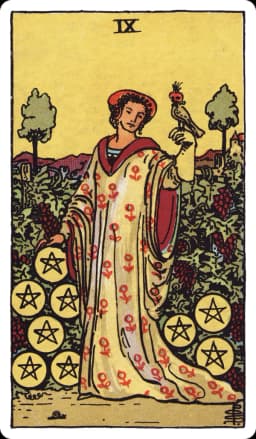
Both describe material stability, but the Nine of Pentacles shows someone at ease and self-sufficient, genuinely enjoying resources they've built. The Four of Pentacles shows someone tense and defensive, still gripping tightly rather than settled — stability achieved but not yet trusted enough to be relaxed into.
Does reversed Four of Pentacles always mean financial trouble?
No — reversed can go either direction. It sometimes describes a healthy loosening of an overly tight grip on money or control, which is a genuinely positive reading. Other times it describes real financial insecurity surfacing. The surrounding cards and the honest state of your finances usually make clear which applies.
Related Cards
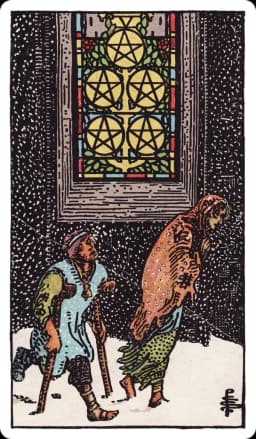
Spreads that read Four of Pentacles
- Decision-Making Spread (Two Paths) — 7 positions, intermediate
- Chakra Spread — 7 positions, intermediate
- Money & Abundance Spread — 5 positions, intermediate
- Career Change Spread — 6 positions, intermediate
Where Four of Pentacles sits in the deck
Card correspondences sourced from the Hermetic Order of the Golden Dawn tradition — see our methodology.