Major Arcana · Major Arcana
Wheel of Fortune
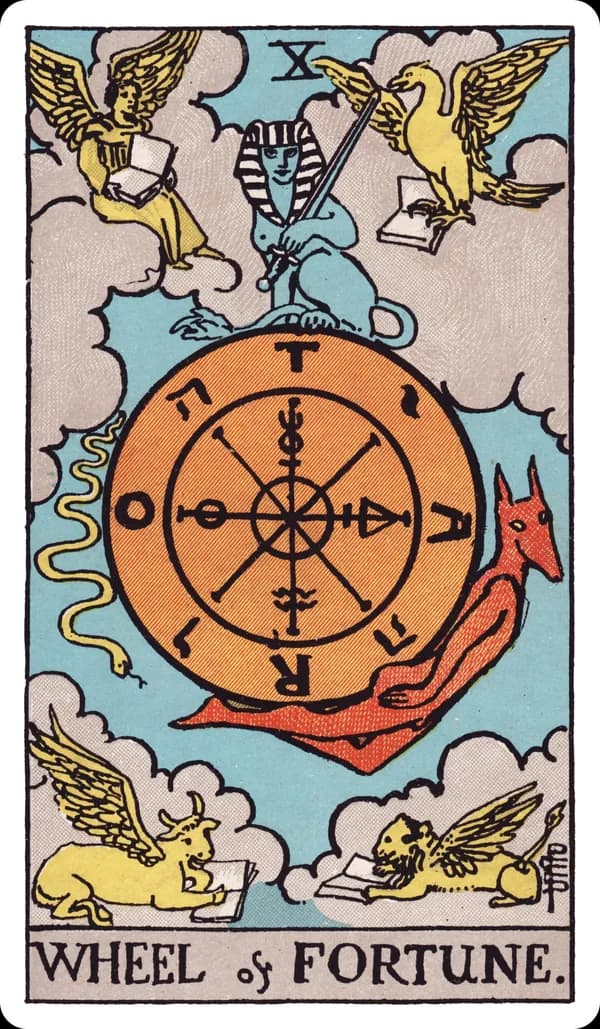
After the Hermit's solitary mountain peak, the deck's traveler looks up to find a wheel suspended in open sky, turning on its own regardless of anyone's individual effort or preference — a striking contrast to the willed, deliberate cards that came before it. A sphinx sits fixed at the top holding a sword, unmoved by the wheel's rotation, while a jackal-headed figure rises on one side and a serpent descends on the other, embodying the wheel's endless cycle of ascent and descent. Numbered X, closing the first full decade of the Major Arcana's sequence, this card represents forces genuinely larger than individual control — fate, timing, and the cyclical nature of fortune, which rises and falls regardless of how much willpower a person applies. Where the Chariot and Strength were both about mastering something through personal effort, the Wheel of Fortune openly acknowledges that some turns of circumstance simply arrive on their own schedule, and the wisest response is adapting to the cycle rather than fighting it.
- Element
- fire
- Ruling planet / sign
- Jupiter
Numerology: Ten closes the Major Arcana's first full cycle and reduces back to one (1+0=1) — an ending that's simultaneously a fresh turn, the same way the wheel itself has no true beginning or end, only positions that keep changing. It marks completion doubling back into new potential rather than a final stop.
Upright Meaning
Upright, the Wheel of Fortune signals a genuine turning point — a shift in circumstances that arrives through timing and momentum rather than through your own direct effort. It favors recognizing and moving with a favorable change rather than resisting it: an unexpected opportunity, a stroke of good timing, or simply the sense that a difficult cycle is genuinely turning toward something better after a period of struggle. This card carries a strong sense of fate and larger cyclical forces at work — not everything in life responds to willpower alone, and the Wheel names the moments when circumstance itself is shifting in your favor. Jupiter's association with luck and expansion adds real optimism to this card: an upswing, a lucky break, or an opportunity arriving at exactly the right moment is squarely this card's territory. In a reading, the Wheel of Fortune often suggests that change is coming (or already underway) whether you actively push for it or not, and the more useful response is staying flexible and ready to take advantage of a shifting situation rather than clinging to how things have been.
Reversed Meaning
Reversed, the Wheel of Fortune's favorable turn either resists or reverses into a downturn. The most common reading is resistance to change: clinging to a familiar situation even as circumstances are clearly shifting, refusing to adapt to a cycle that's genuinely turning, which tends to make an unavoidable change harder rather than preventing it. A second reading is bad timing: an opportunity that arrives at the wrong moment, or effort that's genuinely well-placed but simply doesn't align with the current cycle's direction, no fault of the person involved. A third reading is a downturn specifically: a run of bad luck, a setback after a period of relative ease, or a sense that circumstances have turned against you for reasons that don't trace back to anything you did wrong. Not every difficulty here is a personal failure — sometimes the wheel is simply on its way down, and the more useful response is patience and adaptation rather than self-blame, trusting the cycle will eventually turn again the way it always does.
Read the full reversed meaning →Symbolism
The Hebrew letters around the wheel's rim are traditionally read as spelling out YHVH, a name of God in Jewish tradition, interspersed with alchemical symbols for mercury, sulfur, water, and salt — a deliberate blending of Hebrew mysticism and Western alchemy that reflects the wider esoteric synthesis running through the entire Rider-Waite-Smith deck's symbolism. The sphinx at the wheel's top, sword in hand but otherwise motionless, represents a stillness or wisdom that exists above the endless rise and fall below it — a reminder that even amid constant change, something can remain steady. The four winged creatures in the corners — commonly identified as a man or angel, an eagle, a lion, and a bull — are the same four figures that reappear around the dancing figure in the World, the deck's final card; each reads a book, undisturbed by the wheel's motion, traditionally linked to the four fixed astrological signs (Aquarius, Scorpio, Leo, and Taurus) and to the four evangelists in Christian iconography, suggesting a deeper order underlying the wheel's apparent randomness. Jupiter's rulership, the traditional planet of luck, expansion, and fortune, reinforces the card's core theme: forces of growth and opportunity that arrive through timing and circumstance as much as through personal effort.
Wheel of Fortune from the Rider-Waite-Smith deck: a large wheel hangs in a blue sky, marked with Hebrew letters and alchemical symbols around its rim, a sphinx holding a sword seated at its top, a jackal-headed figure rising on the right side and a serpent descending on the left, while a winged angel, an eagle, a lion, and a bull — each holding an open book — sit in the four corners reading among the clouds.
→ See what Jupiter means in your horoscope on GetMyHoro
→ Find your own life-path number on NumberAngel
In Love
Timing and circumstance, more than either person's deliberate effort, drive this card's love reading. Single, it often favors an unexpected shift — meeting someone through a chance circumstance, a change in your life situation opening up possibilities that weren't there before, or simply the sense that your romantic luck is genuinely turning after a quieter stretch. It's a weaker fit for a deliberate, planned pursuit of a specific person, since this card's nature favors things arriving through circumstance rather than direct engineering. Partnered, it can describe a relationship entering a genuinely new phase — for better, driven by changing circumstances rather than either partner's direct effort. Reversed, the caution splits: resisting a change the relationship (or your own readiness for one) clearly needs, holding onto a familiar but no-longer-working situation out of fear of the unknown, or a genuine downturn — a rough patch, bad timing, or circumstances working against the relationship through no clear fault of either person. It can also describe repeating a familiar pattern because change feels harder than staying stuck, even when the pattern isn't serving you.
Read the full love meaning →In Career
At work, the Wheel of Fortune favors recognizing and moving with a shifting opportunity — a sudden opening, a change in company direction, or an unexpected chance that arrives through timing and circumstance more than through deliberate planning. This card suits flexibility over rigid long-term plans; it rewards staying alert to shifting circumstances and being ready to act when a favorable turn appears, rather than assuming your current trajectory will simply continue unchanged. It's also associated with career changes driven by external factors — industry shifts, restructuring, a market opportunity — as much as by your own initiative. As coworker or manager energy, the Wheel of Fortune describes someone whose career has been shaped significantly by good timing and adaptability, often landing well specifically because they moved with changing circumstances rather than fighting them. Reversed, the caution points toward resisting a professional change that's clearly needed, or a career downturn — a layoff, a missed opportunity, a stretch of bad timing — that isn't really a reflection of your actual ability. It can also describe repeating the same professional pattern out of comfort even as circumstances have clearly shifted around it, needing adaptation you've been avoiding.
Read the full career meaning →Money & Health — Reflection Themes
Money: This card, taken as a theme for financial reflection, favors recognizing and adapting to shifting circumstances: an unexpected opportunity, a favorable turn in timing, or simply a financial cycle turning upward after a harder stretch. It carries genuine optimism about financial luck and timing, though it favors staying flexible and ready to act rather than assuming any one financial state, good or bad, is permanent. Reversed, watch for either resisting a needed financial change — holding onto an outdated plan or habit out of comfort — or a genuine downturn arriving through circumstances outside your control, a market shift, an unexpected expense, or simply bad timing. Worth remembering, especially with this card, that a financial setback isn't automatically a sign of poor judgment; sometimes the cycle itself has turned.
Health: This card can point toward a genuine shift in physical or mental wellbeing — a turn toward feeling better after a difficult period, or an unexpected change in circumstances that affects your health in ways not entirely within your control. It favors adapting to your body's changing needs over time rather than expecting one static routine to work forever. Reversed, watch for resisting a needed change to a routine that's clearly stopped serving you, or a genuine downturn in wellbeing that isn't really a reflection of anything done wrong — a setback that arrived through circumstance as much as through any identifiable cause. Health, like fortune, moves in cycles rather than a single fixed line, and a harder stretch doesn't erase the chance of the cycle turning again.
Spiritual Meaning
A sphinx sits perfectly still atop this card's endlessly turning wheel, sword in hand, undisturbed by the constant rise and fall below it — a fitting image for the equanimity this card asks of anyone caught in a hard turn of circumstance. Its message is that life moves in cycles genuinely larger than individual control, and the useful response isn't clinging to good fortune or despairing during a hard one, but staying centered regardless of which direction the wheel is currently moving. As the tenth numbered trump, closing the sequence's first full arc, it marks the point where personal effort — will, structure, discipline, patience — meets forces genuinely beyond individual control. Pulling this card tends to favor practicing acceptance of a change already underway, trusting that the same cyclical nature that brought a difficulty will, in its own time, bring it around again toward something better.
Yes or No?
For yes/no questions, the Wheel of Fortune leans toward 'yes' — a favorable turn of circumstance arriving through timing and momentum rather than direct effort. This card is a genuinely optimistic sign for questions where luck, timing, or external circumstance plays a real role, since it names precisely those forces turning in your favor. An opportunity, a shift in fortune, or whether a difficult period is genuinely about to turn around — this card meets exactly those questions with its warmest yes. Reversed, the answer shifts toward a caution rather than a flat no: the timing may currently be working against the outcome, or resistance to a needed change is blocking a favorable turn that would otherwise happen naturally. Because this card's whole nature is cyclical, a reversed reading today doesn't rule out a different answer once the cycle turns again, which it eventually will.
Read the full yes-or-no breakdown →Frequently Asked Questions
Does the Wheel of Fortune always mean good luck?
Upright, it's one of the more optimistic cards in the deck, generally favoring a positive turn of circumstance. Reversed, it more often signals a downturn or resistance to a needed change, so the reversal genuinely matters for how favorably this card reads.
Is the Wheel of Fortune about fate or free will?
It's traditionally read as acknowledging that some outcomes are shaped by forces genuinely beyond individual control — timing, circumstance, and cyclical change — without denying that personal effort still matters. Many readers treat it as a reminder to work with the current cycle rather than purely against it.
What do the four creatures around the Wheel of Fortune represent?
Their reading posture is worth noticing specifically: each is absorbed in a book rather than watching the wheel turn, suggesting a fixed body of knowledge that doesn't get rewritten by whichever way luck happens to be moving at a given moment.
Why is bad luck under the Wheel of Fortune not always your fault?
Because this card explicitly represents forces of timing and circumstance that operate independently of individual effort or worth — a downturn under this card's reading isn't necessarily a sign of poor judgment, since the wheel's motion, by its own nature, includes both rises and falls that aren't caused by the person experiencing them.
Related Cards
Spreads that read Wheel of Fortune
- Year Ahead Spread — 12 positions, advanced
- Pros and Cons Spread — 5 positions, beginner
Where Wheel of Fortune sits in the deck
- Ten of WandsThe Wands card numbered 10
- Ten of CupsThe Cups card numbered 10
- Ten of SwordsThe Swords card numbered 10
- Ten of PentaclesThe Pentacles card numbered 10
- The MagicianReduces to the same root number (1)
- The SunReduces to the same root number (1)
- The EmperorAlso fire — Aries
- StrengthAlso fire — Leo
Card correspondences sourced from the Hermetic Order of the Golden Dawn tradition — see our methodology.