Minor Arcana · Pentacles
Ten of Pentacles
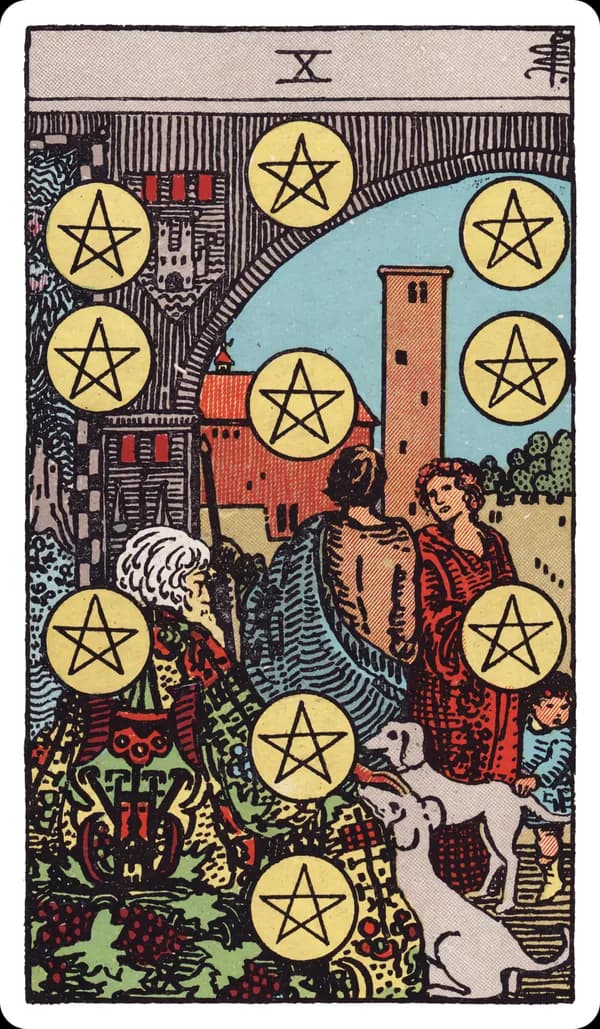
The Ten of Pentacles is the busiest, most populated scene in the entire suit, an elderly man seated beneath a carved stone archway, two dogs at his side, watching a younger couple and a small child play in the foreground, the whole scene framed by a walled town glimpsed through the arch behind them. Ten pentacles are arranged around the composition in the specific pattern associated with the Kabbalistic Tree of Life, not scattered randomly but placed with real intention, tying the card's material abundance to something older and more structured than simple luck. Nothing about the scene suggests a single triumphant moment; it reads instead as an ordinary afternoon within a family and a place that have clearly been established for a long time, wealth so settled it's become the unremarkable backdrop to a child's play rather than something anyone in the frame is actively celebrating. Where the Nine of Pentacles shows one woman's individually earned comfort, the Ten widens the lens considerably, security extended across generations, a household, and the physical place that holds them all together.
- Element
- earth
- Ruling planet / sign
- Mercury in Virgo
- Suit
- pentacles
Numerology: Golden Dawn title "Lord of Wealth" — Mercury's connective exchange meeting Virgo's careful stewardship describes wealth that moves between people and generations rather than sitting static in one pair of hands. Ten closes the suit's cycle the way every ten does, a full circle completed, here specifically as security passed on rather than security merely held.
Upright Meaning
Where the Nine holds exactly one figure, this card is crowded on purpose, an elder, a couple, a child, two dogs, a whole walled town glimpsed through the archway behind them. Upright, it describes long-term security that extends beyond any single person, wealth or stability built specifically to outlast the individual who built it. It favors thinking generationally: the real subject here is continuity, effort invested not just for your own benefit but for a family, a community, or a legacy that continues after you. It often shows up around genuinely established stability, a home fully paid for, a family business, an inheritance received or being planned, wealth settled enough to have become the reliable backdrop to ordinary life rather than something anyone actively worries about day to day. It can also describe the accumulated wisdom an elder brings to a family, value that isn't purely financial but includes real, hard-won experience passed down.
Reversed Meaning
The archway that frames this family so comfortably upright can start to look less solid once the card reverses. A financial loss significant enough to threaten long-term security is the most literal shape, an inheritance squandered, a family business failing. A family dispute over inheritance is a second, conflict about who gets what, or whose contribution actually earned a share of a legacy. A third is broader instability, a family that looks established on the surface but is actually resting on shakier ground than it appears. What's actually breaking down tells you which fits: money itself points toward the financial-loss reading, conflict over money points toward inheritance disputes, and a general sense of shaky ground points toward instability.
Read the full reversed meaning →Symbolism
The elderly man's position, seated, watching, slightly apart from the couple and child's activity, suggests a patriarch or founder figure, someone whose accumulated effort built the foundation the younger generation now simply gets to enjoy without having built it themselves. His two dogs, calm and settled beside him, reinforce a sense of established, comfortable domesticity rather than any active threat or urgency anywhere in the scene. The carved archway, decorated with grapevines and heraldic crests, is a specifically dynastic image, family identity literally built into the architecture, a home that carries history rather than existing as a blank, purchased structure. The ten pentacles arranged in the Tree of Life pattern is one of the deck's more overtly esoteric details, suggesting the material wealth shown here isn't separate from a larger, structured cosmic order but is instead one legitimate expression of it. The walled town glimpsed through the archway situates this family within a wider, established community rather than isolated wealth existing apart from any social context. Unlike the Nine's single figure, this card is crowded on purpose, generational continuity depicted quite literally as more than one person present and accounted for.
The Ten of Pentacles from the Rider-Waite-Smith deck: an elderly man sits beneath a grand archway carved with grapevines and coats of arms, two dogs beside him, watching a couple and a small child in the foreground, ten pentacles arranged around the scene in the pattern of the Tree of Life, a walled town visible through the archway.
→ See what Mercury in Virgo means in your horoscope on GetMyHoro
→ Find your own life-path number on NumberAngel
In Love
In love readings, this card points most reliably toward a relationship built for real staying power, potentially marriage, family, or a shared life meant to run well beyond the present moment, not a fling with an uncertain shelf life. Single, it can mark being drawn toward, or ready for, something with genuine long-term potential specifically, not a fling but something built with a future family and legacy in mind. Partnered, it frequently describes a relationship that's reached genuine, settled stability, perhaps including shared family or a home, security that's become an unremarkable, comfortable backdrop rather than something actively negotiated day to day. Reversed, the reading turns toward instability threatening that long-term picture, financial strain affecting a family's security, or genuine conflict, sometimes literally over money or inheritance, disrupting what had felt like settled stability.
Read the full love meaning →In Career
This card at work usually describes a career built for genuine long-term security, a family business, a role with real generational continuity, or work specifically oriented toward building something that outlasts your own individual involvement. It favors thinking in terms of legacy, decisions made with a longer time horizon than the next paycheck. It can also describe mentorship specifically, passing accumulated professional wisdom down to someone earlier in their career. Reversed, it points toward instability threatening an otherwise established professional situation, a family business in real financial trouble, or conflict over succession or ownership, a professional legacy contested rather than smoothly transferred.
Read the full career meaning →Money & Health — Reflection Themes
Money: Genuinely long-term financial security, wealth built specifically to last across years or generations rather than a single windfall, is this card's core financial theme, read as a prompt for reflection rather than instruction. It favors thinking beyond your own immediate needs toward what you're actually building for others, a legacy that extends past your own lifetime. Reversed, it can point to a real financial loss threatening that long-term security, or conflict specifically about money within a family, disputes over inheritance or shared resources that damage relationships as much as finances.
Health: Long-term physical or mental wellbeing built specifically to last, habits and support systems established with enough foresight that they hold up over years, is this card's health theme as a subject for reflection. It favors thinking generationally about health too, patterns passed down through a family worth examining honestly as part of your own picture. Reversed, the same card can flag a health foundation that looked settled proving less stable than it appeared, or family conflict specifically affecting wellbeing, disagreement about caregiving for an aging relative. This card isn't linked to any one condition; what it signals is the durability of wellbeing built across a longer stretch of time than any single moment.
Spiritual Meaning
A family spanning generations, gathered comfortably beneath a home built by those who came before them, offers a genuinely powerful image of continuity, the sense that your own life is one link in a longer chain rather than something isolated and self-contained. This card, in a spiritual context, often marks connecting with ancestry or lineage, honoring what was built and passed down, or consciously considering what you're building for whoever comes after you. It rewards thinking beyond your own individual journey toward the legacy, wisdom or otherwise, that you're actually leaving behind. Reversed, the reading shifts toward disconnection from that lineage, ancestral wisdom available but genuinely unclaimed, or spiritual conflict within a family that fractures the continuity this card at its best represents.
Yes or No?
This card leans toward yes specifically for questions about long-term security, stability, or whether something is being built to genuinely last. It favors durable, generational thinking over short-term gain: ask it whether a foundation will hold up over years and it answers with real confidence, ask it about an immediate payoff and that confidence mostly evaporates. Reversed, the yes weakens toward either real financial or relational instability undermining what had looked settled, or family conflict, particularly around inheritance, disrupting the continuity this card's upright form depends on.
Read the full yes-or-no breakdown →Frequently Asked Questions
What do the ten pentacles arranged in the Tree of Life pattern mean?
The arrangement ties this card's material wealth to a larger, structured spiritual and cosmic order rather than treating it as separate or accidental, a genuinely esoteric flourish among the RWS deck's numbered pip cards, hinting that the security on display fits into something bigger and more intentional than simple good fortune.
Is the Ten of Pentacles a good card for marriage or starting a family?
Yes, few cards in the deck describe long-term commitment and generational staying power as directly as this one does. It favors relationships and families built to outlast the present moment by design, not by accident.
What's the difference between the Ten of Pentacles and the Nine of Pentacles?
The Nine shows one person's individually earned comfort and self-sufficiency. The Ten widens the picture considerably, security and legacy extended across a whole family or generations, built by more than one person and meant to outlast any single individual.
Does reversed Ten of Pentacles always mean losing an inheritance?
Not always, though a financial loss or an inheritance dispute is one common reading. It can also describe broader instability hidden beneath an outwardly settled family or financial picture, without necessarily involving a literal inheritance at all.
Related Cards
Spreads that read Ten of Pentacles
- Relationship Spread (Two-Person) — 6 positions, intermediate
Where Ten of Pentacles sits in the deck
Card correspondences sourced from the Hermetic Order of the Golden Dawn tradition — see our methodology.