Minor Arcana · Swords
Ten of Swords
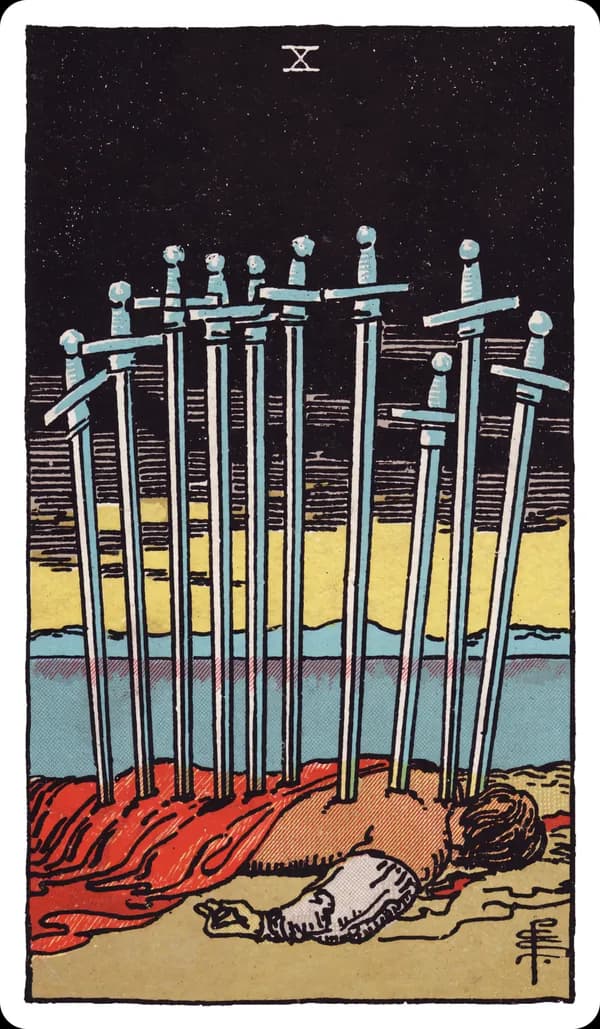
The Ten of Swords shows the suit's darkest single image and its quietest sign of hope in the same frame: a man lies face down, ten swords driven into his back in an unbroken line, the damage total and, on the surface, unmistakably final. The sky above him is heavy and black, storm-dark, matching the scene's obvious devastation. But the horizon tells a different story. Past the man's stilled body, past the last of the swords, the sky brightens into a calm, golden sunrise, spreading gently over distant hills and water, entirely undisturbed by the wreckage in the foreground. This is the only card in the deck to pair total collapse with a literal, visible sunrise in the same composition, and that pairing is the whole point: the worst has genuinely, fully happened, and the day is beginning anyway. Where the Nine of Swords shows fear of an ending that hasn't arrived yet, the Ten of Swords shows the ending having already, completely occurred, with nothing left to dread because there's nothing left to happen. What's left is only what comes after.
- Element
- air
- Ruling planet / sign
- Sun in Gemini
- Suit
- swords
Numerology: Golden Dawn title "Lord of Ruin" — the Sun's clarifying light meeting Gemini's restless duality produces total, undeniable exposure rather than warmth. Ten closes the suit's cycle at its bleakest point on the surface, though a genuine sunrise on the horizon quietly signals the reduction back to one that every closing ten in the deck carries within it.
Upright Meaning
Upright, the Ten of Swords describes an ending that has already, definitively happened, painful, total, and, importantly, complete rather than still unfolding. It favors accepting that completeness rather than continuing to fight a battle that's actually already over: this card's real cruelty would be denying the ending occurred and continuing to struggle against it, when the more honest and ultimately less painful path is acknowledging that this particular chapter is finished. It can describe betrayal specifically, an ending brought about by someone else's actions rather than simply circumstance, a hurt made sharper by who caused it. It's often associated with hitting a genuine low point, rock bottom, the point past which things can't reasonably get any worse in this particular situation, which carries its own strange, hard-won relief once it's actually reached rather than still being anticipated. The sunrise on the horizon is the card's real message, and it's worth taking seriously even in the depths of the foreground devastation: because this ending is total, it also closes the loop entirely, clearing the ground completely for something new to begin, in a way a partial, unresolved difficulty never quite manages to do.
Reversed Meaning
Reversed, the Ten of Swords most often describes recovery beginning, the sunrise the upright card only shows on the horizon finally becoming the more immediate reality, real healing and rebuilding underway after a genuinely difficult ending. It favors patience with that rebuilding process: this card's recovery tends to be gradual rather than instant, matching the sunrise's own unhurried, steady spread across the sky rather than a sudden burst of light. A second reversed reading involves resisting an ending that's actually already occurred, refusing to accept that something is over, continuing to fight a battle that's genuinely finished, which tends to prolong suffering rather than resolve it, since energy spent denying a completed ending is energy not spent on the real work of rebuilding afterward. A third reading describes a difficult situation dragging on longer than it needs to, an ending delayed rather than avoided, still painfully unresolved rather than mercifully complete. Distinguishing these usually comes down to whether real forward motion is present: genuine rebuilding points toward recovery, continued struggle against an already-settled fact points toward resistance.
Read the full reversed meaning →Symbolism
Ten swords, one for every number the suit's pip cards count through, arranged in a single unbroken line down the figure's back, is a deliberately total image, this isn't a partial defeat with room for a different outcome, it's the full sequence, the whole story concluded at once. The dark red cloak beneath him is sometimes read as blood, sometimes simply as the color of the ending itself, either way it reinforces that something significant and final has occurred here, not a minor setback. His stillness matters as much as the swords: he isn't struggling, reaching, or reacting, the fight, whatever it was, is entirely over, and the posture itself communicates that continuing to resist would be pointless because there's genuinely nothing left to resist. The black sky directly above him is heavy and total, matching the scene's devastation without qualification. And then the horizon: golden, calm, undisturbed, a sunrise that doesn't care that a battle just ended badly a few feet away, indifferent in a way that reads, paradoxically, as comfort rather than cruelty. The sun doesn't wait for permission or for the wreckage to be cleared before it rises; it simply does, on its own schedule, regardless of what happened in the night that came before it.
The Ten of Swords from the Rider-Waite-Smith deck: a man lies face down on the ground, ten swords piercing his back in a straight line from shoulders to legs, a dark red cloak beneath him, a black sky above giving way to a bright yellow sunrise breaking calmly over distant hills and water on the horizon.
→ See what Sun in Gemini means in your horoscope on GetMyHoro
→ Find your own life-path number on NumberAngel
In Love
In a love reading, the Ten of Swords often describes a definitive, painful ending, a breakup, a betrayal, a relationship concluding in a way that leaves little ambiguity about whether it's actually over. For someone single, it can mark the end of hope for a specific connection that had genuinely run its course, or the final, clear-eyed acknowledgment that a situation you'd been holding out hope for has actually, fully concluded. It can also describe betrayal discovered, a painful truth about someone's real intentions or actions finally becoming undeniable rather than merely suspected. For someone partnered, it frequently marks a relationship's genuine end, sometimes through one clear, decisive event, sometimes through the final, unavoidable acknowledgment that a slow decline has actually reached its conclusion. This card rarely describes ambiguity, its whole visual language is totality and completeness, which paradoxically makes it one of the more clarifying cards in the suit even in its pain. Reversed, the reading turns toward recovery beginning after that ending, real healing underway, or, less comfortably, continuing to resist an ending that's genuinely already occurred, refusing to accept a relationship is over in a way that delays the real work of moving forward into whatever comes next.
Read the full love meaning →In Career
At work, the Ten of Swords frequently describes a definitive professional ending, a job loss, a project's complete failure, a professional relationship concluding in a way that leaves little room for ambiguity about what's happened. It favors accepting that ending clearly rather than continuing to fight for a situation that's genuinely already concluded, since this card's message is that clean, total endings, however painful, clear real ground for what comes next in a way a drawn-out, unresolved decline never quite manages. It can also describe professional betrayal specifically, being let go unfairly, having credit or a position taken by someone else's undermining, an ending made sharper by its cause. Reversed, the career reading points toward recovery beginning after that ending, a new role or direction gradually taking shape, professional confidence slowly rebuilding after a genuine low point. It can also describe refusing to accept that a professional situation is actually over, continuing to apply unwanted effort toward a role or a company that has, in reality, already concluded its relationship with you, or a difficult professional situation being needlessly dragged out rather than allowed to reach its actual, clarifying conclusion.
Read the full career meaning →Money & Health — Reflection Themes
Money: As a theme for financial reflection, the Ten of Swords upright can describe a definitive financial low point, a significant loss, a bankruptcy, a financial chapter concluding in a way that leaves little ambiguity about what's happened. It favors accepting that low point clearly, painful as it is, rather than continuing to deny its full scope, since genuinely acknowledging the bottom is usually the necessary first step toward the rebuilding this card's reversed form describes. It can also describe financial betrayal, being deceived or taken advantage of in a way that concludes a financial arrangement or relationship decisively. Reversed, it can point to financial recovery beginning, a slow, steady rebuild after hitting a genuine low, or it can describe continuing to deny or resist a financial reality that's already settled, refusing to accept a loss has occurred in a way that prevents the real work of rebuilding from actually starting. Take this, as with the site's money reflections generally, as a prompt to face a difficult financial reality honestly rather than as a forecast on its own.
Health: As a theme for reflection, the Ten of Swords upright can describe reaching a genuine low point in a health situation, physical or emotional, a difficult diagnosis, a crisis point, an ending of some kind, a phase of illness, a relationship with an old version of your own body or capability, that has genuinely, completely concluded. It favors honest acknowledgment of that low point as real and total, since this card's particular relief tends to arrive only once the full weight of the ending is actually accepted rather than continued to be fought or denied. Reversed, the same card can flag genuine recovery beginning, a slow, gradual healing process finally underway after reaching the bottom, or it can describe continuing to resist a health reality that's already settled, refusing to accept a diagnosis or a limitation in a way that delays the real adaptation and healing that acceptance tends to make possible. There's no particular condition tied to this card; what matters here is the difference between an ending fully faced and one still being denied.
Spiritual Meaning
A total, undeniable collapse paired with a calm, indifferent sunrise on the same horizon is one of the deck's most powerful spiritual images, suffering that is entirely real and entirely valid, sitting directly beside a renewal that doesn't wait for permission to begin. The Ten of Swords tends to arrive spiritually during a genuine rock bottom, a spiritual dark night where an old identity, belief, or way of living has definitively ended, painful precisely because it's total rather than partial. It rewards trusting that totality rather than fighting it, since many spiritual traditions treat a complete ending as the necessary clearing that makes real, ground-up renewal possible in a way a partial, lingering decline never quite achieves. Reversed, the spiritual reading shifts toward the sunrise itself finally becoming the more immediate reality, genuine rebuilding underway, or, less comfortably, continuing to resist a spiritual ending that's already occurred, refusing to let an old identity or belief system go even once it's genuinely, completely finished.
Yes or No?
For yes/no questions, the Ten of Swords is one of the more direct 'no' answers in the deck, since its core meaning is a definitive, completed ending, which maps poorly onto almost any hoped-for favorable outcome someone is asking about. If your question concerns whether a specific situation, relationship, or plan will continue or succeed, this card is a fairly clear signal that the honest answer involves a genuine, total conclusion rather than continuation. It's worth taking this verdict seriously rather than hoping other cards in the spread override it, since this particular card rarely shows up as a minor caveat to an otherwise favorable reading. Reversed, the verdict softens somewhat, particularly if your question concerns something already in the past, has the worst already happened, is recovery beginning, since a reversed Ten of Swords often confirms that the low point has been reached and real rebuilding is genuinely starting, a meaningfully different and more hopeful kind of answer than more difficulty still to come.
Read the full yes-or-no breakdown →Frequently Asked Questions
Why does the Ten of Swords show a sunrise if the scene is so devastating?
The sunrise is the card's real message: because the ending shown is total and complete, it also clears the ground entirely for something new to begin. It's one of the deck's clearest visual arguments that a full, honest ending, however painful, creates more genuine room for renewal than a partial, drawn-out decline ever manages to.
Is the Ten of Swords the worst card in the deck?
Most readers actually rank a handful of reversed cards, like reversed Devil's active self-sabotage or a stalled Eight of Swords, as harder to sit with long-term, precisely because those describe ongoing distortion rather than a fact already settled. This card's totality is what makes it uncomfortable to draw, not necessarily what makes it the worst to live through.
What's the difference between the Ten of Swords and the Nine of Swords?
Picture them as two points on a single timeline rather than two separate misfortunes: the Nine is the night before, replaying every way it could go wrong, and the Ten is the morning after, when there's nothing left to replay because it already happened. Readers who draw the Nine often find the actual event, once it arrives, is less catastrophic than the anticipation was.
Does reversed Ten of Swords mean the ending didn't really happen?
Not usually, it more often describes recovery beginning after a real ending, or, less favorably, refusing to accept an ending that's genuinely already occurred. It rarely undoes the ending itself; it more often describes what happens next, moving forward or resisting the need to.
Related Cards
Spreads that read Ten of Swords
- Five-Card Spread — 5 positions, beginner
- Break-Up / Closure Spread — 5 positions, intermediate
- Weekly Spread — 7 positions, intermediate
Where Ten of Swords sits in the deck
Card correspondences sourced from the Hermetic Order of the Golden Dawn tradition — see our methodology.