Minor Arcana · Wands
Ten of Wands
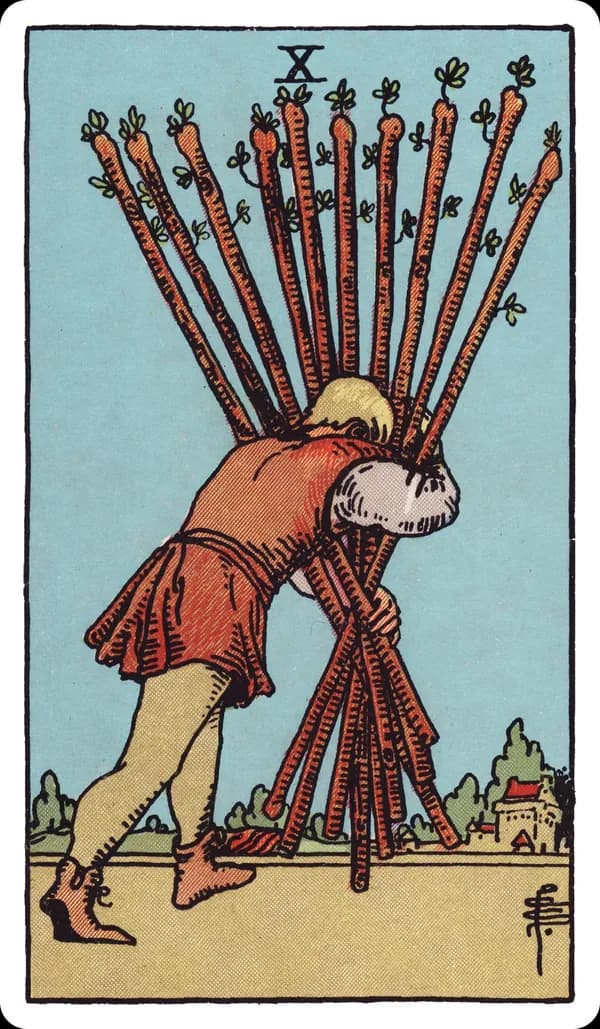
The Ten of Wands closes the suit's numbered sequence with an image that has nothing triumphant about it: a man carrying all ten wands at once, arms wrapped fully around the bundle, back bent forward under the weight, his face almost entirely hidden behind the load he's carrying. He's not being attacked, defended against, or celebrated by anyone, unlike so many of the suit's earlier scenes; this is a private, unglamorous kind of struggle, made harder by the fact that no one else appears to be sharing it. In the distance, across a plowed field, a small town and a house are visible, close enough to see, far enough that reaching them still requires real effort. The wands themselves aren't being used for anything, they're simply being hauled, dead weight rather than tools currently doing work. It's a striking contrast to the suit's opening burst of pure potential in the Ace: where that card showed fire as a single, hopeful spark, this one shows fire's energy fully spent carrying obligations that piled up faster than they were ever meant to be carried by one person alone.
- Element
- fire
- Ruling planet / sign
- Saturn in Sagittarius
- Suit
- wands
Numerology: Golden Dawn title "Lord of Oppression" — Saturn's weight landing on Sagittarius' usually far-reaching optimism describes a burden heavy enough to shorten the view to just the next few steps. Ten closes the Wands suit's cycle not with triumph but with the specific cost of getting everything this far single-handedly.
Upright Meaning
Upright, the Ten of Wands describes carrying more responsibility, work, or obligation than is comfortable, often because each individual piece was reasonable to take on at the time and only became a genuine burden in combination with everything else. It favors recognizing the accumulation honestly: this card rarely describes one dramatic overload, more often a slow buildup of commitments that each made sense alone and now, together, are genuinely heavy. It can mark real, near-term success, the destination is visible, close enough to see, but it doesn't pretend the final stretch is easy; the card is honest that reaching the goal still requires carrying the full weight the whole remaining way. This is a card about legitimate effort rather than wasted struggle, the plowed field beneath the figure signals productive ground, not a pointless or self-sabotaging burden, but it's equally honest that legitimate effort still has a real cost worth naming rather than minimizing. The core question this card asks is rarely whether the work is worth doing, it's whether it needs to keep being carried entirely alone, all the way to the end, without ever setting any of it down.
Reversed Meaning
Reversed, the Ten of Wands most often describes finally releasing part of a burden, delegating a responsibility, saying no to a new obligation, or simply setting something down that's been carried far longer than it should have been. This is one of the more genuinely relieving reversed cards in the deck when read this way: the load lightens not because the goal was abandoned, but because it stopped needing to be carried by one person alone. A second, less comfortable reversed reading describes burnout that's already arrived rather than being narrowly avoided, the point where the weight has become unsustainable and something, a project, a commitment, a relationship's worth of unshared labor, has to give whether or not you've consciously decided to let it. A third reading involves collapse under the weight rather than a controlled release, dropping everything at once rather than setting pieces down deliberately, which solves the immediate overload but can create its own new problems. Telling these apart usually comes down to whether the release feels chosen and controlled, pointing toward healthy delegation, or forced and sudden, pointing toward burnout or collapse.
Read the full reversed meaning →Symbolism
The bundle's size relative to the man carrying it is the image's central exaggeration, and it's deliberate: ten wands is genuinely more than two arms can comfortably manage, which is exactly the point. He's chosen, or been given, or simply accumulated, more than any one person reasonably should carry alone, and the artwork makes that visually obvious rather than subtle. His obscured face matters too — he can't see clearly where he's going, both literally, since the wands block his view, and figuratively, since being this overloaded tends to narrow focus down to just the next step rather than the larger picture. The plowed field beneath him is worth noting: it's cultivated, productive ground, not wilderness, suggesting this burden is the result of real, legitimate effort and responsibility rather than random misfortune. The house and town in the distance represent the destination, close enough to be visible, which is both hopeful, the goal is real and reachable, and cruel, since it's still far enough away that the load has to be carried the whole remaining distance. Unlike the earlier Seven and Nine of Wands, there's no visible opponent here at all; the struggle in the Ten of Wands is entirely with the load itself, self-inflicted or accepted rather than imposed by anyone else in the frame.
The Ten of Wands from the Rider-Waite-Smith deck: a man bent forward under the weight of ten wands bundled tightly in his arms, his face obscured by the load, trudges toward a distant town and house across a plowed field.
→ See what Saturn in Sagittarius means in your horoscope on GetMyHoro
→ Find your own life-path number on NumberAngel
In Love
In a love reading, the Ten of Wands can describe a relationship carrying real weight, shared responsibilities, financial pressure, caretaking duties, that has become genuinely heavy for one or both partners, even if none of it is anyone's fault individually. For someone single, it can describe entering a new connection while already carrying unrelated burdens, work stress, family obligations, that leave little energy left over for the relationship itself, worth naming honestly rather than expecting a new partner to simply absorb. For someone partnered, it frequently marks a relationship where one person has quietly taken on far more of the practical or emotional labor than the other, a load that's sustainable in the short term but genuinely unsustainable if it continues unaddressed and unshared. This card rewards an honest accounting of who's actually carrying what, rather than assuming the current division of effort is fine simply because no one has said otherwise. Reversed, the reading turns toward relief, finally sharing a burden that had been carried alone, renegotiating an unequal division of labor, or a difficult chapter finally lightening. It can also describe burnout in the relationship itself, exhaustion that's built up past the point of easy repair without real, direct conversation about the imbalance.
Read the full love meaning →In Career
At work, the Ten of Wands frequently describes a workload that has become genuinely excessive, not necessarily through any single bad decision, but through a slow accumulation of responsibilities that each made sense to accept individually. It favors honesty about the accumulation over quiet endurance: this card's message is rarely that the work itself is wrong, it's that carrying all of it single-handedly, all the way to the goal, has a real and worsening cost. It can describe being close to a genuine achievement, a completed project, a promotion, a finished goal, while still needing to push through a heavy, effortful final stretch to actually get there. Reversed, the career reading points toward delegation finally happening, responsibilities redistributed to a fairer division across a team, or a project handed off rather than dragged across the finish line entirely alone. It can also describe burnout that's already set in, past the point where simply pushing harder will help, or a sudden, uncontrolled collapse, quitting abruptly, missing a deadline outright, rather than a planned, deliberate release of some of the load. The corrective this card usually points toward is asking for help earlier than pride or habit typically allows.
Read the full career meaning →Money & Health — Reflection Themes
Money: As a theme for financial reflection, the Ten of Wands upright can describe carrying real financial responsibility, supporting others, managing debt, funding a long-term goal, that's become genuinely heavy even though each individual obligation was reasonable when it was taken on. It favors honest accounting over quiet endurance: naming the full weight of what's currently being carried financially, rather than treating each commitment as a separate, manageable piece in isolation from all the others. It can also describe being close to a real financial goal, savings, a debt paid off, a purchase achieved, while still needing to push through a genuinely effortful final stretch to actually reach it. Reversed, it can point toward financial relief, a debt finally paid down, an expense successfully shared or reduced, a burden lightened through a clear decision rather than continued strain. It can also describe financial burnout, exhaustion from managing money stress for too long without support, or a sudden financial collapse, a missed payment, an abrupt cutback, rather than a planned, gradual easing of the load.
Health: As a theme for reflection, the Ten of Wands upright often points to physical or mental exhaustion from carrying too much for too long, not one acute crisis, but an accumulation of ordinary stress that's become genuinely heavy in combination. It favors recognizing the buildup honestly rather than minimizing it because no single source of stress seems severe enough on its own to explain how tired you actually feel. It can also describe pushing through a difficult final stretch toward a real goal, a recovery, a fitness target, a finished treatment plan, while still needing to carry real, effortful weight the rest of the way there. Reversed, the same card can flag genuine relief finally arriving, a burden lightened, a responsibility shared, rest that's actually being taken rather than continually deferred. It can also point to burnout that's already crossed into real depletion, or a sudden physical or mental collapse, illness, exhaustion that finally forces rest, rather than a chosen, gradual reduction of the load. Rather than flagging any particular condition, this card's real value here is naming how much accumulated, often underestimated weight you're actually carrying.
Spiritual Meaning
Carrying something all the way to a visible destination, without ever quite setting it down along the way, is a genuinely honest picture of a specific spiritual struggle, and the Ten of Wands names it directly rather than dressing it up as noble sacrifice. It marks a stage where devotion, responsibility, or service has tipped from meaningful into genuinely depleting, worth examining honestly rather than treating continued endurance as automatically virtuous. It rewards asking a plain question many spiritual traditions circle around gently: does carrying this alone actually serve the goal, or has it simply become habit, obligation, or a way of proving worth through visible struggle. The plowed field beneath the figure is a useful counterweight to that reading, since it reminds that the effort itself is genuinely legitimate, not wasted or self-inflicted for its own sake, even while the manner of carrying it, entirely alone, deserves real reconsideration. Reversed, the spiritual reading shifts toward release, whether chosen and graceful or forced by exhaustion, and toward the harder practice of trusting that letting something go doesn't mean abandoning the goal it was meant to serve.
Yes or No?
The Ten of Wands leans toward 'yes,' but a heavily qualified one: the goal you're asking about is likely reachable, the destination in the card's own imagery is visible and close, but reaching it will require carrying real, effortful weight the entire remaining distance, not a smooth or easy final stretch. It favors questions about whether persistence toward a near goal will pay off, since the card's core image is precisely that, close but not yet arrived, over questions expecting an easy or uncontested path. A question hoping for immediate relief or an effortless resolution gets a weaker answer from this card, since its whole scene involves ongoing, visible strain rather than ease. Reversed, the yes shifts meaning rather than simply weakening: it can mean the burden is finally being released, which is favorable news for your wellbeing even if it means the original goal, as originally planned, may need to change or be shared differently. It can also mean collapse under the weight rather than a controlled release, worth checking honestly against your own current capacity before assuming which reversed reading actually applies to your situation.
Read the full yes-or-no breakdown →Frequently Asked Questions
Why does the man in the Ten of Wands carry all ten instead of leaving some behind?
The image is often read as a portrait of overcommitment rather than necessity, he's chosen or accumulated more than he needs to be carrying entirely alone. The card's core message frequently points toward setting some of the load down or sharing it, rather than continuing to haul all ten the whole distance single-handedly.
Is the Ten of Wands a bad card to draw?
Not inherently bad, but genuinely effortful, it describes real, near-term achievement paired with real, significant strain to get there. It's less a warning of failure and more an honest acknowledgment that the final stretch toward a legitimate goal is heavier than it should be to carry alone.
The Nine and Ten of Wands both show someone worn down — what actually separates them?
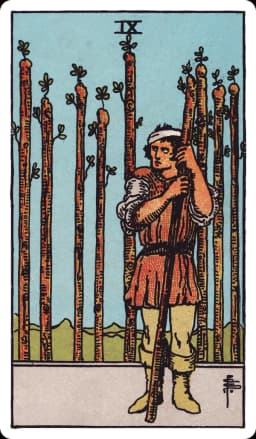
The Nine of Wands describes a wary, wounded defender holding a position, watching for further conflict. The Ten of Wands describes a different kind of exhaustion entirely, no opponent in sight, just the sheer physical and practical weight of obligations accumulated and carried, usually alone.
Does the Ten of Wands mean I'm close to finishing something?
Often yes, the visible town and house in the card's background represent a real, close destination. The card is honest, though, that the remaining distance still has to be covered while carrying the full weight of what's already been taken on.
Related Cards
Spreads that read Ten of Wands
- New Moon Spread — 4 positions, beginner
- Career Change Spread — 6 positions, intermediate
Where Ten of Wands sits in the deck
Card correspondences sourced from the Hermetic Order of the Golden Dawn tradition — see our methodology.