Major Arcana · Major Arcana
The World
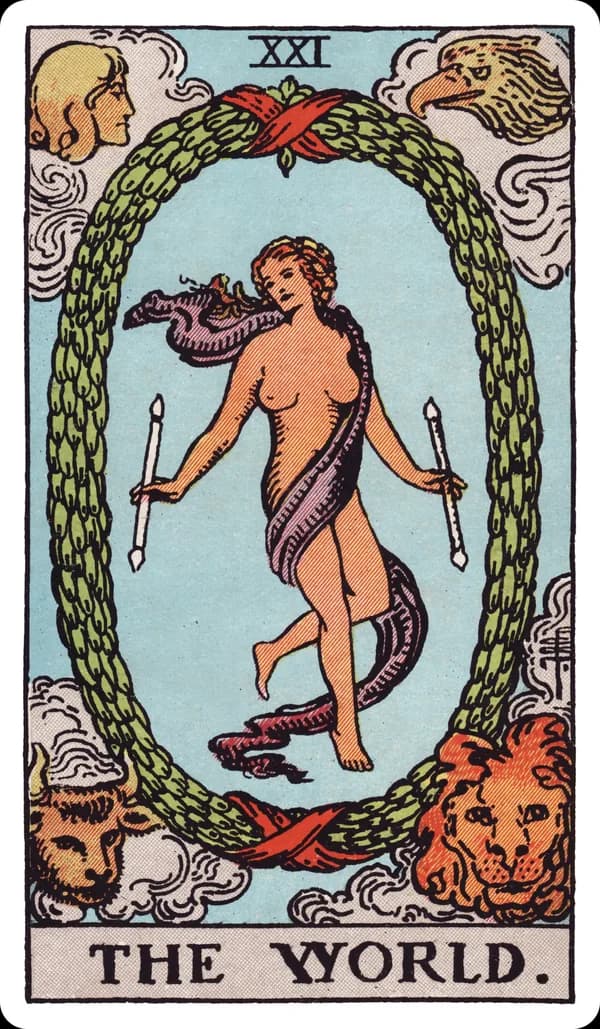
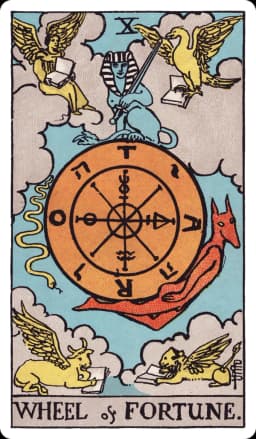
A figure dances inside an oval wreath of laurel at the exact center of the Rider-Waite-Smith World card, and that dance is the whole point of the image: XXI is the last numbered card of the Major Arcana, and its central figure looks entirely at ease with having arrived. She is lightly draped in a length of violet fabric that wraps around her hips and trails off at both ends, holding a short wand in each hand — one of several visual echoes back to the Magician (I), the very first numbered trump, closing the sequence's loop rather than simply ending it. The laurel wreath is bound top and bottom by two red ribbons twisted into a figure-eight, the same lemniscate shape that floats above the Magician's head and crowns Strength's lion — a symbol, repeated across the deck, for a force that has become continuous and self-sustaining rather than linear. In each corner of the card, outside the wreath, a different creature looks inward: a winged human figure at upper left, an eagle at upper right, a bull at lower left, a lion at lower right. These four are the fixed signs of the zodiac — Aquarius, Scorpio, Taurus, and Leo — and the same four figures appear at the corners of the Wheel of Fortune (X), except here they are calm and settled rather than turning. Where the Wheel showed fate in motion, the World shows that motion completed and held steady.
- Element
- earth
- Ruling planet / sign
- Saturn
Numerology: Twenty-one (reducing to three, 2+1) closes the full Major Arcana cycle on a creative, integrated register — completion as its own kind of birth. Saturn's rulership here is fitting: the planet of structure and time governs the card that marks a structure, and a stretch of time, finally reaching its finished shape.
Upright Meaning
Upright, the World is tarot's clearest single image of a finished chapter — not a small milestone, but the genuine close of something that took real time and real effort to build. It shows up when a long project reaches its finish, a personal goal that's been worked toward for months or years finally lands, a period of study or growth concludes, or a major life phase (a relationship, a job, a stretch of healing) reaches a natural, satisfying resolution rather than an abrupt one. Because the card sits at the very end of the Major Arcana's numbered sequence, it also carries a specific flavor of integration: not just one thing succeeding, but multiple threads of effort finally aligning into a coherent whole. The card's literal name gives it an additional, more concrete reading too — travel, particularly international or long-distance travel, and a sense of the world genuinely opening up rather than staying local and familiar. Because the wreath reads as a gateway as much as a boundary, the World rarely means an ending in the sense of a full stop; it means a threshold being crossed, with whatever comes next only visible once you've actually stepped through. In a reading about a specific goal, the World upright is usually read as confirmation: the effort already invested has genuinely paid off, or is about to.
Reversed Meaning
Reversed, the World describes something that's close to finished but hasn't actually closed — a project stalled at ninety percent, a goal delayed by circumstance or by your own reluctance to let it conclude, a chapter that keeps almost ending without quite doing so. It's a card of loose ends: a detail left unresolved, a conversation left unfinished, a formality left unsigned, any of which can hold up a completion that is, in every other respect, already earned. A second reversed reading points inward rather than at external delay: a lesson the current chapter was supposed to teach hasn't fully landed yet, and the same pattern is likely to recur in a new form until it does. This isn't a punitive reading so much as a practical one — the card is naming unfinished business rather than failure. A third, subtler reversed meaning is resistance to an ending that has, in fact, already happened: holding onto the shape of a finished chapter (a job you've outgrown, a relationship that's run its course, an identity that no longer fits) instead of acknowledging the completion and stepping through the gateway it represents. Distinguishing 'not yet closed' from 'refusing to close' usually depends on whether the delay is coming from outside circumstances or from your own hesitation.
Read the full reversed meaning →Symbolism
Look at the dancer's stance and one specific detail repeats a gesture from earlier in the deck: her legs cross at the shin, the same crossed-leg position the Hanged Man (XII) holds while suspended from his tree. In both cases the crossed leg marks a figure who has stopped struggling against their position and is instead held, or moving, within it deliberately — here, dancing rather than suspended. The oval wreath enclosing her is a vesica-piscis shape, an almond formed by two overlapping circles that recurs across centuries of religious art as a gateway between worlds; read that way, the whole card becomes a threshold image rather than a closed loop — completion here isn't a wall sealing something off, it's an opening onto whatever comes after. Laurel itself carries inherited meaning of its own: a wreath of laurel leaves was the mark given to victors in ancient Greek and Roman contests, so the specific plant framing this figure already meant 'accomplishment recognized' long before tarot borrowed the image. The four creatures fixed in the corners connect to an older Christian iconographic tradition, the tetramorph — the four Evangelists (Matthew as the angel, Mark as the lion, Luke as the ox, John as the eagle) depicted together as a symbol of a complete, four-part testimony. Their calm, settled postures here, compared to their more active equivalents on the Wheel of Fortune, mark the difference between a cycle still turning and one that has come fully around and paused.
The World from the Rider-Waite-Smith deck: a lightly draped dancing figure holds a wand in each hand at the center of an oval laurel wreath bound top and bottom with red ribbon, her legs crossed at the shin; in the four corners outside the wreath, a winged human figure, an eagle, a bull, and a lion each look inward.
→ See what Saturn means in your horoscope on GetMyHoro
→ Find your own life-path number on NumberAngel
In Love
In a love reading, the World upright favors relationships reaching a genuine milestone — not the early excitement of a new connection, but the later arrival of something that's been built deliberately over time finally taking its full, settled shape: a wedding, a long-planned move together, the sense of a partnership having become whole rather than still forming. For someone single, this card often points less toward an imminent new relationship and more toward a personal sense of completeness that makes you genuinely ready for one — the work of becoming whole on your own terms landing before another person enters the picture, rather than a partner being needed to supply what's missing. It's a favorable card for a relationship that's crossed a long distance, literally or figuratively, to reach the person you're now with. Reversed, the love reading points to a relationship-defining step that keeps getting delayed — a proposal that keeps not happening, a conversation about the future that keeps being postponed, or a couple that has, in effect, already reached its natural end but hasn't said so out loud yet. It can also describe your own sense of personal wholeness stalling just short of where it needs to be for a healthy partnership, which is worth naming honestly before looking outward for a relationship to complete.
Read the full love meaning →In Career
At work, the World upright marks the successful close of a long project, a degree or certification finally completed, a role that's been worked toward for years finally secured, or — reading the card's literal name at face value — a job that takes you somewhere genuinely new, including an international move, a global role, or work with meaningfully wider reach than what came before. It's a strong card for anyone finishing a major body of work: the satisfaction it describes comes specifically from effort accumulated over real time, not a lucky break. It can also mark the end of a career chapter in the broader sense — not necessarily leaving a job, but reaching a level of mastery or integration in a role where you finally feel like all the separate skills you've built have come together into real competence. Reversed, the career reading points to a promotion, sign-off, or project completion that keeps almost happening without quite closing — bureaucratic delay, a final approval stuck in someone else's queue, or your own reluctance to call a body of work finished when it's genuinely ready. It can also describe staying in a role well past the point where its lessons have been learned, repeating a familiar pattern instead of stepping through to whatever comes next.
Read the full career meaning →Money & Health — Reflection Themes
Money: A long-term financial goal actually being reached is what the World upright most often names as a theme for financial reflection — a debt finally paid off, a savings target hit after years of consistent contribution, a major purchase completed without shortcuts. Its energy is cumulative rather than sudden: where a card like the Wheel of Fortune can describe a stroke of luck, the World describes the payoff of sustained, deliberate effort, which is worth noticing if you're currently in the middle of a long financial plan and wondering whether it's working. It's also, taken loosely, a favorable card for financial decisions connected to travel or relocation, given the card's literal association with the wider world beyond your usual circumstances. Reversed, it points to a financial goal sitting frustratingly close but not quite closed — a mortgage almost paid off, an investment almost matured, a savings plan interrupted just short of its target by an unplanned expense or a moment of impatience. It can also flag holding onto an old financial arrangement (a shared account, a lingering debt, a subscription or commitment) past the point where it still serves you, worth reviewing honestly rather than letting it continue by default.
Health: A health or fitness goal reaching genuine completion is what the World upright often names, held here as reflection rather than diagnosis — a recovery process reaching its natural end, a training goal actually met, or simply a sense that body and mind currently feel integrated and well-supported rather than working against each other. Its cumulative quality matters here too: this isn't a card about a sudden burst of wellness, it's about a longer stretch of consistent care finally showing its results. It's also a reasonable card to associate with travel-related wellbeing — the good kind of disruption a trip or change of scenery can bring to an otherwise stuck routine. Reversed, the same card can describe a health goal or recovery process that's stalled close to its finish, a treatment plan left incomplete, or difficulty fully closing out an old injury or habit that keeps resurfacing in a slightly different form because the underlying pattern hasn't been fully addressed. Taken as a mirror rather than a verdict, the reversed World is a nudge to look honestly at what specific piece of a health goal is actually left undone, rather than assuming the whole effort has failed simply because it hasn't concluded yet.
Spiritual Meaning
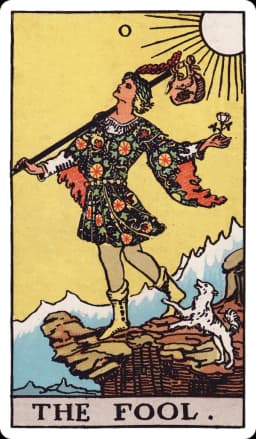
Spiritually, the World represents integration — not a single insight, but many separate pieces of a longer inner journey finally sitting together as a coherent whole. Readers who track the Major Arcana as one continuous arc, from the Fool's opening leap through every archetype that follows, treat this final numbered card as that arc's natural close: the traveler who left with nothing has, by this point, encountered will, intuition, structure, loss, hope, and every other lesson the deck offers, and arrives here changed rather than simply returned to where they started. The card's oval wreath, read as a gateway rather than a wall, keeps that ending from feeling final in a flat sense — completion in this card's vocabulary is always also a threshold, a door opening onto whatever the next cycle turns out to be. In a spiritual-development reading, drawing the World can mark the genuine close of a long stretch of inner work — a period of therapy, study, grief, or growth that has reached real resolution — or it can mark a broader sense of having integrated seemingly separate parts of yourself (ambition and rest, logic and intuition, discipline and spontaneity) into something that finally feels whole rather than in conflict.
Yes or No?
For yes/no questions, the World upright is one of the most confidently favorable cards in the deck — a genuine 'yes,' specifically for questions about whether sustained effort will actually pay off or whether a long process is nearing its successful close. Because the card is about completion earned over real time rather than a sudden windfall, treat its yes as strongest for questions like 'will this finally come together' or 'is this chapter actually finished' rather than for questions about quick, immediate outcomes. Reversed, the honest reading softens to 'close, but not yet' rather than a genuine no — the underlying trajectory toward success or completion remains intact, but something specific (a delay, a loose end, a reluctance to call it done) is holding up the final step. In most reversed-World situations, naming that specific holdup is more useful than treating the reversed card as bad news, since the groundwork for the eventual yes is, in almost every case, already in place.
Read the full yes-or-no breakdown →Frequently Asked Questions
Does the World always mean an ending?
It marks a genuine completion, but the card's own imagery — a wreath shaped like a gateway rather than a wall — treats that completion as a threshold rather than a full stop. It's usually better read as 'this chapter is finished' than as 'nothing more is coming,' since something new typically follows once the current cycle has actually closed.
Why do the four creatures in the corners matter?
Set this card's four figures directly beside their counterparts on the Wheel of Fortune: there, the same angel, eagle, bull, and lion are shown mid-motion, part of the turning cycle. Here they're settled, reading rather than caught in the wheel's rotation, a deliberate signal that the cyclical churn depicted earlier in the deck has, for now, actually resolved.
Is the World a card about literal travel?
Often, yes — many readers take the card's name at face value, and it's a genuinely favorable card for questions about international travel, relocation, or an opportunity that takes you meaningfully outside your usual surroundings, alongside its broader meaning of completion in any area of life.
How is the World different from the Sun?
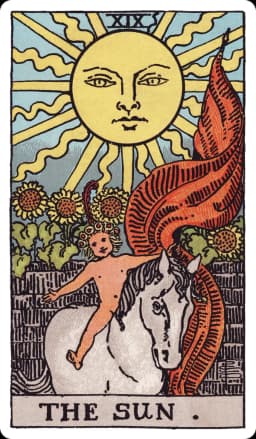
The Sun (XIX) describes joy, vitality, and success as an ongoing state — things going well right now. The World (XXI) describes a longer arc reaching its actual conclusion — not just things going well, but a specific chapter, project, or cycle being finished. The Sun is closer to a sustained feeling; the World is closer to a finish line.
Related Cards
Where The World sits in the deck
Card correspondences sourced from the Hermetic Order of the Golden Dawn tradition — see our methodology.