Major Arcana · Major Arcana
The Fool
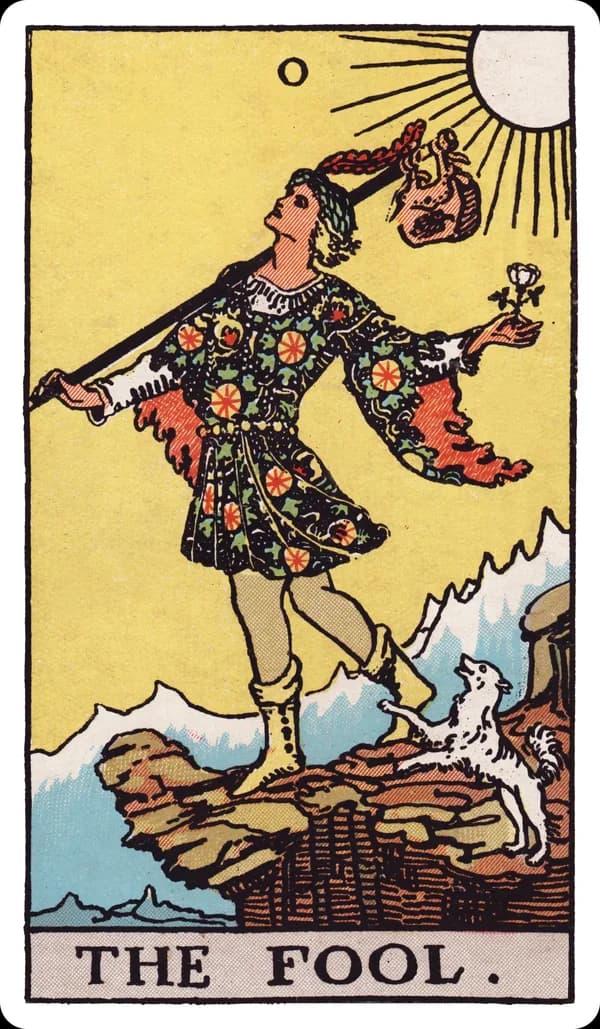
The Fool opens the Major Arcana at zero, before the numbered sequence even begins — which is exactly the point. In the Rider-Waite-Smith artwork, a young traveler in bright, loose clothing stands at the edge of a cliff, face turned upward toward the sun rather than down at the ground beneath his feet. A small white dog trots alongside him, either warning him of the drop or simply along for the journey; the two readings say something different about how much attention the Fool is paying to consequences. He carries almost nothing: a small bindle tied to a stick, a white rose in his free hand, and a fool's-cap feather that marks him as the deck's designated innocent rather than its designated idiot — in tarot, 'the Fool' inherits meaning from the medieval court jester archetype, someone permitted to speak plainly and act outside convention precisely because no one expects them to know better. That distinction matters for how the card reads: the Fool isn't stupidity, it's the state of not yet being bound by the rules that come later in the deck's journey.
- Element
- air
- Ruling planet / sign
- Air
Numerology: Zero is the unnumbered card — pure, unbounded potential before the Major Arcana's numbered journey begins. Every other trump counts forward from here; the Fool is the step taken before counting starts.
Upright Meaning
Upright, the Fool is tarot's clearest single symbol for a genuine fresh start — not a small adjustment to an existing plan, but a real leap into something unfamiliar. It shows up when a reading concerns starting a venture, taking a trip, entering a relationship, or making any choice where the honest answer to 'do you know exactly how this ends' is no. The card doesn't judge that uncertainty; it treats it as the necessary cost of anything genuinely new. Where the Magician (the very next card, I) represents deliberate, skillful action, the Fool represents the moment just before skill and planning enter the picture at all — pure willingness. That makes it a card of trust: trust in your own instincts, in the people around you, or in the process itself, even without a guarantee of the outcome. It also carries a strong note of authenticity. Because the Fool hasn't yet been shaped by the lessons of the cards that follow, the card is sometimes read as an invitation to act from your most unfiltered, honest impulse rather than from an accumulation of past caution. In a reading about a decision, the Fool upright often suggests that the overthinking has gone on long enough, and that the more useful next step is a genuine first move rather than more analysis.
Reversed Meaning
Reversed, the Fool's openness curdles into carelessness. Where the upright card asks you to trust a leap, the reversed card is a caution that the leap in question hasn't been thought through even at a basic level — not 'don't take risks,' but 'this specific risk is missing information you could have gathered.' It frequently appears when someone is about to repeat a pattern that has already cost them before, ignoring a fairly obvious warning sign (echoing the white dog at the Fool's heels, unheeded rather than heeded). The reversed Fool can also point outward rather than inward: instead of you being the reckless party, it can indicate that you're the one being taken advantage of by someone else's impulsiveness or someone else's incomplete promises — a partner, a business contact, or a plan that sounded better before anyone checked the details. A second, gentler reading applies when the card follows a period of genuine caution: reversed Fool energy can also mean being so afraid of appearing naive that you refuse every opportunity, freezing rather than leaping, which is its own kind of imbalance. Distinguishing which reading applies usually comes down to what surrounds the Fool in the spread — cards suggesting active momentum point toward recklessness; cards suggesting stagnation point toward excessive caution masquerading as wisdom.
Read the full reversed meaning →Symbolism
Every element in the card's artwork earns its place. The cliff edge is the card's central tension — read one way, it's the recklessness of stepping forward without checking the ground; read the other way, it's the willingness to trust an unseen path, since a genuinely new beginning can never be fully scouted in advance. The white rose in the Fool's left hand is a traditional symbol of purity and a fresh start, distinct from the red rose of passion that shows up elsewhere in the deck. The small bag on the stick holds everything he owns, and it's deliberately light — the Fool travels unencumbered, without the baggage (literal and figurative) that weighs down later cards in the sequence. The white dog is usually read as either loyal protective instinct or as an unheeded warning, and both readings are traditionally valid — which is itself instructive: even the Fool's own intuition is depicted as ambiguous. The mountains in the background are distant and sunlit, suggesting the destination exists and is reachable, even if the traveler can't map the whole route from where he's currently standing. Numbered zero rather than one, the Fool also sits slightly outside the Major Arcana's main sequence — often read as the card that can be inserted anywhere in the 22-card journey, representing the leap that precedes any of the other archetypes' lessons, not just the first one.
The Fool from the Rider-Waite-Smith deck: a young traveler in bright clothing steps toward a cliff edge with a small white dog at his heels, a bindle on a stick over his shoulder, facing a sunlit mountain range, apparently unaware of the drop just ahead.
→ See what Air means in your horoscope on GetMyHoro
→ Find your own life-path number on NumberAngel
In Love
In a love reading, the Fool upright often marks the very earliest, most electric stage of a connection — the version of attraction that exists before either person has fully assessed compatibility, red flags, or logistics. For someone single, it can describe an unplanned, spontaneous meeting or the decision to finally put yourself out there again after a period of guardedness. For someone already partnered, it can suggest injecting more spontaneity into a relationship that has settled into routine — a genuinely new shared experience, rather than a fix for an underlying problem. The card's honesty motif matters here too: the Fool in a relationship context often asks whether you're showing up as your real, unguarded self, or a curated version designed to be more palatable. Reversed, the love reading shifts toward a genuine caution: rushing into commitment before either party has actually gotten to know the other, ignoring incompatibilities that are already visible, or being swept along by someone else's romantic momentum rather than your own considered interest. It can also describe a relationship that started on a whim and never developed the substance to sustain it once the initial excitement faded. None of this is a verdict on any specific relationship's future — it's a reflection prompt about how much of what's happening is genuine connection versus the thrill of novelty itself, and whether that distinction currently matters to you.
Read the full love meaning →In Career
At work, the Fool upright is one of the strongest cards for a career pivot, a new job, launching a business, or taking on a project with no established playbook. It favors the person willing to be a beginner again — accepting the discomfort of not yet being the expert in the room in exchange for the freedom of not being boxed in by 'how we've always done it.' Entrepreneurial readings lean on this card heavily: the Fool describes the founder stage of a venture, when enthusiasm and belief matter more than a fully proven model, which is both the card's strength and its risk. It can also show up as advice to bring a beginner's mindset to a role you already hold — approaching a stale problem the way someone brand-new to it would, without the accumulated assumptions. Reversed, the career reading turns toward under-preparation: taking a job, project, or leap without the due diligence that was genuinely available to you, or ignoring a colleague's or mentor's clear warning about a plan's weak points. It can also describe career recklessness driven by boredom or restlessness rather than a real opportunity — quitting or pivoting for the sake of change itself, without a considered next step. The corrective isn't necessarily 'don't move' — it's closing the specific information gap the reversed card is pointing at before committing further.
Read the full career meaning →Money & Health — Reflection Themes
Money: Read as a reflection on your relationship with money, the Fool upright often surfaces around a new income stream, an unplanned purchase or investment opportunity, or a genuinely fresh financial start after a setback. It favors initiative over caution, and in that sense it can describe the excitement of a new venture's early promise. It is worth sitting with what 'leap' specifically means in your situation: is it starting to save or invest at all after putting it off, or is it one particular transaction you are being pulled toward emotionally rather than analytically? Reversed, the Fool is one of tarot's clearer prompts to pause before a money decision that has not been fully thought through — an impulse purchase, an investment driven by excitement rather than research, or lending and borrowing on the strength of a relationship rather than a clear agreement. It can also point toward exposure to someone else's carelessness: a shared account, a business partner, or a family member whose spending habits create a risk you have not yet named to yourself. However the card lands, treat it as a mirror for your own financial instincts and current appetite for risk — a place to start thinking, not a forecast.
Health: Read as a reflection rather than anything clinical, the Fool upright can point toward the energy of a fresh start: beginning a new movement practice, changing an old habit, or simply feeling a burst of physical or mental energy after a slower period. Its restless, forward-facing quality sometimes shows up as a nudge toward trying something physically new rather than defaulting to the familiar routine. Reversed, the same card can flag a pattern worth noticing: taking on a new activity, diet change, or lifestyle shift abruptly and without adequate preparation — a common way people get hurt or burn out fast on an otherwise good instinct. It can also point to a more general carelessness with day-to-day wellbeing, skipping the basics of sleep, food, and rest in favor of momentum and excitement elsewhere in life. The Fool has no fixed link to any specific condition or outcome; its usefulness here is as a prompt to notice where in your physical or mental routine you might be either avoiding a change you need or making one too quickly to sustain.
Spiritual Meaning
Spiritually, the Fool represents the soul before it has accumulated the specific lessons the rest of the Major Arcana walks through — sometimes read as the seeker at the very start of a path, and sometimes read as the part of anyone, at any stage, that's still capable of approaching life with genuine open curiosity rather than accumulated certainty. Many tarot readers treat the full 22-card Major Arcana sequence as 'the Fool's Journey' — a symbolic arc in which this card's traveler passes through every other archetype (the Magician's will, the High Priestess's intuition, and onward through Death, the Star, and finally the World's completion) before arriving, changed, back at a kind of renewed innocence. In that framing, drawing the Fool can mean you're at the start of a meaningful chapter of self-development, or it can mean you're being invited to revisit that beginner's openness even in the middle of a much longer personal journey. It's a genuinely optimistic card in most spiritual contexts: a reminder that not knowing exactly where a path leads is not the same as the path being wrong.
Yes or No?
For yes/no questions, the Fool upright leans toward a 'yes' — but a specific kind of yes, one that comes bundled with an unspoken 'if you're willing to act without a guarantee.' This is a card of genuine forward motion, not assured success, so read the 'yes' as encouragement to take the leap rather than a promise it lands the way you're hoping. A relationship, a job, a trip, a creative project — this card shines specifically on questions about starting any of them, since starting is genuinely what the card is about; it says far less about how the middle or end goes, since those belong to cards further along the deck's numbered sequence. Reversed, the honest reading shifts to 'no, not like this' rather than a flat no: the underlying idea may still be sound, but the current plan is missing preparation, information, or a realistic look at the risk involved. When that happens, naming the specific missing piece — a fact left unchecked, a person left unconsulted, a contingency never considered — tends to be more useful than either forcing the leap anyway or dropping the idea altogether.
Read the full yes-or-no breakdown →Frequently Asked Questions
Does the Fool mean something bad is about to happen?
No — quite the opposite in most contexts. The Fool is generally one of the more optimistic cards in the deck, representing a fresh start rather than a warning. The 'foolish' framing refers to the traveler's innocence and lack of accumulated caution, not to a prediction of misfortune. Reversed, it does carry a caution about recklessness, but even then it's about being more careful with a specific decision, not a sign of doom.
Why is the Fool numbered zero instead of one?
Zero places the Fool outside the main numbered sequence of the Major Arcana (I through XXI), which is part of why many readers treat it as the card representing pure, unshaped potential — the state that exists before any of the numbered lessons begin. Some tarot traditions also read zero as a card that can be inserted anywhere in a spread's implied sequence, representing a leap of faith at any stage of a journey, not just the very beginning.
What's the difference between the Fool and reckless behavior?
The distinction usually comes down to information and self-awareness. The upright Fool represents a leap taken with open eyes, accepting that some uncertainty is unavoidable in anything genuinely new. The reversed Fool represents a leap taken with eyes closed — ignoring available information, an obvious warning sign, or a realistic assessment of risk. The same action (starting something new) can be either reading depending on how much groundwork was actually done first.
Is the small dog in the Fool card a good sign or a bad sign?
It's genuinely read both ways, and that ambiguity is usually treated as intentional rather than as something to resolve. Some readers see the dog as loyal, protective instinct accompanying the traveler; others see it as an urgent, unheeded warning about the cliff edge just ahead. Which reading fits best usually depends on the rest of the spread — cards suggesting support nearby favor the loyal-companion reading, while cards suggesting risk or warning favor the unheeded-alarm reading.
Related Cards
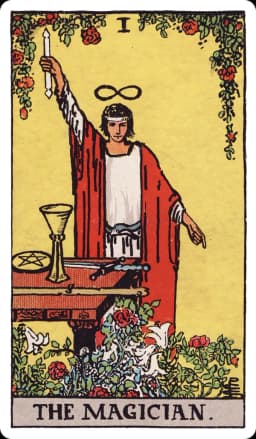
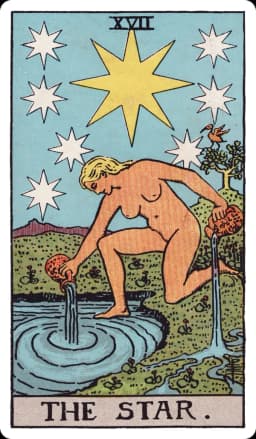
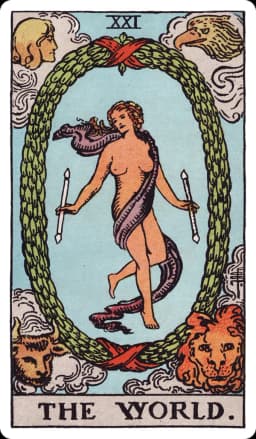
Where The Fool sits in the deck
Card correspondences sourced from the Hermetic Order of the Golden Dawn tradition — see our methodology.