Major Arcana · Major Arcana
Justice
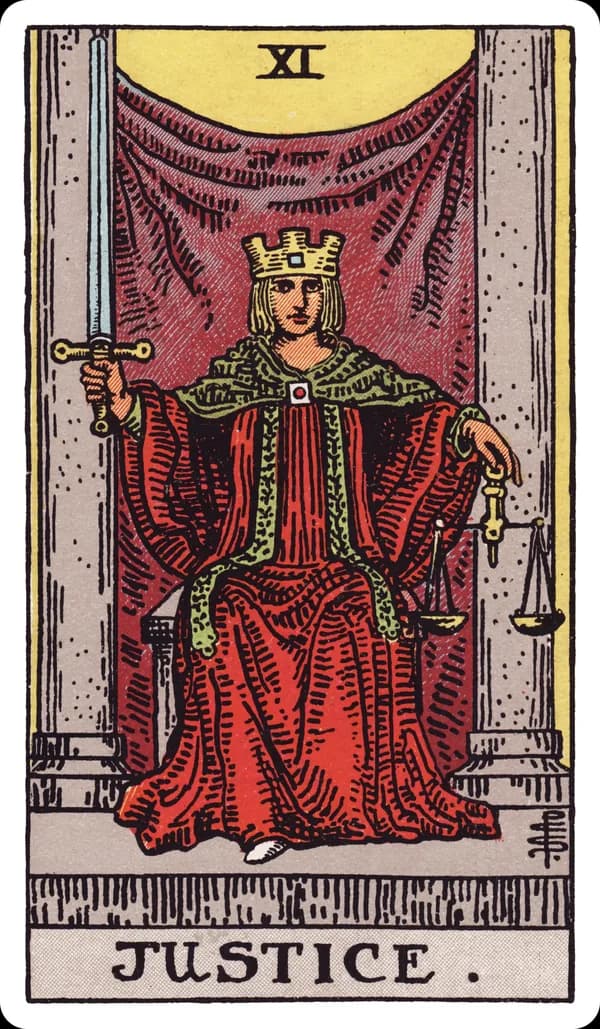
Justice sits between two pillars, echoing both the High Priestess and the Hierophant before her, but where they each held something back — a veiled mystery, a doctrine passed down through ritual — Justice holds her instruments in plain, open sight: an upright sword in one hand, a set of level scales in the other. Numbered XI (or VIII in some non-RWS decks, a genuinely contested point noted below), she represents the Major Arcana's clearest statement about consequence: that actions produce real, proportionate effects, and that truth, examined honestly, tends to come out even when it's uncomfortable. Her sword points straight up, unwavering, a symbol of clear, cutting truth rather than punishment for its own sake; the scales in her other hand are level, weighing a matter fairly rather than favoring either side before the evidence is actually in.
- Element
- air
- Ruling planet / sign
- Libra
Numerology: Eleven reduces to two (1+1) and restates the High Priestess's duality at a more mature, active register — no longer passive receptivity, but the deliberate act of weighing two sides against each other until a clear, balanced conclusion is reached. Coming right after the Wheel of Fortune's cycles of fate, eleven insists that consequences still follow from choices, even amid forces genuinely larger than any one person.
Upright Meaning
Upright, Justice favors fairness, truth, and honest accountability — a situation where the facts, examined clearly, will lead to a proportionate and fair outcome, whether that outcome favors you or not. This card often shows up in readings about legal matters, formal decisions, or any situation where the truth genuinely matters and where being honest, even when it's inconvenient, is the better path. It rewards taking responsibility for your own actions and their real consequences, rather than looking for a way around accountability. Ruled by Libra, a sign strongly associated with balance and fairness, Justice values clear-eyed, unbiased evaluation over emotional argument — she asks you to look at a situation as objectively as possible, weighing genuine evidence rather than what you'd prefer to be true. This card can also point toward karma in the broadest sense: not mystical punishment, but the simple, reliable truth that actions have consequences, and that a pattern of honest, fair dealing tends to be rewarded with fair treatment in return over time. In a reading, Justice often suggests that whatever is currently unresolved will be settled fairly if you approach it honestly, even if the process of getting there requires uncomfortable clarity.
Reversed Meaning
Reversed, Justice signals dishonesty, avoided accountability, or a genuinely unfair outcome. The most common reading is someone (possibly you) avoiding responsibility for their own actions — dodging a consequence that's actually deserved, or refusing to be honest about a situation because the truth is uncomfortable. A second reading points to actual injustice: a situation where the outcome genuinely doesn't match what's fair, whether that's a legal matter that goes wrong, a decision made with real bias, or circumstances that simply don't reward honest effort the way they should. A third reading is dishonesty more broadly: being lied to, lying to yourself, or a situation clouded by misinformation that's preventing a clear, truthful resolution. This card reversed is a genuine reminder that the world doesn't always deliver fair outcomes, even when the upright card's ideal of proportionate consequence is what should happen — sometimes the honest response is naming that unfairness clearly rather than assuming you must have deserved it. Distinguishing readings usually comes down to whether accountability is being actively avoided by someone, or whether an outcome is simply, painfully unfair through no fault of the person experiencing it.
Read the full reversed meaning →Symbolism
The upright sword Justice holds, double-edged and pointed straight up, is traditionally read as impartial truth that cuts cleanly through confusion or deception — not a weapon aimed at anyone specifically, but a tool for clarity, capable of cutting in either direction depending on where the truth actually lies. The scales in her other hand represent the careful weighing of cause and effect: nothing in this card's worldview is random or unearned, and every action carries a proportionate consequence that a fair, honest accounting will eventually reveal. The square clasp fastening her robe at the throat is a small but deliberate symbol of honesty and fair dealing, echoing similar geometric symbols of grounded, material integrity found elsewhere in the deck. A genuinely contested point worth naming honestly: the Rider-Waite-Smith deck numbers this card XI, with Strength at VIII, while some earlier esoteric traditions and the Thoth deck swap them (Justice at VIII, Strength at XI) to preserve a stricter correspondence with the zodiac's traditional ordering. This site follows the standard RWS numbering used throughout, since RWS is the deck being illustrated, but both traditions remain valid within different branches of tarot history.
Justice from the Rider-Waite-Smith deck: a crowned figure in a red robe sits enthroned between two grey pillars, holding an upright double-edged sword in the right hand and a set of balanced scales in the left, a square clasp fastening the robe at the throat.
→ See what Libra means in your horoscope on GetMyHoro
→ Find your own life-path number on NumberAngel
In Love
Honesty and mutual accountability anchor this card's love reading — a relationship where both people are truthful, where responsibilities and effort are genuinely balanced, and disagreements get resolved through fair, clear-eyed discussion rather than manipulation or avoidance. Single, this card often favors honest self-reflection about your own patterns, taking real accountability for your part in what didn't work rather than attributing it only to bad luck or the wrong partners — a genuinely useful, if uncomfortable, exercise before pursuing a new connection. Partnered, this card frequently signals a relationship needing a fair, honest reckoning — a serious conversation where both people own their actual contributions to a problem, or a decision made on its actual merits rather than emotion alone. Reversed, the caution points toward dishonesty in a relationship — a partner not being truthful, an imbalance where one person carries more of the relationship's effort than the other, or a breakup or conflict that's genuinely unfair to one side. It can also describe avoiding your own responsibility for a relationship's problems, refusing to see your part in a pattern that keeps recurring.
Read the full love meaning →In Career
At work, Justice favors fair dealing, honest accountability, and decisions made on genuine merit — a workplace where effort and results are recognized proportionately, where contracts and agreements are honored, and where disputes get resolved through honest, clear-eyed evaluation rather than office politics or favoritism. This card often shows up around legal or formal workplace matters specifically: contracts, negotiations, HR decisions, or any situation where a fair, documented process matters. It also favors taking real accountability for your own professional mistakes rather than deflecting blame, trusting that honest ownership tends to be respected more, over time, than evasion. As coworker or manager energy, Justice describes someone fair-minded and even-handed, someone whose decisions are respected because they're seen as genuinely impartial rather than driven by favoritism. Reversed, the caution points toward workplace unfairness — being passed over for a promotion or credit you genuinely earned, a colleague avoiding accountability for a mistake that affects you, or a decision made with real bias rather than on the actual merits. It can also describe your own avoidance of a professional responsibility you know you should be owning.
Read the full career meaning →Money & Health — Reflection Themes
Money: This card, read as a theme for financial reflection, favors honest, fair, and well-documented dealings: an agreement entered into with full transparency, a decision made on its actual merits rather than wishful thinking, or simply being honest with yourself about your actual financial situation rather than avoiding an uncomfortable truth. It suits legal or formal financial matters specifically — contracts, settlements, taxes, anything requiring careful, accurate accounting. Reversed, watch for either financial dishonesty clouding a decision that needs real transparency, or a genuinely unfair financial outcome — being shortchanged in a deal, an unequal arrangement, or a situation where honest effort simply wasn't rewarded fairly. It can also describe avoiding financial accountability, refusing to face an honest reckoning with debt or an unequal arrangement in a shared relationship.
Health: This card favors honest, clear-eyed evaluation of your own physical and mental wellbeing — being truthful with yourself, and with a healthcare provider, about symptoms, habits, or patterns rather than minimizing or avoiding an uncomfortable truth. It suits weighing genuine cause and effect in your own health, noticing honestly what actually correlates with how you feel rather than assuming causes you'd prefer to believe. Reversed, watch for avoidance — refusing an honest reckoning with a pattern that needs attention, or being less than truthful with a provider or with yourself. It can also point to an outcome that feels genuinely unfair — a health situation that doesn't seem to match effort or good choices, which this card acknowledges as a real possibility rather than always assuming a hidden personal cause.
Spiritual Meaning
An upright sword and a level pair of scales, held in plain sight rather than hidden behind a veil or passed down through ritual — this card's whole argument is that consequence follows action honestly and openly, closer to the broader idea of karma found across many traditions than to punishment imposed from outside. It asks for genuine self-honesty: an unflinching look at your own actions and their actual effects, rather than a comfortable story that avoids harder truths. As the eleventh numbered trump, following the Wheel of Fortune's acknowledgment of fate and cycles, it insists that choices still matter and still produce real consequences, even amid forces larger than individual control. Pulling this card tends to call for honest self-examination — owning your actual actions and their real effects, trusting that this kind of clear-eyed accountability leads toward genuine integrity over time.
Yes or No?
For yes/no questions, Justice leans toward 'yes' — but specifically a yes conditioned on honesty and fairness genuinely being on your side. If the question concerns whether a fair, honest outcome will prevail — a legal matter, a dispute, a situation where you've acted with integrity — this card affirms that truth and fair dealing will generally win out, even if it takes real time or effort to get there. It's a weaker fit as a simple yes for a question where you already know, honestly, that the facts or your own conduct don't actually support a favorable outcome; Justice doesn't grant favorable results to unfair claims. Reversed, the answer sharpens into caution: either dishonesty, yours or someone else's, is clouding the situation, or the honest answer is that the outcome may genuinely be unfair regardless of what you've done right. There, an honest self-assessment matters more than assuming the answer either way — checking whether accountability is being avoided somewhere in the situation, or whether a genuine unfairness needs to be named and addressed rather than simply accepted.
Read the full yes-or-no breakdown →Frequently Asked Questions
Is Justice card XI or VIII in tarot?
It depends on the tradition: the Rider-Waite-Smith deck (used throughout this site) numbers Justice as XI and Strength as VIII, while the Thoth deck and some earlier esoteric sources swap them to preserve a stricter zodiac correspondence. Both are legitimate within their respective traditions; this site follows RWS numbering since that's the deck being illustrated.
Does Justice mean I'll win a legal matter?
Upright, it favors a fair, honest outcome where the truth is accurately weighed, which is a genuinely favorable sign if your position is honest and well-supported. It's not a guarantee independent of the actual facts, however — this card rewards genuine fairness rather than simply wanting to win.
What's the difference between Justice and karma?
They're closely related concepts — Justice represents the principle that actions produce proportionate, honest consequences, similar to how karma is understood across many spiritual traditions. The tarot card frames this specifically around fairness, truth, and accountability rather than a broader cosmic reward-and-punishment system.
Does reversed Justice always mean something bad happened to me unfairly?
Not always — it can describe genuine unfairness you didn't cause, but it just as often points to accountability being avoided, whether by you or someone else, or dishonesty clouding a situation. The surrounding cards usually clarify which reading fits your specific situation.
Related Cards
Spreads that read Justice
- Horseshoe Spread — 7 positions, intermediate
Where Justice sits in the deck
Card correspondences sourced from the Hermetic Order of the Golden Dawn tradition — see our methodology.