Minor Arcana · Wands
Nine of Wands
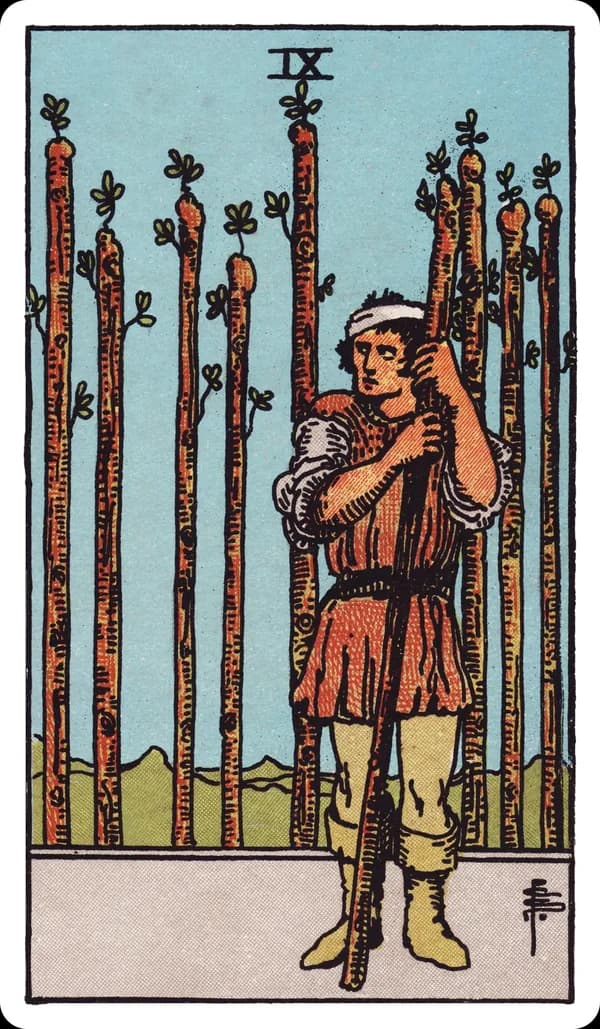
By the time a reader reaches the Nine of Wands, the suit's earlier fights have already left a mark, literally: the man in this card wears a bandage wrapped around his head, evidence of a blow already taken rather than one still coming. He stands gripping a ninth wand like a staff, weight shifted onto it in a way that reads as much like leaning as like readiness, while eight more wands rise behind him in a tight, fence-like row, planted and upright, as if he built a barricade out of everything he had left. His eyes are turned back over his shoulder, not forward — he isn't watching for the next blow from where he expects it, he's checking whether the last one is really finished. Where the Seven of Wands shows a fresh defender meeting a live challenge with full energy, this card shows someone further along: worn down, wary, still standing, but visibly changed by what it's cost him to get here. Numbered nine, one step from the suit's final reckoning in the Ten, this is persistence stretched about as far as it can go before something has to give.
- Element
- fire
- Ruling planet / sign
- Moon in Sagittarius
- Suit
- wands
Numerology: Golden Dawn title "Lord of Great Strength" — the Moon's watchfulness settling into Sagittarius' long-range endurance describes strength that has become vigilance rather than force. Nine, one step from the suit's final reckoning, is where persistence has to hold on without yet knowing the fight is actually over.
Upright Meaning
Upright, the Nine of Wands describes persistence that has real cost attached to it — you're still standing, still holding your position, but you've been through enough already that the holding itself takes visible effort. It favors continuing rather than quitting, particularly when you're closer to the end of something than it might currently feel: this card's number puts it one step from the suit's completion, traditionally read as encouragement that the worst is likely behind you even if it doesn't feel that way yet. The card's wariness is realistic rather than excessive — after real setbacks, caution is a rational response, not a character flaw, and this card doesn't ask you to drop your guard before it's actually safe to. It differs meaningfully from the Seven of Wands' confident, still-fresh defense: where that card describes someone meeting a challenge with energy to spare, this one describes someone meeting whatever comes next with considerably less in reserve, relying on grit and built defenses rather than fresh strength. The core message is unglamorous but genuine: you've taken real hits and you're still here, and that fact alone is worth more credit than it usually gets.
Reversed Meaning
Reversed, the Nine of Wands most often describes exhaustion tipping past what resilience can sustain — the point where continued vigilance stops protecting you and starts costing more than whatever it's guarding against. It can point to burnout specifically: the kind that comes not from one hard event but from staying braced for the next one for too long without any real recovery in between. A second reversed reading involves guardedness curdling into something closer to paranoia — seeing threats that aren't actually there anymore, unable to stand down even once the danger has genuinely passed, because the nervous system never got the memo that it's safe to. A third, particularly painful reading is giving up near the very end: quitting one step before the finish line the upright card suggests is close, worn down by a fight that's actually almost over. Distinguishing these usually comes down to timing and honesty about your own state: if real threats persist, the burnout reading fits; if the danger has passed but the wariness hasn't, the paranoia reading fits; if you're tempted to stop just short of a finish that's genuinely near, the near-finish reading is the one worth sitting with.
Read the full reversed meaning →Symbolism
The bandage is the detail every reading of this card returns to, and it does real work: this figure has already been hurt, which separates his caution from simple nervousness. He isn't imagining danger, he's remembered it, and the wariness in his stance is earned rather than paranoid. The eight wands behind him, planted close together like a palisade, suggest he's used everything available to build some kind of defense before this moment, which is why he's now down to holding only the ninth — the last one still in reserve rather than already committed. His backward glance is the card's most quietly devastating detail: after everything, he still can't fully trust that it's over, which is its own kind of cost separate from any physical wound. Unlike the Seven of Wands' active swing, mid-motion and mid-fight, this figure is essentially static, holding a position rather than actively contesting one. The landscape around him is left deliberately plain, almost featureless, putting all the visual weight on his body and his watchfulness rather than on any specific threat, which is part of why this card so often gets read as a portrait of hypervigilance itself as much as of any particular battle.
The Nine of Wands from the Rider-Waite-Smith deck: a bandaged man leans warily on a single upright wand, glancing back over his shoulder, while eight other wands stand planted behind him in a fence-like row, his stance guarded and his posture tired but unbroken.
→ See what Moon in Sagittarius means in your horoscope on GetMyHoro
→ Find your own life-path number on NumberAngel
In Love
In a love reading, the Nine of Wands can describe entering a new connection while still carrying the caution of a previous one that hurt — not closed off entirely, but watching for the same warning signs even when this particular person hasn't given any. For someone single, it often marks the tail end of healing: real trust rebuilding, but slowly, and with a wariness that takes real time and evidence to fully soften. Partnered, this card often points to a relationship that's weathered a genuine hard stretch, an argument, a betrayal, a difficult season, and is still standing, though both people remain a little braced, watching for a repeat rather than fully relaxed. It rewards patience with your own pace: this card doesn't ask you to trust faster than actually feels safe, only to notice when the caution has done its job and might be ready to ease. Reversed, the reading turns toward guardedness that's stopped serving the relationship, either burnout from constantly bracing for a problem that keeps not materializing, or giving up on a connection that was actually closer to real safety and stability than it felt in the moment. Read the full love meaning below for how this plays out differently depending on how recently the original hurt actually happened.
Read the full love meaning →In Career
At work, the Nine of Wands often describes holding a position or a project through a genuinely difficult stretch, a round of layoffs survived, a hard quarter gotten through, a difficult manager or client relationship endured, coming out the other side changed but still functioning. It favors sticking with something you've already invested heavily in, particularly when the hardest part may actually be nearly finished, even though the fatigue makes that hard to trust right now. This card can also describe a defensive, watchful posture at work that's reasonable given real history, not naive trust in a workplace that's previously let you down, but calibrated caution based on what's actually happened. Reversed, the career reading points to burnout that's crossed from reasonable caution into genuine depletion, or vigilance that's stopped tracking real threats and started reacting to ordinary workplace friction as though it were the last crisis all over again. It can also describe leaving a role or a project just before it would have paid off, worn down by a fight that was, in fact, nearly won. The corrective here is rarely more force; it's usually rest, a second opinion on how close to done things actually are, or genuine support rather than continuing to hold the line entirely alone.
Read the full career meaning →Money & Health — Reflection Themes
Money: As a theme for financial reflection, the Nine of Wands upright can describe holding a financial position through real pressure, protecting savings through a difficult stretch, sticking with a repayment plan through a hard year, staying the course on a long-term goal despite setbacks that have already cost something real. It favors continued discipline specifically when the goal is genuinely close, even if the fatigue of getting there makes the finish line hard to see clearly. It can also describe financial wariness that's earned rather than excessive, caution born from a real past loss rather than baseless anxiety. Reversed, it can point to financial burnout, being so worn down by ongoing money stress that even reasonable spending or saving decisions start to feel like more vigilance than you have left to give. It can also describe abandoning a financial plan right before it would have paid off, or a scarcity mindset that persists even once a real financial threat has actually passed, treating every decision as though the crisis is still active when it may no longer be.
Health: As a theme for reflection, the Nine of Wands upright can describe recovering from something real while still carrying the wariness that comes with it, back on your feet but not yet fully trusting your own resilience, watching for a relapse or a repeat even as you continue functioning. It favors continued care and persistence, particularly when you're closer to genuine recovery than the ongoing fatigue makes it feel. It can also describe the specific exhaustion of managing an ongoing condition or stressor that requires constant vigilance, a kind of tiredness that comes from never fully being able to let your guard down. Reversed, the same card can flag burnout tipping past sustainable: vigilance about your own wellbeing that's become so constant it's exhausting in itself, or anxiety about health that persists even once the actual danger has passed. It can also describe stopping a recovery effort, a treatment plan, a habit change, right before it would have paid off, worn down by a process that's actually nearly complete. No single diagnosis attaches to this reading; what matters more is whether your vigilance about your own wellbeing still feels sustainable or has tipped into depletion.
Spiritual Meaning
A figure who has survived something real and hasn't yet let his guard back down is a genuinely honest spiritual image, and the Nine of Wands resists the temptation to rush past real difficulty toward premature peace. It marks a stage many spiritual paths describe honestly: growth that comes after real hardship, where the lesson has technically been learned but the nervous system hasn't caught up yet, still braced for a threat that may have already passed. It rewards patience with your own healing timeline rather than forcing calm before it's genuinely available, trusting that the wariness itself will ease once enough safety has actually been proven rather than simply declared. It can also describe the specific spiritual discipline of continuing a practice through a difficult season, not because it feels easy, but because you're close enough to some kind of completion that stopping now would cost more than continuing. Reversed, the spiritual reading shifts toward vigilance that's become its own obstacle, unable to receive genuine peace because some part of you still expects it to be temporary or false.
Yes or No?
The Nine of Wands leans toward 'yes,' but a tired, hard-won one: the position you're asking about can likely hold, provided you're able to keep going through what may be the final stretch of real difficulty rather than expecting an easy remaining path. It answers questions about whether persistence will pay off with real, if cautious, encouragement, since this card's number places it one step from the suit's completion, traditionally read as a sign the worst is likely behind rather than still ahead. A fresh, energetic start is a weaker fit for this card, whose whole posture is defensive and depleted rather than eager. Reversed, the yes weakens considerably toward 'not without real rest or support first' — continuing to push on pure grit alone, without recovery, risks giving up right before a finish that was actually close, or burning out in a way that undoes the ground already held. Where that caution applies, the more useful question isn't whether to keep going, but what specific support or rest would actually make continuing sustainable.
Read the full yes-or-no breakdown →Frequently Asked Questions
What does the bandage on the figure in the Nine of Wands mean?
It signals that this person has already been hurt, not that they're imagining a threat. It's a key detail that separates this card's wariness from baseless anxiety — the caution here is earned by real past events, not conjured from nothing.
Is the Nine of Wands a good card to draw?
Mostly favorable, though effortful — it describes real resilience and being close to the end of a hard stretch, rather than an easy or uncontested situation. The card rewards persistence but also acknowledges genuine fatigue.
The Nine and Seven of Wands both show a defender — what tells them apart?
Look at the visible cost each figure has paid: the Seven's defender shows no injury and swings with real energy, while the Nine's figure wears a bandage and leans on his wand rather than wielding it freely. That physical toll is the deck's way of marking how much further along, and how much more depleted, the Nine's defense actually is.
Does the Nine of Wands mean I'm almost done with something difficult?
Often, yes — its position near the end of the suit's numbered sequence is traditionally read as a sign the hardest part is likely nearly over. The card doesn't guarantee an easy final stretch, but it does suggest the finish is closer than the current fatigue makes it feel.
Related Cards
Where Nine of Wands sits in the deck
Card correspondences sourced from the Hermetic Order of the Golden Dawn tradition — see our methodology.