Minor Arcana · Swords · Court Cards
King of Swords
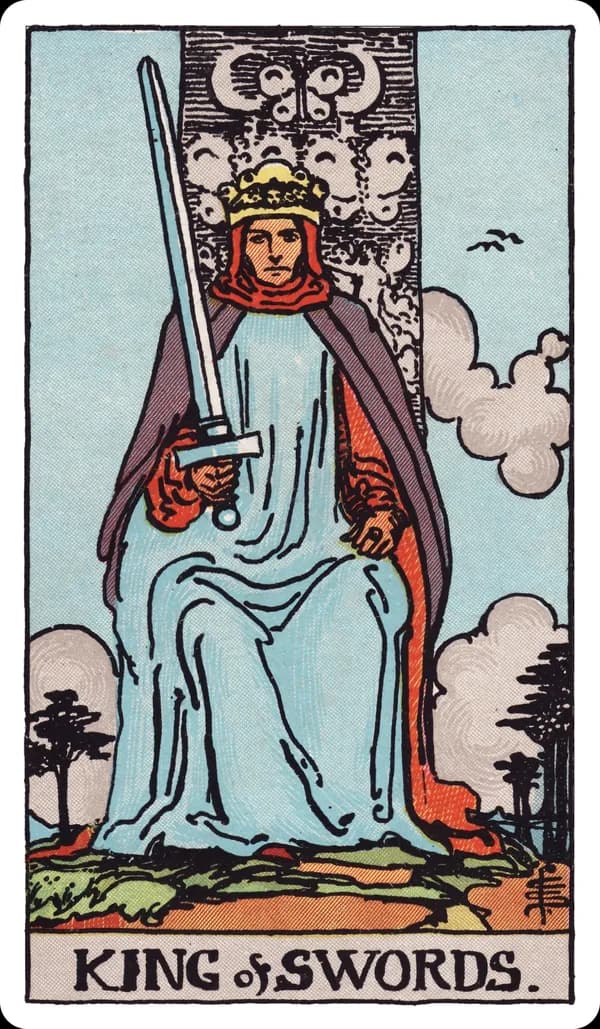
The King of Swords sits facing directly forward, his sword held upright and perfectly steady in one hand, no visible strain or urgency in his grip, authority so fully settled it requires no visible effort to maintain. His throne is carved with butterflies, echoing the same softer symbol found on the Queen's throne, and a crescent moon, a quieter, more reflective image than the suit's more turbulent scenes typically carry. Behind him, two birds cross a clear sky, and the landscape stretches out in bare, wintry trees and distant mountains, a scene stripped of ornament, matching this figure's own stripped-down, unsentimental clarity. Unlike the Knight's headlong charge or the Page's alert curiosity, this figure is entirely still, judgment already fully formed and simply held, ready to be applied rather than still being worked out. He represents the suit's intellectual power at its most mature and established, mental clarity that's become genuine, lasting authority rather than momentary insight or fast, reactive decisiveness.
- Element
- air
- Ruling planet / sign
- Air signs: Gemini–Libra–Aquarius
- Suit
- swords
- Court rank
- king
Numerology: Kings are the court's fire-natured rank — each suit's element fully mastered and directed outward with real authority. In Swords, fire meeting air produces judgment applied with settled force, a mind's clarity turned into structure and principle rather than reaction, decision made from established, tested authority.
Upright Meaning
Where the Knight of Swords converts thought into motion almost instantly, and the Page is still gathering the evidence to think at all, this figure has already finished thinking, and finished long ago. Upright, the King of Swords describes intellectual authority earned through real mastery, judgment that's clear, fair, and grounded in established principle rather than momentary impulse. It favors truth and consistent, clear-headed logic; this card fits situations calling for objective, well-reasoned decision-making, cutting through confusion or bias with real, disciplined clarity. Someone carrying this energy tends to be genuinely wise and fair, respected for judgment that holds up under real scrutiny, someone others turn to precisely because their conclusions, even difficult ones, tend to be right. It shows up often in readings involving a legal or ethical matter requiring careful, impartial judgment, or a decision that benefits from stepping back from emotion to see the actual facts clearly. Its core strength is mature, settled intellectual authority, trusting a well-reasoned conclusion enough to stand behind it, provided that reasoning has genuinely earned the confidence being placed in it.
Reversed Meaning
A mind this sure of itself stops being checked by anything outside it once reversed, and the strain shows up in three recognizable shapes. The first is manipulation: real intelligence and clear reasoning turned toward misleading rather than informing, a technically sound argument built to win rather than to arrive at what's actually true. The second is cold logic, a conclusion that's correct on paper and indifferent to who it affects, decisions defensible by the numbers while ignoring real human cost. The third is abuse of power, expertise or authority used to intimidate or dominate rather than to genuinely guide, a mind more interested in winning than in being right. A related shape is rigidity, a well-earned framework applied so consistently it's stopped questioning itself, certainty calcified past the point of real correction. Telling them apart comes down to intent and effect: deliberate misdirection points to manipulation, correct-but-heartless conclusions point to cold logic, and authority wielded to dominate points to abuse of power.
Read the full reversed meaning →Symbolism
The single-handed, effortless grip on his sword is the clearest visual marker separating him from the suit's other court figures, where the Page needs both hands and visible concentration, this king holds the same tool with total, practiced ease, mastery so complete it no longer requires conscious effort to maintain. His direct, forward gaze, like the Queen's, suggests confidence that doesn't need to be validated from any particular angle, an authority secure enough not to need performing. The butterflies on his throne tie him to the Queen's gentler symbolism, suggesting that beneath his stern, unsentimental exterior lies the same capacity for genuine transformation and tenderness, present but disciplined rather than openly displayed. The crescent moon is a more unusual detail for this suit, sometimes read as a sign that even this figure's clear, rational authority draws on something beyond pure logic, intuition or reflection quietly present beneath the surface composure. The stark, wintry landscape behind him, bare trees, distant mountains, no lush color anywhere, reflects a mind that values clarity and truth over comfort or decoration, judgment stripped down to what's actually, provably true rather than dressed up in anything softer or more forgiving than the facts themselves warrant.
The King of Swords from the Rider-Waite-Smith deck: a king sits facing forward on a throne carved with butterflies and a crescent moon, holding an upright sword steadily in one hand, two birds flying in the sky behind him, distant mountains and bare trees stretching across the horizon.
→ See what Air signs: Gemini–Libra–Aquarius means in your horoscope on GetMyHoro
→ Find your own life-path number on NumberAngel
In Love
Trust that's actually earned, not just claimed, is what this card contributes to a love reading more than any single gesture. A partner under its influence, or a version of yourself, brings real clarity and honesty into the relationship, someone whose word holds up because their judgment is consistently sound, even about difficult topics. Single, this describes someone genuinely thoughtful and unlikely to play games, approaching a new connection with the same careful, considered judgment they'd bring to any other important decision. This card favors substance over romantic intensity; a King of Swords connection builds on respect and honest, considered communication rather than sweeping passion. Partnered, expect a relationship built on mutual respect for each other's judgment, disagreements worked through with fairness and logic rather than raw reaction. Reversed, the reading turns toward manipulation or cold detachment, intelligence used to control or mislead a partner, or a relationship so governed by cool logic that real emotional warmth has quietly gone missing from it.
Read the full love meaning →In Career
At work, the King of Swords frequently describes mature, respected professional authority, sound judgment earned through real experience, someone trusted to make fair, well-reasoned decisions even under real pressure or ambiguity. It favors clear, principled leadership: this card's energy suits situations that call for objective, unbiased decision-making, cutting through office politics or confusion with genuinely sound, disciplined reasoning. As workplace energy, it can describe a leader or mentor who's genuinely fair and consistent, respected precisely because their judgment holds up over time and doesn't shift based on favoritism or mood. Reversed, the career reading points toward intellectual authority being used to manipulate or dominate, a leader whose genuine expertise has become a tool for control rather than genuine service to the team, or decisions made with technically sound logic that ignore real human cost and consequence. It can also describe rigid, inflexible professional thinking, an established approach applied so consistently that it's stopped questioning whether it's still actually the right one for a changed situation.
Read the full career meaning →Money & Health — Reflection Themes
Money: As a theme for financial reflection, the King of Swords upright can describe mature, disciplined financial judgment, decisions grounded in real, careful analysis rather than emotion or impulse, a track record of sound financial reasoning that's earned genuine trust over time. It favors objective, unemotional evaluation of financial decisions: this card's real strength is clear-headed analysis, weighing a financial choice on its actual merits rather than on hope or fear. Reversed, it can point to financial manipulation, being deceived by someone using sophisticated, technically accurate-sounding reasoning to mislead rather than genuinely inform, or cold, purely logical financial decisions made with no regard for their human cost, a technically sound choice that ignores real consequences for people involved. It can also describe rigid financial thinking, a strategy or rule applied so consistently that it's stopped being reevaluated even once circumstances have genuinely changed enough to warrant a different approach. Treat this the way any money-related reflection on this site is meant to be used, a prompt to pair sound analysis with genuine attention to real, human consequence.
Health: As a theme for reflection, the King of Swords upright can describe approaching your own health with real, disciplined clarity, seeking out genuine expertise, making decisions based on sound information rather than fear or wishful thinking, trusting well-reasoned judgment about your own body and mind. It favors objective, informed decision-making over emotional reactivity, though it works best paired with genuine compassion for yourself rather than pure, detached analysis. Reversed, the same card can flag cold detachment from your own physical or emotional needs, treating your wellbeing as a purely logical problem to be solved rather than something that also deserves real warmth and self-compassion, or rigid health rules applied so strictly that they've stopped actually serving your genuine wellbeing. No particular condition is being flagged here; the real distinction worth noticing is between clear, disciplined health judgment and clarity that's hardened into something too cold or too rigid to actually be helpful.
Spiritual Meaning
Authority that no longer needs to prove itself, settled enough to hold its conclusions without visible strain, is a genuinely mature spiritual quality, and the King of Swords often marks a period of hard-won, mature wisdom, spiritual understanding that's been tested and refined into real, dependable clarity rather than untested theory or passing insight. It rewards trusting that earned clarity as a genuine guide, sharing it with others when appropriate, provided it stays paired with the same gentle tenderness the butterflies on his throne quietly represent underneath his composed exterior. It can also describe the discipline of applying honest, consistent principle even when it's difficult, choosing truth over comfort, fairness over favoritism, in a way that requires real, sustained maturity to maintain. Reversed, the spiritual reading shifts toward wisdom that's become cold or controlling, spiritual authority used to dominate rather than genuinely guide, or an intellectual framework so rigid it's stopped being able to hear anything that might actually challenge or refine it further.
Yes or No?
A conclusion that's actually been thought through gets a clear, confident yes from this card, especially for questions about whether a well-reasoned, carefully considered plan is sound. 'Does this hold up under real scrutiny' or 'is my judgment on this trustworthy' fit well, since disciplined, mature clarity is exactly what this card answers best. A question that's really about feeling or relational nuance rather than objective fact suits it far less, since its strength lies specifically in clear-headed reasoning. Reversed, the yes shifts toward a real caution: the underlying logic may still be technically sound, but it's worth checking honestly whether it's being applied fairly, or shading into manipulation, coldness, or rigid thinking that's stopped genuinely questioning itself. A reversed King of Swords is a good moment to ask whether a conclusion is actually correct, or simply confidently, persuasively argued.
Read the full yes-or-no breakdown →Frequently Asked Questions
What does the crescent moon on the King of Swords' throne mean?
Swords cards otherwise carry almost no lunar imagery anywhere in the deck, which is exactly why this detail stands out to close readers of the artwork. A crescent, rather than a full or new moon, is sometimes read as a partial, waxing quality, suggesting this figure's reflective side is present but deliberately kept in reserve rather than fully on display.
Is the King of Swords a cold or unemotional card?
Upright, no, it describes clear, disciplined judgment that can still include real fairness and care, the butterflies on his throne echo the Queen's gentler symbolism. Reversed is where the coldness reading more directly applies, when logic has detached from any real human consideration.
Both King and Queen of Swords are shown with clear, unclouded skies behind them — does that mean their clarity works the same way?
Not quite. The Queen's clarity tends to come through personal, lived experience and is expressed with more visible individual warmth. The King's authority is more structural and impersonal, honest judgment applied through established principle and role rather than through direct experience.
Does reversed King of Swords always mean someone is lying to me?
Not always, though manipulation using sophisticated, technically accurate-sounding reasoning is one common reading. It can also describe cold, heartless logic or rigid thinking that's stopped questioning itself, without necessarily involving deliberate deception.
Related Cards
Where King of Swords sits in the deck
Card correspondences sourced from the Hermetic Order of the Golden Dawn tradition — see our methodology.