Minor Arcana · Pentacles
Ace of Pentacles
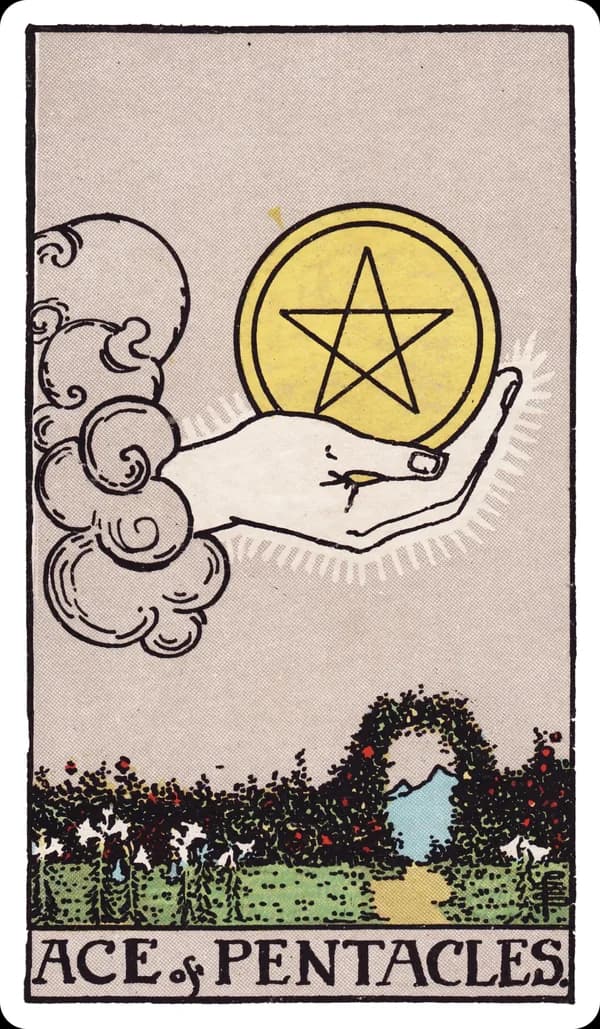
Of the four Aces, Pentacles is the only one whose gift you could actually hold, spend, or plant. A hand extends from a cloud — the same device used across all four Aces to signal a gift arriving from beyond ordinary circumstance — but where the Ace of Cups offers an overflowing chalice and the Ace of Swords a double-edged blade, this hand offers a single, solid gold coin engraved with a five-pointed star. Below it, a tended garden of white lilies opens onto a path that runs beneath a rose-covered archway toward low hills in the distance. Nothing about this scene is dramatic or urgent — no dove descends, no clouds are stirred by wind — and that stillness is the point. Earth is the slowest of the four elements to move and the hardest to fake, so its Ace doesn't announce itself the way Wands' fire or Swords' air might. It simply arrives, solid and real, and waits to see whether you'll pick it up.
- Element
- earth
- Ruling planet / sign
- Earth (root force, no decan)
- Suit
- pentacles
Numerology: Aces sit before counting starts in a suit — the seed form of the element, not yet shaped by circumstance. For Pentacles that seed is plainly physical: not an idea about money or security, but the literal fact of an opportunity landing in your hand before you've decided what to build with it.
Upright Meaning
Upright, the Ace of Pentacles signals a genuine material opening: a job offer, a windfall, an investment that finally makes sense, or simply the first solid, practical idea that could become something real if you follow through. It is the most literal of the four Aces — where Cups offers feeling and Wands offers inspiration, Pentacles offers something you can point to and measure. That doesn't make it a lesser gift; it makes it a foundational one, since money, health, and material stability are frequently what free up the bandwidth to pursue everything the other three suits describe. The card favors starting something with real, tangible follow-through rather than staying in the idea stage — an opportunity offered is not the same as an opportunity accepted, and the coin in the image is extended toward you, not yet placed in your palm. It also carries an undertone of groundedness: whatever begins here is meant to be built on solid footing rather than speculation, which is part of why this Ace tends to read as steadier and less impulsive than the Fool's leap or the Ace of Wands' spark. In a reading about a new venture, a raise, a health kickstart, or a first step toward long-term security, the upright Ace of Pentacles is one of the more reliably encouraging cards in the deck to draw.
Reversed Meaning
Reversed, the Ace of Pentacles points to an opportunity that's being missed, mishandled, or built on ground that isn't as solid as it looks. This can be as direct as a genuinely good offer arriving and going unanswered — fear, distraction, or simple procrastination getting in the way of picking up what's being extended. It can also describe poor planning at the outset: starting a venture, accepting a new role, or making a financial commitment without doing the basic groundwork the upright card's cultivated garden implies should come first. A third, quieter reading concerns instability after a promising start — an opportunity that looked solid at first but turns out to rest on unstable footing, whether that's an employer's shaky finances, an unrealistic budget, or a plan that depended on circumstances outside your control staying fixed. Because this is the suit's root card, its reversal tends to affect everything built afterward more than a reversal further into the suit would; a shaky Two of Pentacles is a wobble, but a reversed Ace suggests the wobble started at the foundation. The corrective isn't usually to abandon the opportunity altogether — it's to go back and do the part of the groundwork that got skipped: read the contract, check the numbers, ask the question you've been avoiding, before building anything further on top of it.
Read the full reversed meaning →Symbolism
The single pentacle held aloft is deliberately unadorned by any other figure or event — no dove, no lightning, no rushing water, just a hand, a coin, and a cultivated landscape below it. That garden is doing real work in the composition: unlike the Ace of Wands' wild, half-tamed forest or the Ace of Swords' bare mountain peak, this ground has clearly been worked by human hands already, rows of lilies planted with intention rather than growing wild. The path beneath the rose archway leads somewhere specific rather than trailing off into unmapped territory, suggesting that the opportunity in your hand comes with an implied next step, not just raw potential. Lilies themselves carry a long association with purity and renewal across multiple symbolic traditions, softening what could otherwise read as a purely transactional image of money changing hands. The archway is worth lingering on: a threshold you walk through rather than a wall you climb, and it's covered in roses rather than left bare, tying this card's material gift back to something that has to be tended and cared for, not simply acquired and forgotten. Numbered one, it sits at the very root of everything the Pentacles suit will go on to explore — the partnership of the Two, the craft of the Three, the hoarding of the Four, all the way to the Ten's generational estate — each later card is this same coin, further along in its journey through the world.
The Ace of Pentacles from the Rider-Waite-Smith deck: a hand emerges from a cloud offering a single large gold pentacle, held above a flowering garden of white lilies, with a rose-covered hedge archway framing a path toward distant hills.
→ See what Earth (root force, no decan) means in your horoscope on GetMyHoro
→ Find your own life-path number on NumberAngel
In Love
In a love reading, the Ace of Pentacles describes something less common in this suit than material questions: the emotional and practical safety a relationship provides. It can mark the beginning of a connection that feels genuinely stable and dependable from the start, or a partner who shows love through concrete, reliable acts — consistency, follow-through, showing up — rather than grand romantic gestures. For someone single, it can point toward meeting a person who's genuinely ready to build something real, not just enjoy the spark of a new connection. For someone partnered, it can mark a relationship reaching a new level of practical commitment: moving in together, merging finances, or simply a season where the relationship starts to feel like solid ground rather than an open question. Reversed, the card can describe a relationship that feels materially or emotionally precarious — promises made without follow-through, a partnership that hasn't found its footing, or a connection that started with real promise but hasn't been given the ongoing care it needs to hold. It can also point to letting a genuinely good, stable connection pass by because it doesn't come with enough excitement attached, mistaking steadiness for dullness. Either way, this card asks a plain question rarely posed this directly elsewhere in the deck: is what's being built here actually built to last, or does it only look that way from a distance?
Read the full love meaning →In Career
At work, the Ace of Pentacles is one of the clearest, most literal cards in the deck for a new job offer, a promising business idea, or the first real opening in a career path you've been trying to break into. It favors opportunities with tangible, demonstrable value — a role with a clear scope, a project with a real budget, a client who actually pays on time — over vague promises of future upside. Where the Fool favors the leap itself, the Ace of Pentacles favors the leap toward something you can already see has real substance to it. It's also a strong card for the very beginning of a long-term career plan: the first class taken toward a new qualification, the first client of a freelance practice, the first real interview that goes somewhere. Reversed, the career reading turns toward opportunities that look promising but haven't been vetted closely enough — a job offer with vague terms, a business idea that hasn't been tested against real numbers, or a promising lead that quietly stalls out because no one followed up. It can also describe a genuinely good opportunity being turned down out of hesitation, or accepted without asking the practical questions (compensation, stability, scope) that would have caught a problem early. Slowing down long enough to check whether the ground under an opportunity is actually solid is usually the fix, more than walking away from it altogether.
Read the full career meaning →Money & Health — Reflection Themes
Money: A new source of income landing in your lap without much effort on your part is the scenario this card fits most naturally — a bonus, a gift, an unplanned refund, or a first paycheck from something you just started. As a theme for reflection on your relationship with money, the upright Ace of Pentacles asks less about how much is arriving and more about what you do with the opening once it's in your hand: whether you let it become the seed of something (savings, an investment, a debt paid down) or let it slip through without much intention behind it. It's also a fitting card for the very first step of a longer financial plan — opening the account, making the first deposit, starting the budget you've been putting off. Reversed, the picture shifts to a financial opportunity mishandled at the start: money that arrives and gets spent before any plan for it forms, an investment entered into without doing the numbers first, or a financial habit built on ground that turns out to be shakier than it looked. It can also point to a specific missed chance — an offer, a deal, a moment to act — that quietly passed by while you hesitated. However it lands, this card is a starting point for noticing your own instincts around new money, not a forecast of exactly how much is coming or when.
Health: Read as a theme for reflection, the upright Ace of Pentacles often shows up around the start of a genuinely sustainable health habit — not a dramatic overhaul, but a small, concrete change (a new sleep routine, the first week of consistent movement, finally booking the appointment you'd been putting off) that has real staying power because it's grounded rather than aspirational. Earth-suit cards tend to favor the body's literal, physical dimension over the emotional territory Cups covers or the mental territory of Swords, and this Ace is no exception: it's frequently a nudge toward paying attention to the physical basics — food, rest, movement, medical care — as the foundation everything else in your wellbeing gets built on. Reversed, it can point to a health-related opportunity or good habit not being taken up: putting off the checkup, starting a routine without any real plan for keeping it going, or letting a genuinely promising start (a diet, a treatment, a new practice) fall apart because the groundwork wasn't solid enough to support it long-term. It carries no fixed link to any specific diagnosis or condition — its usefulness here is as a prompt to notice whether a health opportunity currently in front of you is being picked up and built on, or quietly left on the table.
Spiritual Meaning
This is the Pentacles suit's version of grace — a gift landing in your hand rather than one you had to fight for, except here the gift is grounded rather than ethereal, concerned with the here-and-now physical world rather than a mystical elsewhere. Drawing this card can mark the start of feeling more genuinely at home in your own body, or a growing sense that spiritual life doesn't have to mean rejecting the material world in favor of some purer, more abstract plane — that tending a garden, building something with your hands, or simply managing your material life with care can be as much a spiritual practice as meditation or ritual. Some readers connect this card to the root chakra specifically, the seat of basic safety and belonging in the body, which the Ace's imagery of solid ground and cultivated earth supports well. It's also a fitting card for anyone whose spiritual path has felt too heady or disconnected from daily life lately — a reminder that the sacred and the practical aren't actually opposites, and that a well-tended garden is its own kind of devotion.
Yes or No?
For yes/no questions, the Ace of Pentacles upright is a confident, grounded 'yes' — and unusually for the deck, it's a yes about something concrete and checkable rather than a feeling or a leap of faith. Because the card's whole imagery is a solid object changing hands, it answers questions about tangible opportunities (a job, a loan, a purchase, a practical plan) with more certainty than it answers questions about feelings or timing, which belong more naturally to Cups or Swords cards. Reversed, the honest read softens to 'the opportunity is real, but something about how it's being approached needs attention first' — not a flat no, but a caution that the groundwork hasn't been done. If your question involves a specific offer or opportunity and this card comes up reversed, the more useful next move is usually reviewing the actual terms and details rather than treating the card's caution as a reason to walk away entirely.
Read the full yes-or-no breakdown →Frequently Asked Questions
Is the Ace of Pentacles always about money specifically?
Not exclusively, though it's the most literally material of the four Aces. It represents any tangible new beginning — a job, a health habit, a piece of property, a practical plan — grounded in the physical, real-world dimension of life the Pentacles suit governs, rather than emotion (Cups), thought (Swords), or inspiration (Wands). Money is a common and natural reading, but not the only one.
Why does the Ace of Pentacles show a garden instead of clouds or open sky?
The cultivated garden, unlike the wilder or barer landscapes in the other three Aces, signals that this suit's gifts are meant to be tended rather than simply received. It's a visual cue that whatever opportunity this card represents comes with an implied next step of care and follow-through, not a one-time windfall.
What's the difference between the Ace of Pentacles and the Ace of Cups?
Both are gifts extended by a hand from a cloud, but they govern different territory: the Ace of Cups offers emotional and intuitive opening — love, compassion, creative inspiration — while the Ace of Pentacles offers something concrete and material — money, work, physical health, tangible security. A reading can reasonably feature both if a situation touches on the heart and practical circumstances at once.
Does reversed Ace of Pentacles mean I'll lose money?
Not directly — it's less a card of loss than of an opportunity not yet properly grounded. It's more likely describing a chance being missed, rushed into without enough groundwork, or built on shakier footing than it appears, rather than predicting an outright financial loss.
Related Cards
Spreads that read Ace of Pentacles
- Star Spread — 7 positions, intermediate
- New Moon Spread — 4 positions, beginner
- Full Moon Spread — 4 positions, beginner
Where Ace of Pentacles sits in the deck
Card correspondences sourced from the Hermetic Order of the Golden Dawn tradition — see our methodology.