Minor Arcana · Pentacles · Court Cards
Knight of Pentacles
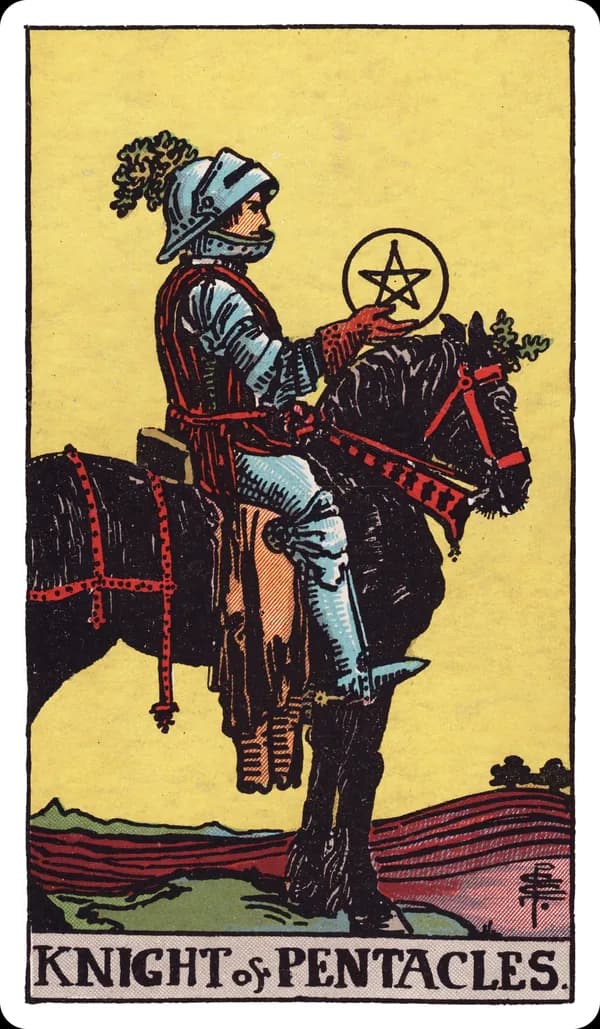
The Knight of Pentacles is, by a wide margin, the deck's stillest knight, seated on a solid black workhorse that stands with all four feet planted on the ground rather than rearing or charging the way the suit's other mounted knights do. He holds a single pentacle up before him, studying it with steady, unhurried attention, and his horse waits, patient and still, exactly as prepared to stand here as to eventually move forward. A freshly plowed field stretches out behind him in neat, even rows, work already done with the same careful, methodical attention this figure clearly brings to everything. There's no urgency anywhere in the frame, no wind, no storm, no scattering birds, just a solid, capable figure and a solid, capable animal, both entirely at ease with taking exactly as long as the work actually requires. Where the Knight of Wands looks ready to gallop off the page and the Knight of Swords is already mid-charge, this figure looks like he could sit exactly where he is, unmoved, for as long as it takes to get the job done correctly.
- Element
- earth
- Ruling planet / sign
- Earth signs: Taurus–Virgo–Capricorn
- Suit
- pentacles
- Court rank
- knight
Numerology: Knights are the court's air-natured rank — forward motion given to each suit's element. In Pentacles, air moving earth produces the court's slowest, steadiest kind of progress, momentum so measured and deliberate it can look, from a distance, almost like standing still.
Upright Meaning
Every other knight in this deck is caught mid-motion, mid-charge, mid-storm — this one and his horse are simply standing there, and that stillness is the whole message. Upright, the card favors momentum so measured it barely looks like momentum at all: a project advanced by daily, unglamorous increments rather than one decisive leap, a skill built through the kind of repetition that never makes for an exciting story. Someone embodying this energy is the person a team quietly, correctly assumes will finish what they start, not because they're the most talented in the room but because their pace doesn't depend on being inspired that day. It suits a habit still being built, a slow-moving but genuinely solid project, or simply a stretch of life where showing up matters more than any single dramatic result. Its real strength is a consistency that survives boredom, bad weather, and low motivation alike, because none of those were ever actually the engine driving it in the first place.
Reversed Meaning
Stop the horse permanently and stillness turns into something else entirely — reversed, this card most often means motion that's quietly become no motion at all, effort maintained on the surface while real progress has actually ground to a halt underneath it. A second, closely related shape is boredom: the same task, done so many times it's stopped teaching anything, competence with the spark gone out of it. A third is a harder edge of the upright card's steadiness — an approach defended simply because it's familiar, not because it's still actually working, change resisted mainly because change itself feels risky. Worth separating by what's actually visible: nothing moving forward at all, even with continued effort, points to stagnation; disengagement from an otherwise fine routine points to boredom; and a flat refusal to try something different despite clear evidence it's needed points to stubbornness.
Read the full reversed meaning →Symbolism
The horse's stillness is the image's most important departure from the suit's other three knights, a workhorse rather than a warhorse, built for sustained, reliable labor rather than speed or dramatic display. Its solid black color and heavy build reinforce dependability over flash, an animal chosen for what it can be trusted to do consistently, day after day, rather than for how impressive it looks in a single dramatic moment. The knight's steady grip on his pentacle, studied rather than brandished, echoes the Page's careful attention but with real, accumulated confidence behind it now, someone who has moved well past studying a coin for the first time into actually, reliably working with it. The freshly plowed field behind him, neat and evenly worked, is the visible evidence of exactly the kind of patient, unglamorous labor this figure specializes in, real progress made, but made slowly, methodically, one row at a time rather than all at once. Compared with the other three Knights' active landscapes, storms, deserts, chaos, this figure's plain, orderly field is itself a statement: reliable progress doesn't need drama to actually be real and lasting.
The Knight of Pentacles from the Rider-Waite-Smith deck: an armored knight sits motionless on a stationary black workhorse in a freshly plowed field, holding a pentacle in one raised hand and looking steadily at it, distant plowed rows stretching toward the horizon.
→ See what Earth signs: Taurus–Virgo–Capricorn means in your horoscope on GetMyHoro
→ Find your own life-path number on NumberAngel
In Love
A partner under this card rarely announces their feelings, they demonstrate them, showing up on time, remembering the small things, doing what they said they'd do without needing to be reminded. Single, it favors a slower courtship over an exciting but unreliable one, letting trust accumulate across enough repeated, ordinary interactions to actually mean something, rather than expecting certainty from a single electric evening. Partnered, this energy shows up in who handles the unglamorous parts of shared life without complaint — the recurring errands, the maintained routines, the follow-through that never gets a round of applause but quietly holds the whole thing together. None of this is especially romantic in the traditional sense, and that's rather the point: reliability here is its own form of devotion. Reversed, either the relationship has settled into routine with no real presence behind it, or one partner is refusing to budge on something both people can see needs to change.
Read the full love meaning →In Career
A colleague under this card is rarely the loudest person in the meeting, but they're the one whose deliverables never slip, and over a long enough stretch that reputation tends to outlast flashier ones. It favors a project advanced steadily, one completed task at a time, over a single high-visibility breakthrough that depends on everything going right at once. As workplace energy, it suits roles built on trust earned through repetition — the person a manager stops double-checking because the work has simply never needed it. Reversed, that same steadiness can curdle into a role that's stopped actually going anywhere despite looking busy, a routine kept out of habit rather than usefulness, or flat resistance to a process change that the rest of the team has already accepted is overdue.
Read the full career meaning →Money & Health — Reflection Themes
Money: Financial habits under this card build the unglamorous way — automatic transfers that happen whether or not anyone feels motivated that month, debt paid down in identical monthly increments, a budget followed because it's routine rather than because it's exciting. Read as a theme for reflection, its real strength is that this kind of consistency doesn't rely on willpower renewing itself daily, which is exactly why it tends to actually work over years rather than weeks. Reversed, a savings plan can look active while it's actually stalled, or an outdated financial approach gets kept simply because switching feels like more effort than it's worth, even once the numbers say otherwise.
Health: A workout routine, a sleep schedule, a way of eating that doesn't depend on motivation showing up fresh each morning, that's this card's contribution to physical wellbeing, consistency that holds specifically because it isn't relying on excitement to keep going. Read as a theme for reflection, it rewards trusting that boring, repeated effort is often the actual mechanism behind real, lasting change, more than any single intense burst ever manages to be. Reversed, a routine can keep running long after it's stopped producing any real result, or get defended out of familiarity even once it's genuinely time to try something else. This card doesn't attach to any particular diagnosis; what it signals instead is simply whether the routine is still working or just still happening.
Spiritual Meaning
Nothing in this image is waiting for inspiration to strike before it moves, and that's worth sitting with as its own kind of teaching: showing up to a practice, meditation, prayer, quiet reflection, on the days it feels flat as well as the days it feels alive. What the plowed field behind this figure actually shows is accumulated, unglamorous progress, row after row of ordinary effort that adds up to something only when looked at from a distance. Practiced this way, spiritual discipline stops depending on feeling holy in the moment and starts simply being a thing that gets done, which tends to outlast any practice that only shows up when it's emotionally rewarding. Reversed, a practice can keep running on autopilot with no real presence behind it, or a single, once-useful method gets clung to well past the point it's still producing any actual growth.
Yes or No?
This card's yes is earned slowly rather than granted quickly — it's confident about whether persistence will eventually be rewarded, and considerably less confident about whether the reward is coming fast. Questions about a long habit, an ongoing project, or whether continuing to show up is worth it get a genuinely encouraging answer here. Questions hoping for a quick or dramatic result get a much weaker one, since speed simply isn't what this figure is built for. Reversed, the yes softens toward a specific caution: either something has stalled and needs a real look, or the current approach has outlived its usefulness and deserves to be updated rather than simply repeated again.
Read the full yes-or-no breakdown →Frequently Asked Questions
Why is the Knight of Pentacles' horse standing still instead of moving?
Unlike the deck's other three knights, this figure and his horse are shown at rest, entirely unhurried, emphasizing patient, methodical reliability over speed or urgency. It's a deliberate visual contrast that sets this card apart as the suit's steadiest, least dramatic form of progress.
Is the Knight of Pentacles a good card for a long-term project?
Yes, it strongly favors sustained, methodical effort over a long stretch, the specific quality a long-term project actually needs to succeed. It rewards patience and consistency over any single burst of intense effort.
What's the difference between the Knight of Pentacles and the Page of Pentacles?
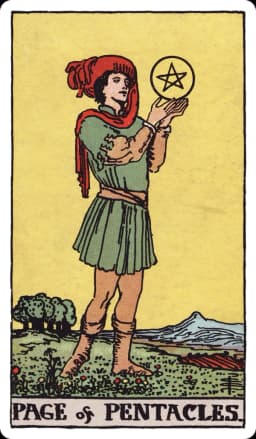
The Page is still in the early, studying stage, examining an opportunity before acting on it. The Knight has moved into steady, ongoing, methodical action, already doing the reliable, repeated work rather than just beginning to consider it.
Does reversed Knight of Pentacles always mean laziness?
Not necessarily, it more often points to stagnation, boredom, or stubbornness rather than a simple lack of effort. Sometimes the person is still working hard, just on autopilot, in a way that's stopped actually producing forward progress.
Related Cards
Spreads that read Knight of Pentacles
- Star Spread — 7 positions, intermediate
Where Knight of Pentacles sits in the deck
Card correspondences sourced from the Hermetic Order of the Golden Dawn tradition — see our methodology.